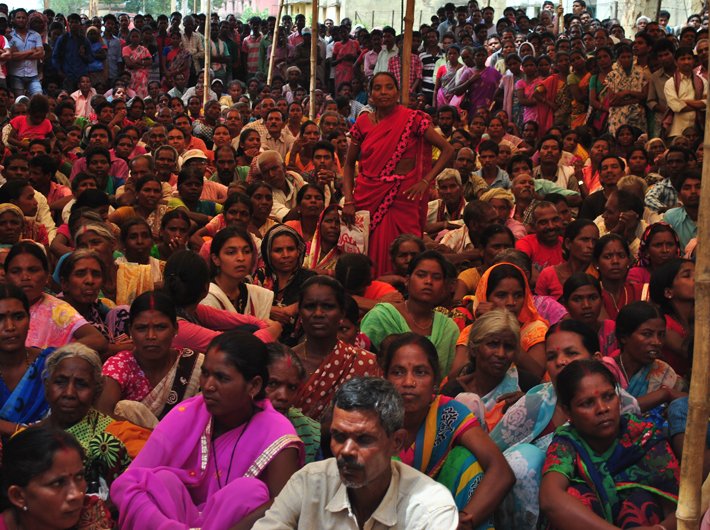
Jharkhand has reached a make-or-break point in the battle against hunger. For the first time, the National Food Security Act (NFSA) makes it possible to ensure that no one sleeps on an empty stomach. Many people, however, are still struggling to secure their entitlements under the Act. By way of reality check, a careful survey of NFSA was recently completed by student volunteers in Dumka and Gumla districts of Jharkhand. A house-to-house survey was conducted in six small villages, three each in Bharno block (Gumla district) and Ramgarh block (Dumka district). [See below for the main findings of the survey.] The survey concluded on June 14 with a lively public hearing on NFSA in Bharno.
The district supply officer (Vinod Mishra), block development officer (Shweta Ved), district grievance redress officer (DGRO, Ashok Kumar Shah) and other representatives of the block and district administration attended the public hearing. The panel also included Balram (state advisor to the supreme court commissioners in the right to food case), Reetika Khera (associate professor, IIT Delhi), Nandini Nayak (assistant professor, Ambedkar University Delhi), Lijo Chako (chief directing officer of Head Held High Foundation) and Ankita Agrawal (consultant, National Institute of Rural Development).
The public hearing began with a brief overview of the survey findings. The survey had found that almost all the 661 survey households were eligible under NFSA, as per official criteria notified by the government of Jharkhand. However, only 74% of the survey households have a new ration card (“Priority” or “Antyodaya”) as of now. Coverage has increased post NFSA, but this varies significantly across regions. Further, some family members’ names are often missing on the new ration cards. As a result, the effective coverage of NFSA in the survey villages was still well below the 86% norm for rural Jharkhand.
Many respondents also complained of receiving less their due (5 kg per person per month in the case of Priority households) – about 16% less in an ordinary month, with a much larger shortfall in the last two months when the supply chain was disrupted in large parts of Jharkhand. On a more positive note, 90 of the respondents were satisfied with food grain quality.
This was followed by testimonies from people in the survey villages and nearby villages. More than 500 people from about 25 villages attended the public hearing to voice their grievances related to the public distribution system (PDS). Issues related to cancellation of ration card despite eligibility, missing members on the ration card, not receiving full entitlement and others were brought up for discussion with the district and block administration.
One of the main issues discussed in the meeting was the absence of ration card amongst eligible households. Many people complained about not having a ration card, including many who had a ration card (even an Antyodaya card in some cases) in pre-NFSA times. In this regard, the following promises were made by the BDO: (1) camps would be held at the Panchayat Bhawan every Thursday to accept applications for new ration cards and add missing members (2) genuine AAY applicants will be issued ration cards within 15 days.
Another critical problem related to the role of the local marketing officer (MO), Sushil Kandir. There were vocal complaints of corruption and gross absenteeism on his part from a massive section of the crowd. The BDO herself stated that the MO rarely comes to Bharno. The DSO added that even contacting him on the phone is difficult as his mobile is switched off most of the time. In spite of all this, the DSO and DGRO pleaded helplessness and failed to state clearly what action would be taken against the MO. Eventually, the DGRO agreed to recommend strict action against the MO within three days.
NFSA Verification Survey (Dumka and Gumla, June 2016)
Main Findings
NFSA: Household coverage
Almost all the 661 survey households were eligible under NFSA, as per official criteria notified by the government of Jharkhand. As of now, 74% of them have a new ration card (“Priority” or “Antyodaya”).
Coverage has increased post NFSA, but this varies significantly across regions. For instance, in our Ramgarh sample, coverage went up from a dismal 43% to an appreciable 84% whereas in the Bharno sample it increased marginally from 53% to just 66%. This is indicative of excluded households being concentrated more dominantly in certain regions, which have a much lower coverage. It is critical to identify problems in such regions and ensure that the list of ration cards is corrected in these villages.
Missing persons
Missing persons on the ration cards was a problem the surveyors encountered across villages. Approximately, one in every eight persons is left out of the ration card. This is in addition to the households which are completely excluded. This matters, since NFSA entitlements are defined in per-capita terms (5 kg of grain per person per month).
It was also observed, that for most households which have been recently included as AAY, there is just one person’s name on the card (usually the head of the household). Though, this doesn’t affect the ration entitlements, since it is 35 kg/household but it undermines the coverage done in the state.
PDS: Cheating continues
The survey households normally receive 16% less ration than their entitlements. However, in May 2016, the month preceding the survey, in a few villages ration was either massively cut or not distributed at all. In Salkiya and Chitagutu, two of the three sample villages of Bharno block, beneficiaries received just 2% and 13% ration, respectively. Also, it seems to be a common practice for dealers to deduct 0.5 - 1 kg of grain per person per month for Priority households whereas 3-5 kg per month for Antyodya households.
Fake cards and duplicate names
The survey did not find evidence of “fake cards” in the survey villages. Using Socio-Economic and Caste Census (SECC) data to draw the initial list of ration cards, and putting the entire list in the public domain, must have helped to avoid fake cards.
However, there were some cases of duplicate names, with the same name appearing on two ration cards. In most cases, these looked more like mistakes than fraud. When a name appears twice, the local dealer often appropriates the extra ration.
Quality/Variety of food grains
Unlike the past, most beneficiaries were satisfied with the quality of the food grain. 90% of the households receiving ration said the quality was good/fair. Variety of food grains being served, however, seemed a concern. None of the sample villages in Bharno received wheat as part of their entitlements. Even the sample villages in Ramgarh complained about receiving little quantities of wheat (not more than 0.5 kg per 5kg)
The NFSA implementation in the state has brought about significant and much needed PDS reforms. However, a number of concern areas still remain unresolved. Doorstep delivery which is an integral part of the NFSA was not implemented in any of the sample villages in Bharno. This gives the dealers an excuse to cheat beneficiaries in the name of covering ‘transportation costs’. The NFSA requirement of the ration cards being made in the name of the eldest women have been met in most cases. However, we came across a few cases in all villages where this was violated – despite the woman’s name being on the ration card. Cuts in entitlements still remain extremely frequent and normal. In a nutshell, NFSA has brought substantial improvement in the functioning of the PDS but it still has a long way to go, especially for Bharno.
Appendix 1
Summary tabulations – NFSA Survey 2016 (Jharkhand)
| Metric |
Ramgarh
(Dumka) |
Bharno
(Gumla) |
Overall |
| % HHs with BPL/AAY card pre-NFSA |
43 |
53 |
48 |
| % HHs with PH/AAY card post-NFSA |
84 |
66 |
74 |
| % Missing Names |
14 |
10 |
12 |
| % Entitlements purchased by PH HHs (May 2016) |
83 |
31 |
54 |
| % Entitlements purchased by AAY HHs (May 2016) |
54 |
22 |
49 |
| % Entitlements purchased by PH HHs (Normally) |
87 |
82 |
84 |
| % Entitlements purchased by AAY HHs (Normally) |
79 |
93 |
81 |
% Entitlements purchased by PH + AAY HHs
(May 2016) |
73 |
31 |
53 |
| % Entitlements purchased by PH + AAY HHs (Normally) |
84 |
83 |
84 |
| % HHs which said quality was good/fair |
87 |
94 |
90 |
[This report is based on the communication received from the field.]
Also read: the background on the survey: Poorest states make headway towards food security