On Monday, June 17, West Bengal chief minister Mamata Banerjee finally decided to visit the house of a Barasat college student who was raped and murdered on June 6. From all accounts, the reason behind that visit to Kamduni village in Barasat, some 30 km from Kolkata, was not difficult to decipher: the Mamata administration is faced with a level of bad rap of late that only some of Banerjee’s own disastrous remarks could have caused her in the two years since she took office.
The CM spent less than 10 minutes at the victim’s house, tried to shout down women protesters outside, calling them “CPM supporters”, and tried to turn the incident into yet another “conspiracy” against her government, branding the accused “CPM supporters” as well.
The series of events on June 17 had a sense of déjà vu that Seema S (name changed to protect identity), 23, a Kolkata-based women’s rights activist, could smell right off the wrapper.
On the morning of June 13, Seema S was among the protesters outside the CM’s residence in Kalighat, south Kolkata, raising their voice against the Barasat incident, as well spiralling cases of violence against women in West Bengal (the state recently made it to the top of the infamous chart of national crime records bureau for reporting 30,942 cases of crime against women in 2012, the highest in the country).
Seema S was also among those detained for several hours by Kalighat police – one among a series of incidents in the last more than a year that has become a trademark of the Banerjee-led Trinammol government’s intolerance of any form of dissent.
Governance Now spoke to Seema S, who has volunteered with many NGOs since her high school days and also organises an action group, ‘Take back the night, Calcutta’, the local chapter of a global movement that campaigns for women, transgender and queer communities to reclaim public spaces, to get a bird’s-eye view of the Bengal CM’s latest crackdown on democratic protest.
Over to Seema S:
June 13: the morning shock
I had received an invitation to attend a small rally from Maitree, a network of women’ rights organisations, activists and individuals. We wanted to deliver an open letter to the chief minister, asking her to ensure safety of women and demanding accountability for the police.
We were a group of about 35 people, singing songs of empowerment, chanting slogans and carrying placards. At around 8.30 am we had reached near the main gate of Kalighat temple, some distance from the CM’s residence, when a man came and asked us the purpose of our demonstration. We told him that we wanted to meet the chief minister and deliver the letter to her. He asked us to wait and disappeared.
He returned a few minutes later – by now clothed in police uniform – and identified himself as the officer in charge of Kalighat police station. Before we knew what was going on, he ordered his subordinates to bundle the protestors into the nearby police vans.
In the ensuing chaos senior activists were dragged and pushed roughly into vans. We were completely taken by surprise. The police's handling was so aggressive that many got hurt as the rest of us tried pulling back the activists being detained. In the ensuing melee clothes were torn, glasses and watches broken – it was physically trying.
The police refused to tell us on what grounds the protesters were being arrested.
June 13: astounded in afternoon
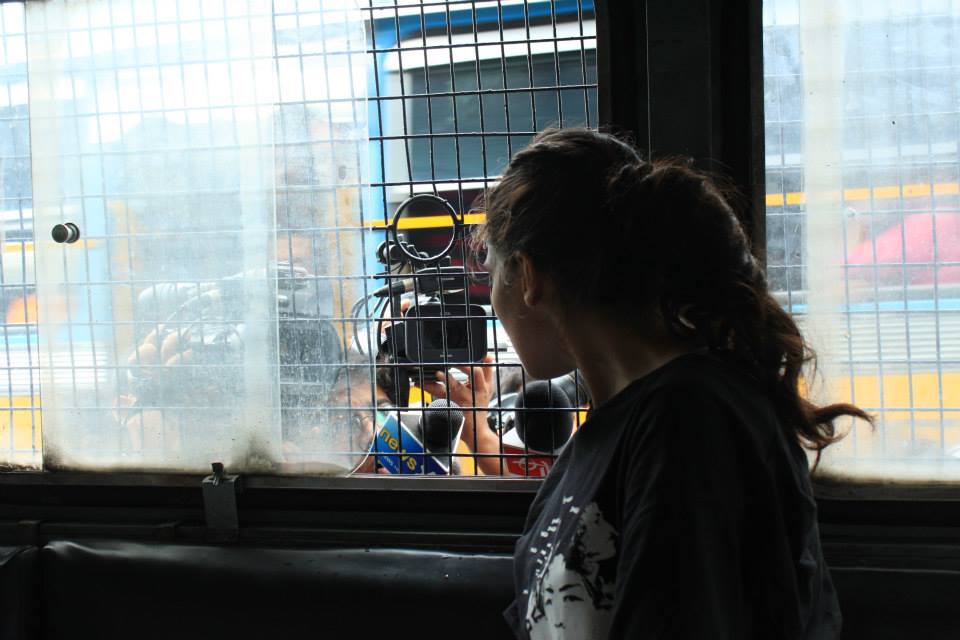
The demonstration had ended and the gathering had dispersed. A few police vans kept following us as we were walking away. Suddenly, without any warning, two women constables aggressively grabbed my arms and shoved me into a van. Three activists who tried to pry me away were also grabbed and pushed into the waiting vans.
The entire affair was so aggressive that my arms and shoulders hurt for the next few days.
We were driven to Lalbazar (the Kolkata Police headquarter) and taken to the central lockup. We were still unaware why we had been arrested. In the lockup we met other activists arrested at various points. We kept updating the developments through social media in a desperate bid to inform people about our predicament.
In the afternoon, after a very tedious wait, an officer informed us that we have been arrested under section 151 of CrPC, which is preventive arrest. It was an arbitrary arrest based on assumption (that the protesters could become violent) and had no basis on actual behavior – we did not engage in anything which had the potential to be considered even remotely dangerous.
Finally, we were freed around 4 pm on a personal risk bond and were told that we will have to seek bail from court the following day. But after release, we were being detained on some pretext or the other, which I believe was done to divert media attention away from the incident.
The next day the judge at the Alipore court dismissed the case against us and we were discharged.
After June 13: living in fear
Something inside snapped that day – my relationship with the city changed, perhaps forever. I had always seen Kolkata as a city where you can protest and speak your mind. Now I feel I could be randomly arrested and framed if I dared antagonise powerful people.
What frustrates me the most is the fact that a serious issue has become a tug of war between political parties. This petty Trinammol versus CPM squabble is impeding a more serious issue: that of safety of women in Kolkata, and elsewhere in the state.
I do not understand why our chief minister is taking everything so personally. We were not protesting against Mamata Banerjee that day. We were protesting violence against women. Some of the activists are working for decades for women’s rights and none of them are affiliated with any political party. But who will make the authorities understand all that?