
“School kholo”: Latehar children demand on Human Rights day

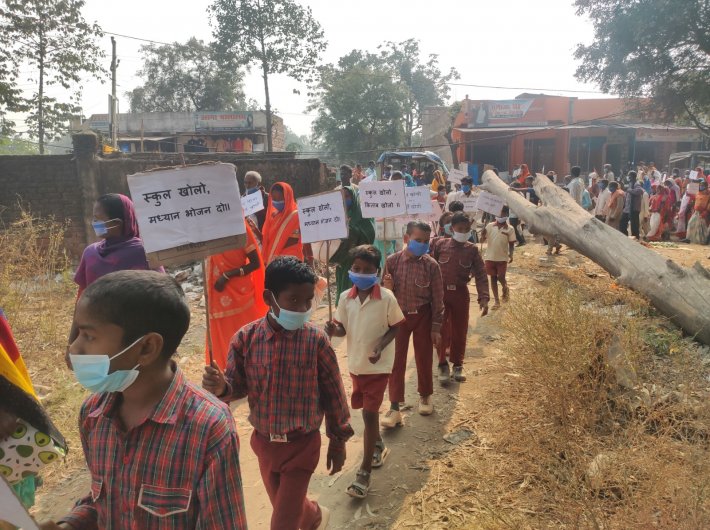
With parents, they take out a rally to press for resuming schooling, mid-day meals

GN Bureau | December 10, 2021

#mid-day meals   #nutrition   #Education   #Covid-19   #Jharkhand  
(Photo courtesy: GSMS)

On Human Rights day, hundreds of children and their parents took out a demonstration rally to the Block office in Manika of Latehar district to protest against the continued closure of primary schools in Jharkhand.

The rally was convened by Gram Swaraj Mazdoor Sangh (GSMS), a local organisation of rural workers.

Primary schools have been closed in Jharkhand for almost two years. The government expects online study to fill the gap, but in areas like Manika very few children can study online. During the village-to-village campaign that preceded the rally, GSMS volunteers found that most children in the primary-level age group are unable to read a simple sentence. This is consistent with the findings of the School Children’s Online and Offline Learning (‘SCHOOL’) survey conducted in 15 states earlier this year: the survey found that, among poor rural families, only 25% of children enrolled in Class 3 were able to read a simple sentence.

Mothers and fathers in Manika feel angry and helpless. Most of them cannot afford private tuitions for their children. They want schools to reopen as soon as possible. “If crowds are allowed in markets, marriage parties and even cricket stadiums, when why are schools closed,” some of them point out, according to a GSMS press release.

On the same day, a huge crowd was allowed to attend a meeting addressed by Chief Minister Hemant Soren in Daltonganj, just an hour from Manika. A few weeks earlier, 40,000 people were allowed to crowd a stadium in Ranchi for the India-New Zealand cricket match.

Participants also brought up other instances of human rights violations in Manika. In Bishunbandh village, there have been two recent incidents of rape, including the rape of a minor girl. In Sadwadih, villagers are opposing an illegal stone mine that causes blast damage to their houses and endangers their children. In Kutmu, farmers are being threatened with eviction from their ancestral fields after the Forest Department bought the land from an absentee zamindar who should not be in possession of it in the first place.

Mahavir, who has been organizing Parhaiya (a Particularly Vulnerable Tribal Group) families in the area for many years, gave a spirited speech on self-governance. In his own village, Parhaiya families have broken the shackles of bonded labour and become self-reliant farmers. “The land, forest, pongs and other local resources are ours, he said, we will not let anyone snatch them from us.” He also castigated the police for failing to act on people’s complaints. “The police thana is ours”, he said, “if they don’t listen to us we will gherao them.” On a similar line, Shyama Singh, mukhiya of Namudag, complained that gram sabha resolutions were ignored by the bureaucracy.

James Herenj, coordinator of NREGA Watch Jharkhand, explained the value of workers’ organizations to the audience. “Landlords, contractors, dealers and middlemen keep trying to undermine our rights, he said, but together we can resist.”

Many participants spoke in their own words about the injustice of schools being closed for so long: “Our children’s future is being ruined. If our children remain illiterate, they will have no choice but to earn a living from hard work in the brick kilns … We cannot afford private tuitions. Even 10-year-old children have forgotten their A, B, C.”

Somwati Devi, from Sadhwadih village and member of GSMS, summed up the sentiment of the audience when she said: “This is a plot against poor people. Big people want us to remain illiterate so that we continue to work for a pittance in their fields and houses.”


Comments


Other News

India faces critical shortage of skin donors amid rising burn cases

India reports nearly 70 lakh burn injury cases every year, resulting in approximately 1.4 lakh deaths annually. Experts estimate that up to 50% of these lives could be saved with adequate access to skin donations.   A significant concern is that around 70% of burn victims fall wi

Not just politics, let`s discuss policies too

Why public policy matters Most days, India`s loudest debates stop at the ballot box. We can name every major leader and recall every campaign slogan. Still, far fewer of us can explain why a widow`s pension is delayed or how a government school`s budget is actually approved. That

When algorithms decide and children die

The images have not left me, of dead and wounded children being carried in the arms of the medics and relatives to the ambulances and hospitals. On February 28, at the start of Operation Epic Fury, cruise missiles struck the Shajareh Tayyebeh school – officially named a girls’ school, in Minab,

The economics of representation: Why women in power matter

India’s democracy has grown in scale, but not quite in balance. Women today are active participants in elections, influencing outcomes in ways that were not as visible earlier. Yet their presence in legislative institutions continues to lag behind. The Nari Shakti Vandan Adhiniyam was meant to addres

India will be powerful, not aggressive: Bhaiyyaji

India is poised to emerge as a global power but will remain rooted in its civilisational ethos of non-aggression and harmony, former RSS General Secretary Suresh `Bhaiyyaji` Joshi has said.   He was speaking at the launch of “Rashtrabhav,” a book by Ravindra Sathe

AI: Code, Control, Conquer

India today stands at a critical juncture in the area of artificial intelligence. While the country is among the fastest adopters of AI in the world, it remains heavily reliant on technologies developed elsewhere. This paradox, experts warn, cannot persist if India seeks technological sovereignty.


Archives

Current Issue

Opinion

Facebook Twitter Google Plus Linkedin Subscribe Newsletter

Twitter






