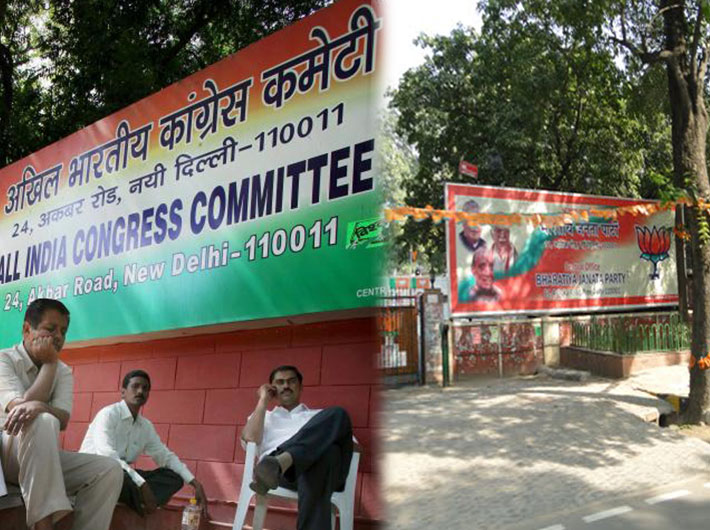
Here is an irony that will explain a lot of paradoxes about democracy in India. The Congress party comes to power and takes a revolutionary step of opening the government up for scrutiny before citizens through the Right to Information (RTI) Act.
And yet it fights tooth and nail not to oppose applying the same law to itself.
That sums up the story of Indian democracy. The executive, along with the judiciary and the legislature, has done a commendable job in deepening democracy but the parties, the middlemen in the game, have done all they could to hold it back.
When the voter wanted to know the background of a candidate, the parties opposed the move, not anybody else. When the voter wanted to know from where and whom they got their funds, they opposed. And these are the same parties that talk of reforming the system – and indeed when in power succeed in doing so to an extent.
MUST-READ: How political parties are making a mockery of election reforms
That is why we hear demands for all sorts of reforms – economic, judicial, bureaucratic, social and so on. But when was the last one heard the demand for reforming our parties? (Well, Rahul Gandhi spoke something on those lines at a CII meet a couple of months ago but then there’s many a slip... etc.)
It is against this backdrop that the June 3 decision of the central information commission (CIC) spells a new dawn for democracy. The CIC has said that six big parties – the Congress, BJP, CPM, CPI, BSP and NCP – are “public authorities”, that is to say they are under the ambit of RTI Act. This decision came on two similar complaints filed in 2011, one from the indefatigable activist Subhash Agrawal, and the other from Anil Bairwal, Jagdeep Chhokar and others from the Association for Democratic Reforms (ADR), an organisation that has done much to clean up the election process to an extent.
(READ THE FULL CIC DECISION IN THE ATTACHMENT BELOW)
Of course, the parties argued why their affairs should remain hidden. Congress treasurer Motilal Vora’s curt submission was that his party did not come under the purview of this law. Shanti Prasad Aggarwal, “rashtriya prabhari” of the BJP, too made the same argument, making it a rare cause that gets bipartisan support. NCP’s PRO Chandan Bose argued at length that his party was an NGO and moreover it did not have resources to spare for replying to RTI queries.
But after threadbare arguments from the two complainants, a three-member, full bench headed by chief information commissioner Satyananda Mishra concluded that the six parties were indeed public authorities and hence the law applied to them too.
READ SUBHASH AGRAWAL’S REACTION HERE: "RTI verdict will check graft, corruption"
“We hold that INC, BJP, CPI(M), CPI, NCP and BSP have been substantially financed by the central government under section 2(h)(ii) of the RTI Act. The criticality of the role being played by these political parties in our democratic set-up and the nature of duties performed by them also point towards their public character, bringing them in the ambit of section 2(h). The constitutional and legal provisions discussed herein above also point towards their character as public authorities,” the CIC ruled.
“The presidents, general/secretaries of these political parties are hereby directed to designate CPIOs and the appellate authorities at their headquarters in 06 weeks time. The CPIOs so appointed will respond to the RTI applications extracted in this order in 04 weeks time.”
By the way, this means people can not only seek specific information from the Congress or the BJP but under section 4(1)(b) of RTI Act, the parties themselves will have to make all relevant information public. As the CIC noted, “Besides, the presidents/general secretaries of the above mentioned political parties are also directed to comply with the provisions of section 4(1)(b) of the RTI Act by way of making voluntary disclosures on the subjects mentioned in the said clause.”
In the days to come, expect at least four of these six parties to make all efforts to maintain status quo. Full disclosure will take time too. But a beginning has been made, thanks to a solitary crusader and a bunch of concerned citizens.