Chhattisgarh deaths spell a setback for population control measures. Experts feel there is nothing wrong with the policy but implementation needs to be improved
India’s population control programme suffered yet another setback recently with the death of 13 women at a government health camp in Pendari, district Bilaspur, Chhattisgarh. The ‘Hum Do, Hamare Do’ slogan took an abrupt U-turn. The news made headlines when 83 women were operated upon by one doctor and his assistant in about six hours and some became critical soon after they were discharged, reporting low blood pressure and vomiting. Preliminary investigations have thrown appalling revelations.
Also read: Callous Chhattisgarh: fake medicines killing men and women
While the 2008 guidelines by the ministry of health stipulate that no more than 30 operations must be performed by one surgeon in a day (for one team with three laparoscopes), 83 were performed in a matter of hours on November 8. Laparoscopic tubectomy, the technical term for the operation, takes at least 25 minutes in per person as it is done under anesthesia. In this case, all it took was five minutes.
Hygiene must be uppermost in this or any other surgery. The Pendari operations were all conducted at a hospital that had been lying closed for some time and women were made to lie on mattresses spread out in dusty corridors. They were not kept under observation as is the norm, and were instead handed over painkillers and antibiotics before being sent home.
Also read: The decaying underbelly of a resurgent India
Rat poison was found in antibiotic ciprocin that the women had been given.
“It is definitely a setback,” said Dr Jagdish Prasad, director general of health services, ministry of health and family welfare, “and for the next two-three years people will try to avoid getting sterilised.” However, he said, there was “no flaw in the government policy” and that the present case was “a failure of the local system”.
While apathy has largely been the hallmark of such government induced health programmes, what came out as a glaring fact was the loopholes in not just government policies but also in the way the entire process is carried out by doctors who are deemed to be life saviours.
“The real flaw lies in the implementation of the prescribed policy. Onsite monitoring of effective implementation of the policy is a warranted must. Any lack or paucity thereon is bound to prove catastrophic and counterproductive as in the present case,” said Dr Jayshree Mehta, president, Medical Council of India. The basic requirements for such an operation—pre-operative tests, diagnostics, post-operative care—nothing was taken care of. “It is imperative for the doctor to ensure that the prescribed rule book is adhered to, not only in letter but also in spirit. Any deviation in this should not only be construed as a disciplinary wrong, but also as a case of breach of ethical conduct and malpractice on part of the concerned registered medical practitioner,” Dr Mehta added.
At the behest of local health workers, the illiterate women from villages had come for a drive that puts the onus of family planning on women.
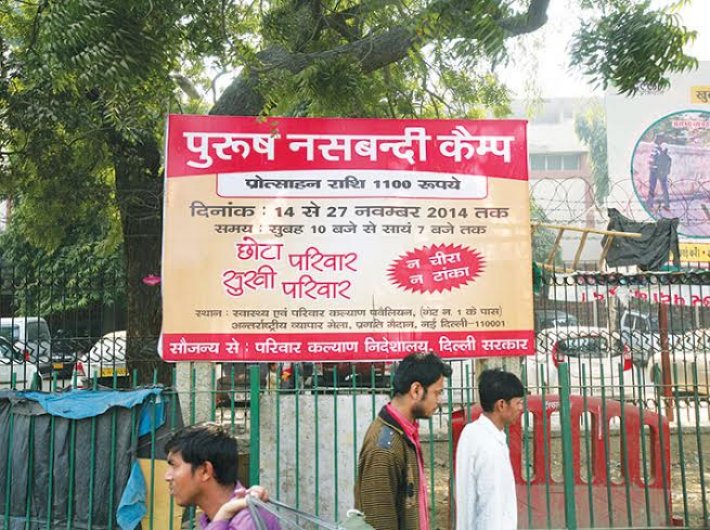
That brings us to the patriarchal nature of our society. It was only during the 1970s that men underwent vasectomies in hordes—most being forced—at the notorious camps put up at the behest of Sanjay Gandhi. The programme was thwarted after much public anger. “The effort of the government’s population control policy is still directed towards vasectomy, but in a male-dominated society they are difficult to convince,” said Dr Vishwa Mohan Katoch, director general, Indian Council of Medical Research (ICMR).
Since the 1970s, the national family planning programme has received many setbacks. And yet, the problems regarding the programme have remained the same. In 2012, 53 women in Bihar were operated upon without anesthesia within two hours in an open field. Dr Prasad cited the basic requirements even for a simple laparoscopic tubectomy. He said, “Patients need to be kept under observation and, most importantly, the laproscope needs to be sterilised.” Reiterated Dr Mehta: “It is not open and permissible for any doctor (surgeon) to turn a blind eye to the hygienic factor while undertaking any surgery as it has a vital bearing on the entire conduct of surgery, especially from the point of view of infections.”
Without basic education and awareness, such programmes may continue to be either abandoned or not reach their justified end. The risks involved in the operation of women are far greater than for men, as vasectomy is a much simpler surgery. Infection, risk of damage to other body organs, bleeding may all be irreversible for a tubectomy surgery patient. “However, there are no risks if the same procedure is done properly. Women should be well informed before they go for laparoscopic tubectomy. After all, it is in their interest, as they go through the child bearing process,” said Dr Katoch. But it is this “if” that remains the greatest hindering factor.
A completely flawed population control policy also brings to light the ‘incentives’ provided to the poor to channelise and boost such drives. In 2011, everything from motorcycles, television sets and a chance to win a Nano car were offered in Rajasthan to help attract more people to undergo sterilisation. Even local health workers are pressured into meeting targets and are promised incentives for every person they ‘motivate’. Dr Prasad denied that. “There is no target fixed for health workers and no one can force anyone to undergo sterilisation.” However, reports say, the doctor arrested in the Chhattisgarh case has also claimed pressure from the government. “Any force or coercion asserted by any agency, including the government, on such count is uncalled for and impermissible. Such a pressure, if exerted, is bound to create problematic situations as has happened in the present case,” Dr Mehta said.
The government authorities continue to vouch for the family planning policy. “India’s population control programme is a success story,” said Dr Katoch. “The birth rate is down to 2.7 from 5.7 children to a woman in 1960. The use of other contraceptive methods must also be encouraged and what is required is a greater awakening and understanding.” The implementation of the same is questionable. Dr Mehta agreed. “The policy which has been put into place by the government does not have any intrinsic wrongs. It is a well-reasoned and thought-out policy document. The only fallacy is its operational implementation, which at times is a victim of the lack of proper, desired and optimal monitoring and effective checks and balances.” Also, the initiative has to be voluntary for which necessary awareness is the desired modality, Dr Mehta added. “The entire implementation process needs to be regulated. And most importantly, government health camps must be held in good hospitals with proper infrastructural facilities,” said Dr Prasad.
The story appeared in December 1-15, 2014, issue