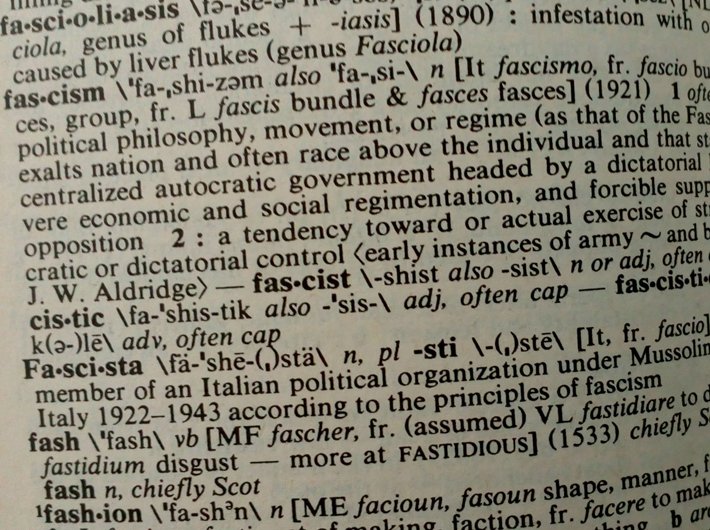
It was Oxford Dictionary that started the trend last month, declaring ‘post-truth’ as the word of the year. Then came dictionary.com, giving that status to ‘xenophobia’. Now Merriam-Webster says ‘fascism’ is at the top of its list of most-searched words in 2016, though it is yet to name the final winner and has even appealed users of its website to look up something else and save the world.
POST-TRUTH
“After much discussion, debate, and research, the Oxford Dictionaries Word of the Year 2016 is post-truth – an adjective defined as ‘relating to or denoting circumstances in which objective facts are less influential in shaping public opinion than appeals to emotion and personal belief’,” the
Oxford Dictionaries website announced.
Explaining the choice, it said the concept has been in existence for the past decade, but “Oxford Dictionaries has seen a spike in frequency this year in the context of the EU referendum in the UK and the presidential election in the US. It has also become associated with a particular noun, in the phrase post-truth politics”.
The website traces the first use of the term to a 1992 essay by the late Serbian-American playwright Steve Tesich in The Nation magazine. “Reflecting on the Iran-Contra scandal and the Persian Gulf War, Tesich lamented that ‘we, as a free people, have freely decided that we want to live in some post-truth world’.”
Simply put, post-truth means truth has become irrelevant in political debates. In other words, as seen in Brexit and Trump campaigns, many people don’t mind if your facts are wrong, if you make baseless allegations and unfounded claims – as long as you voice their real or imaginary fears. That’s xenophobia, the word of the year on another dictionary.
XENOPHOBIA
Dictionary.com names its
word of the year bases on the “data about the words looked up by tens of thousands of curious people at any given moment”. And this year, “one word that spiked time and again reflected a recurring theme in the year’s news, their editors say: ‘fear of the other.’ And that’s why the outlet’s word of the year is xenophobia.”
The website explains that the word has two definitions on the site, “both reflecting the fearful (and often isolationist) sentiments that aired during the Brexit vote, the American election, the debates over what to do with Syrian refugees, racially charged police shootings and even fights over which bathrooms transgender people should be using in public”.
The definitions are:
1. fear or hatred of foreigners, people from different cultures, or strangers.
2. fear or dislike of the customs, dress, etc., of people who are culturally different from oneself.
“Over the past year, headlines tied to gender, sexuality and race dominated the news,” the company’s editors said in a press release. “In particular, many of the year’s biggest stories focused on the way in which individuals or members of a group are perceived, understood, accepted or shut out.”
That sounds like fascism. Which is on its way to becoming the word of the year at Merriam-Webster.
FASCISM
“Fascism' is still our #1 lookup. # of lookups = how we choose our
Word of the Year. There's still time to look something else up,” Merriam-Webster tweeted on November 30.
This dictionary defines ‘fascism’ as:
1. often capitalized: a political philosophy, movement, or regime (as that of the Fascisti) that exalts nation and often race above the individual and that stands for a centralized
autocratic government headed by a
dictatorial leader, severe economic and social regimentation, and forcible suppression of opposition
2. a tendency toward or actual exercise of strong autocratic or dictatorial control
***
These choices of course reflect a trend based on concerns of the English-speaking populations. To what extent they apply to India is open to debate.