Genetically modified Golden rice is rich in vitamin A and a campaign tour is in India to legalise it
“Seven billion people all over world, wake up every morning today with real needs for food, energy and materials. If we change the way we do things and change our technology we can change the impact we have on environment with more people and more consumption,”said Dr Patrick Moore, co-founder, Greenpeace and now leader of Allow Golden Rice Now Campaign . He was speaking at the Golden Rice South Asian Tour organised by Crop Care Federation of India in Mumbai on Thursday. Moore has been working to legalise Golden rice for several years.
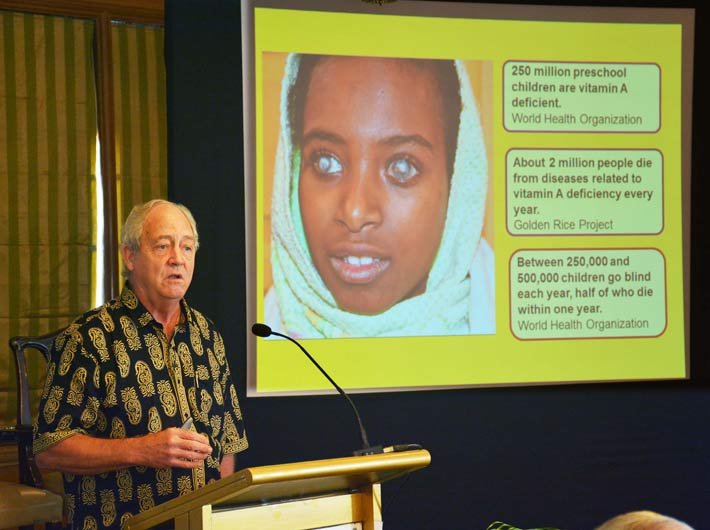
The genetically engineered Golden rice has been fortified with beta carotene and developed for high vitamin A content. The deficiency of vitamin A affects more than 35 million children in India and 2 million children die every year worldwide, while 2,50,000 to 5,00,000 go blind.
Golden rice is cheap and its seeds are viable for poor farmers and 70% of world’s poor depend on rice as staple food.
According to The American Medical Association, "bio- engineered foods have been around for close to 20 years and during that time no overt consequences on human health have been reported."
Explaining the concept of genetically modified, Moore said, " it means plants are transgeneic and created by a recombinant DNA with technology but this has been made a propaganda by Greenpeace for the term genetically modified.”
"The fact is, all human beings are genetically modified like every other plant and animal being there by sexual reproduction- a random mixture of mixture of male and female genes coming together as it happens in nature. You cannot choose genes. Conventional breeding in agriculture is the same as arranged marriage in human society. Gene transfer is common in nature. Understanding horizontal gene transfer is whole new area of understanding evolutionary biology which was never followed or understood until transgenic came along. "
Moore added that 18 million farmers all over world work on 10% of total farmland in the world, which is already in biotech crops. "If irrational restrictions and ban on growing biotech were removed so every farmer could choose GM if he wished, 50% cropland in world today would be bio- tech and in short time no crop will be without some transgeneic to improve it when every crop can be improved."
Giving the example of highly successful Bt. Cotton in India Moore made a case for the technology and said that is important for improving yield and farmers economy so poor farmers can be lifted up from poverty.
Illustrating with an example he said a nuclear power plant will give no emissions as compared to a coal plant that will give out emissions into the air.
”Technology makes a big difference in our footprint on this earth. We need to think logically how can we continue to progress and develop our industry and technology and at the same time reduce the negative effect on that very environment to give our people food, energy and material that we need to survive."
"Four million life- years have been lost in over 10 years since golden rice was improved. No one can say what risk there will be of bringing golden rice except that it will contaminate local variety, which is really bio fortification and not contamination. Contamination is putting something poisonous," he said. Though Golden rice has been around for fifteen years, because it is created with genetic science, Greenpeace and the anti GMO movement oppose it and no country has approved it for cultivation, Moore said.
Crop Care Federation of India data titled “India's Agrarian Miracle Since 2000” says that India and China, once known for chronic food shortage are now world leaders in agricultural production. India is world largest milk producer.
"Small family farms with less than 2 hectares of land have led to a quantum leap in agriculture production in last decade, putting to rest a common belief that only large farms could achieve greater efficiency and productivity" it says. It took thirty years (1970-2000) to double the agriculture GDP, but the subsequent two fold increase came in just one decade from 2000-2013 and Indian agriculture is no longer food grain centric. Almost 60 percent of its agriculture GDP comes from high value fruits, vegetables and milk.
Strongly asking for public- private participation to promote golden rice Moore said, "we need to break monopoly on resistance to Golden rice to let it out."
Speaking at the event chairman of Crop Care Federation Of India, the industry body, Rajju Shroff said, “India is the only country in the world that has a significant share in all sectors of farming like agriculture and horticulture crops, dairy livestock and fish production. It has very high potential and we must give boost to high tech modern agriculture.”