
Hindus in India have relatively low levels of educational attainment. Formal education is especially low among Hindu women, says Pew Research Center report
GN Bureau | December 28, 2016
This is one study that should be a wake-up call for those in the government. A global demographic study carried out by Pew Research Center shows that Hindus in India have relatively low levels of educational attainment – a nationwide average of 5.5 years of schooling.
Muslims and Hindus tend to have the fewest years of formal schooling, says the study. It shows wide disparities in average educational levels among religious groups. These gaps in educational attainment are partly a function of where religious groups are concentrated throughout the world.
“And low levels of attainment among Hindus reflect the fact that 98% of Hindu adults live in the developing countries of India, Nepal and Bangladesh.”
Hindus in India, who make up a large majority of the country’s population and more than 90% of the world’s Hindus, have relatively low levels of educational attainment – a nationwide average of 5.5 years of schooling. While they are more highly educated than Muslims in India (14% of the country’s population), they lag behind Christians (2.5% of India’s population). By contrast, fully 87% of Hindus living in North America hold post-secondary degrees – a higher share than any other major religious group in the region, says the study.
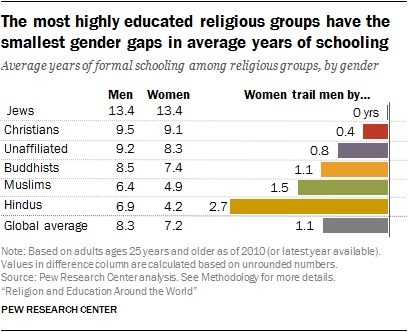
Drawing on census and survey data from 151 countries, the study also finds large gender gaps in educational attainment within some major world religions. For example, Muslim women around the globe have an average of 4.9 years of schooling, compared with 6.4 years among Muslim men. “And formal education is especially low among Hindu women, who have 4.2 years of schooling on average, compared with 6.9 years among Hindu men.”
Yet many of these disparities appear to be decreasing over time, as the religious groups with the lowest average levels of education – Muslims and Hindus – have made the biggest educational gains in recent generations, and as the gender gaps within some religions have diminished, according to Pew Research Center’s analysis.
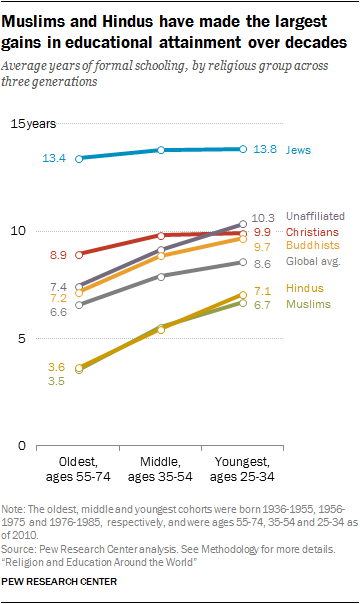
At present, Jewish adults (ages 25 and older) have a global average of 13 years of formal schooling, compared with approximately nine years among Christians, eight years among Buddhists and six years among Muslims and Hindus.
For instance, the youngest Hindu adults in the study (those born between 1976 and 1985) have spent an average of 7.1 years in school, nearly double the amount of schooling received by the oldest Hindus in the study (those born between 1936 and 1955). The youngest Muslims have made similar gains, receiving approximately three more years of schooling, on average, than their counterparts born a few decades earlier, as have the youngest Buddhists, who acquired 2.5 more years of schooling.
Gender gaps also are narrowing somewhat. In the oldest generation, across all the major religious groups, men received more years of schooling, on average, than women. But the youngest generations of Christian, Buddhist and unaffiliated women have achieved parity with their male counterparts in average years of schooling. And among the youngest Jewish adults, Jewish women have spent nearly one more year in school, on average, than Jewish men.
The study points out that education levels vary a great deal by religion. About four-in-ten Hindus (41%) and more than one-third of Muslims (36%) in the study have no formal schooling. In other religious groups, the shares without any schooling range from 10% of Buddhists to 1% of Jews, while a majority of Jewish adults (61%) have post-secondary degrees.
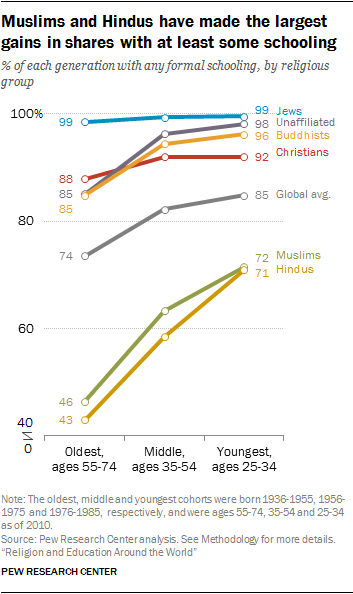
Over three recent generations, the share of Hindus with at least some formal schooling rose by 28 percentage points, from 43% among the oldest Hindus in the study to 71% among the youngest. Muslims, meanwhile, registered a 25-point increase, from 46% among the oldest Muslims to 72% among the youngest.
In some religious groups, the gender gaps in acquiring any formal education are particularly large. For example, just over half of Hindu women (53%) have received no formal schooling, compared with 29% of Hindu men, a difference of 24 percentage points. Among Muslims worldwide, 43% of women and 30% of men have no formal schooling, a 13-point gap. In other religions, the gender differences in the shares with no formal schooling are smaller, ranging from 9 points among the religiously unaffiliated to just 1 point among Jews.
But Hindus have substantially narrowed the gender gap in primary schooling, as shares of Hindu women with no formal schooling decreased across the three generations studied. Among the oldest Hindus, 72% of women and 41% of men have no formal schooling. But among the youngest Hindus in the study, the gender gap is smaller, as 38% of women and 20% of men have no formal schooling.
Muslims also have reduced the gender gap across generations by 11 percentage points. But in the youngest generation, a 10-point difference remains: 33% of Muslim women and 23% of Muslim men have no formal schooling. Among religiously unaffiliated adults and Buddhists worldwide, meanwhile, the gender gap in the shares with no formal schooling has virtually disappeared.
Read the full report here
The extraordinary transaction volumes and value (₹29.82 Lakh crore in August 2026 alone) of the Unified Payments Interface (UPI) have made it not only an Indian success story, but a global one. In 2024, UPI accounted for nearly 49% of the world’s real-time payment transaction volume, with more th
Diplomacy is akin to an art, wherein the summitry, conflict resolution and negotiations form apt constituents of the entire context of deal making and “playing for keeps” in the international arena. The Xi-Trump summit in Washington last week, in which the American president broke all conside
Moving to Delhi-NCR for education can be an exciting experience for students from Northeast India. It gives us a chance to meet new people, experience a different culture and become more independent. But living away from home also comes with challenges that people who have not experienced them may not al
The government has reduced the Basic Customs Duty (BCD) on major imported crude edible oils with a view to moderating domestic edible oil prices, providing relief to consumers and mitigating inflationary pressures arising from the sharp increase in international edible oil prices.
In his opening address at the 18th BRICS Summit in New Delhi on September 12, prime minister Narendra Modi did something India`s diplomacy has been building towards for three years: he moved the ‘Voice of the Global South’ from a slogan to a work plan. Addressing the leaders, he argued that t
The Pradhan Mantri Jan Arogya Yojana (PM-JAY), a welfare scheme which covers approximately 45 crore beneficiaries across India, provides cashless health cover of Rs. 5 lakh per family per year. It is the largest health insurance scheme which helped crores of poor families by reducing out-of-pocket expend











