
Union Budget 2020-21: Central tenet is Ease of Living

At the core are ideas of corruption-free, policy-driven good governance, clean and sound financial sector

GN Bureau | February 1, 2020

#Union Budget   #finance minister   #finance ministry   #Nirmala Sitharaman   #parliament   #economy   #society  
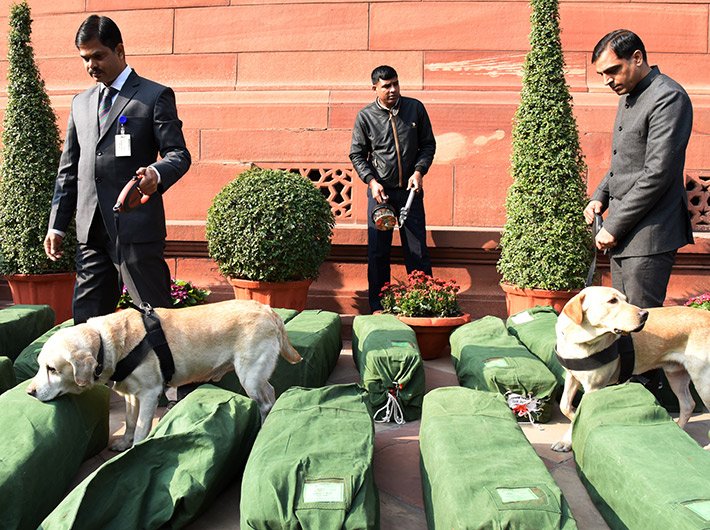
Sniffer dogs check the bundles of the budget documents in the parliament complex ahead of the budget presentation.

“Our prime minister has laid before us ‘Ease of Living’ as a goal to be achieved on behalf of all citizens,” said minister for finance Nirmala Sitharaman while presenting the union budget 2020-21 in parliament Saturday. With this backdrop, our government shall work towards taking the country forward so that we can leapfrog to the next level of health, prosperity and wellbeing,” she added. 

This budget, with the central tenet of Ease of Living for all citizens, is woven around three prominent themes:

* Aspirational India in which all sections of the society seek better standards of living, with access to health, education and better jobs. Its components are Agriculture Irrigation and Rural development; Wellness, Water & Sanitation; and Education & Skills.

* Economic development for all, indicated in the P’s exhortation of “Sabka Saath, Sabka Vikas, Sabka Vishwas”. This would entail pervasive economic reforms and yielding more space for the private sector to ensure higher productivity and greater efficiency. Three components of which are Industry, Commerce and Investment; Infrastructure; and the New Economy.

* A Caring Society, based on Antyodaya, which is both humane and compassionate. Three components of which are Women & Child, Social Welfare; Culture and Tourism and Environment & Climate Change.

These three broad themes are held together by corruption-free, policy-driven good governance and a clean and sound financial sector. The finance minister also said that this budget was being presented against the backdrop of two cross-cutting developments; namely, proliferation of technologies like Machine Learning, Robotics, AI, Analytics, Bio-Informatics; and the highest ever cohort of productive age population (15-65 years). Consequently, the digital revolution has placed India in a unique leadership position globally. The government aims to:

* Achieve seamless delivery of services through Digital governance
* Improve physical quality of life through National Infrastructure Pipeline
* Mitigate Risks through Disaster Resilience
* Boost Social security through Pension and Insurance penetration.

The FM also said that the budget reflects the government’s firm commitment to substantially boost investment in agriculture, infrastructure, social sector, education and health. This is substantiated by increase in expenditure of Rs 3,43,678 crores over Revised Estimates (2019-20) while keeping the fiscal deficit at 3.8% of GDP, she added.

Comments


Other News

The transformation trap: Why efficiency is not innovation

Every company is transforming, or so it claims.   There was a time when the word ‘transformation’ carried weight. It signified bold strategic shifts, reinvention of business models, and breakthrough technologies that fundamentally changed how organizations created

The Sardar biography that throws light on our times

Patel: A Life By Rajmohan Gandhi Aleph Books, 568 pages, Rs 1,199   There are many biographi

Climate change, El Niño rewrite Indian monsoon

The month of July exceeded its rainfall target despite forecasts of a below-normal month under a strengthening El Niño. The reason could be that climate change is amplifying monsoon complexity: West Pacific warming, Western Disturbances and evolving ocean conditions increasingly interact with El Ni&

Mumbai has just 1.28 sq.m. of open space per person: Study

Mumbai`s public space crisis is as much about mismanagement as it is about scarcity, and offers a governance roadmap that can be implemented without new legislation, according to a new report by the Urban Design Research Institute (UDRI) and the NGO Alliance for Governance and Renewal (NAGAR).  

Lok Sabha passes amendment bill to improve public examination system

The Lok Sabha on Wednesday passed the Public Examinations (Prevention of Unfair Means) Amendment Bill, 2026 by a voice vote after an extensive discussion. Replying to the debate, minister of state (independent charge) for science & technology; earth sciences and MoS in the PMO, Dr. Jite

Shri Abhijit Phukon (IES, 2004) appointed as Joint Secretary, Department of Agriculture & Farmers Welfare.

 Shri Abhijit Phukon (IES: 2004) has been appointed as Joint Secretary, Department of Agriculture & Farmers Welfare, Government of India. His appointment, approved by the

Upcoming Conferences


-->

Archives

Current Issue

Opinion

Facebook Twitter Google Plus Linkedin Subscribe Newsletter

Twitter






