
Package of PM’s five schemes for Employment and Skilling
GN Bureau | July 23, 2024
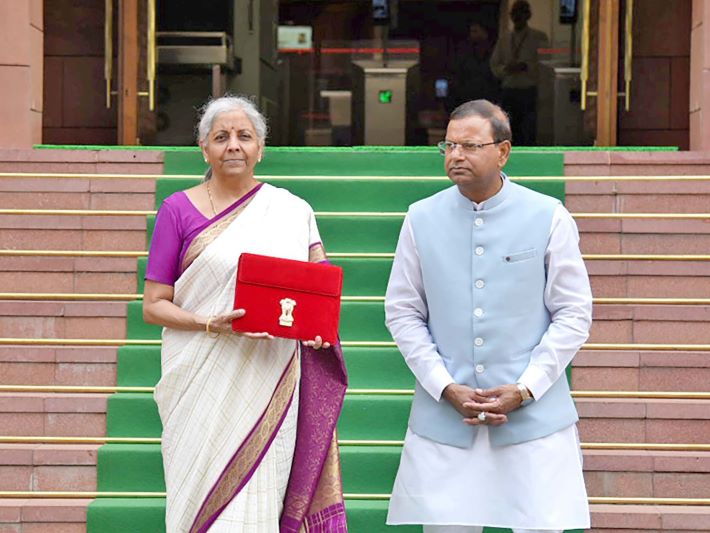
Finance minister Nirmala Sitharaman presented the Union Budget 2024-25 in Parliament on Tuesday. The highlights of the budget are as follows:
Part-A
Budget Estimates 2024-25:
Total receipts other than borrowings: Rs 32.07 lakh crore.
Total expenditure: Rs 48.21 lakh crore.
Net tax receipt: Rs 25.83 lakh crore.
Fiscal deficit: 4.9 per cent of GDP.
Government aims to reach a deficit below 4.5 per cent next year.
Inflation continues to be low, stable and moving towards the 4% target; Core inflation (non-food, non-fuel) at 3.1%.
The focus of budget is on EMPLOYMENT, SKILLING, MSMEs, and the MIDDLE CLASS.
Package of PM’s five schemes for Employment and Skilling
Prime Minister’s Package of 5 Schemes and Initiatives for employment, skilling and other opportunities for 4.1 crore youth over a 5-year period.
Scheme A - First Timers: One-month salary of up to '15,000 to be provided in 3 installments to first-time employees, as registered in the EPFO.
Scheme B - Job Creation in manufacturing: Incentive to be provided at specified scale directly, both employee and employer, with respect to their EPFO contribution in the first 4 years of employment.
Scheme C - Support to employers: Government to reimburse up to '3,000 per month for 2 years towards EPFO contribution of employers, for each additional employee.
New centrally sponsored scheme for Skilling
20 lakh youth to be skilled over a 5-year period.
1,000 Industrial Training Institutes to be upgraded in hub and spoke arrangements.
New Scheme for Internship in 500 Top Companies to 1 crore youth in 5 years
Nine Budget Priorities in pursuit of ‘Viksit Bharat’:
Productivity and resilience in Agriculture
Employment & Skilling
Inclusive Human Resource Development and Social Justice
Manufacturing & Services
Urban Development
Energy Security
Infrastructure
Innovation, Research & Development and
Next Generation Reforms
Priority 1: Productivity and resilience in Agriculture
Allocation of Rs 1.52 lakh crore for agriculture and allied sectors.
New 109 high-yielding and climate-resilient varieties of 32 field and horticulture crops to be released for cultivation by farmers.
1 crore farmers across the country to be initiated into natural farming, with certification and branding in next 2 years.
10,000 need-based bio-input resource centres to be established for natural farming.
Digital Public Infrastructure (DPI) for Agriculture to be implemented for coverage of farmers and their lands in 3 years.
Priority 2: Employment & Skilling
As part of the Prime Minister’s package, 3 schemes for ‘Employment Linked Incentive’ to be implemented - Scheme A - First Timers; Scheme B - Job Creation in manufacturing; Scheme C - Support to employers.
To facilitate higher participation of women in the workforce,
working women hostels and crèches to be established with industrial collaboration
women-specific skilling programmes to be organized
market access for women SHG enterprises to be promoted
Skill Development
New centrally sponsored scheme for Skilling under Prime Minister’s Package for 20 lakh youth over a 5-year period.
Model Skill Loan Scheme to be revised to facilitate loans up to
Rs 7.5 lakh.
Financial support for loans upto '10 lakh for higher education in domestic institutions to be provided to youth who have not been eligible for any benefit under government schemes and policies.
Priority 3: Inclusive Human Resource Development and Social Justice
Purvodaya
Industrial node at Gaya to be developed along the Amritsar-Kolkata Industrial Corridor.
Power projects, including new 2400 MW power plant at Pirpainti, to be taken up at a cost of Rs 21,400 crore.
Andhra Pradesh Reorganization Act
Special financial support through multilateral development agencies of Rs 15,000 crore in the current financial year.
Industrial node at Kopparthy along Vishakhapatnam-Chennai Industrial Corridor and at Orvakal along Hyderabad-Bengaluru Industrial Corridor.
Women-led development
Total allocation of more than Rs 3 lakh crore for schemes benefitting women and girls.
Pradhan Mantri Janjatiya Unnat Gram Abhiyan
Socio-economic development of tribal families in tribal-majority villages and aspirational districts, covering 63,000 villages benefitting 5 crore tribal people.
Bank branches in North-Eastern Region
100 branches of India Post Payment Bank to be set up in the North East region.
Priority 4: Manufacturing & Services
Credit Guarantee Scheme for MSMEs in the Manufacturing Sector
A credit guarantee scheme without collateral or third-party guarantee in term loans to MSMEs for purchase of machinery and equipment.
Credit Support to MSMEs during Stress Period
New mechanism to facilitate continuation of bank credit to MSMEs during their stress period.
Mudra Loans
The limit of Mudra loans under ‘Tarun’ category to be enhanced to Rs 20 lakh from Rs 10 lakh for those who have successfully repaid previous loans.
Enhanced scope for mandatory onboarding in TReDS
Turnover threshold of buyers for mandatory onboarding on the TReDS platform to be reduced from '500 crore to '250 crore..
MSME Units for Food Irradiation, Quality & Safety Testing
Financial support to set up 50 multi-product food irradiation units in the MSME sector .
E-Commerce Export Hubs
E-Commerce Export Hubs to be set up under public-private-partnership (PPP) mode for MSMEs and traditional artisans to sell their products in international markets.
Critical Mineral Mission
Critical Mineral Mission to be set up for domestic production, recycling of critical minerals, and overseas acquisition of critical mineral assets.
Offshore mining of minerals
Auction of the first tranche of offshore blocks for mining, building on the exploration already carried out.
Digital Public Infrastructure (DPI) Applications
Development of DPI applications in the areas of credit, e-commerce, education, health, law and justice, logistics, MSME, services delivery, and urban governance.
Priority 5: Urban Development
Transit Oriented Development
Formulation of Transit Oriented Development plans and strategies to implement and finance 14 large cities above 30 lakh population.
Urban Housing
Investment of Rs 10 lakh crore, including the central assistance of Rs 2.2 lakh crore in next 5 years, under PM Awas Yojana Urban 2.0 proposed to address the , housing needs of 1 crore urban poor and middle-class families.
Street Markets
New scheme to support the development of 100 weekly ‘haats’ or street food hubs every year for the next 5 years in select cities.
Priority 6: Energy Security
Energy Transition
Policy document on ‘Energy Transition Pathways’ to balance the imperatives of employment, growth and environmental sustainability to be brought out.
Pumped Storage Policy
Policy for promoting pumped storage projects for electricity storage to be brought out.
Research and development of small and modular nuclear reactors
Government to partner with private sector for R&D of Bharat Small Modular Reactor and newer technologies for nuclear energy, and to set up Bharat Small Reactors.
Advanced Ultra Super Critical Thermal Power Plants
Joint venture proposed between NTPC and BHEL to set up a full scale 800 MW commercial plant using Advanced Ultra Super Critical (AUSC) technology.
Roadmap for ‘hard to abate’ industries
Appropriate regulations for transition of ‘hard to abate’ industries from the current ‘Perform, Achieve and Trade’ mode to ‘Indian Carbon Market’ mode to be put in place.
Priority 7: Infrastructure
Infrastructure investment by Central Government
Rs 11,11,111 crore (3.4 % of GDP) to be provided for capital expenditure.
Infrastructure investment by state governments
Provision of Rs 1.5 lakh crore for long-term interest free loans to support states in infrastructure investment.
Pradhan Mantri Gram SadakYojana (PMGSY)
Launch of phase IV of PMGSY to provide all-weather connectivity to 25,000 rural habitations.
Irrigation and Flood Mitigation
Financial support of '11,500 crore to projects such as the Kosi-Mechi intra-state link and other schemes in Bihar.
Government to provide assistance to Assam, Himachal Pradesh, Uttarakhand and Sikkim for floods, landslides and other related projects.
Tourism
Comprehensive development of Vishnupad Temple Corridor, Mahabodhi Temple Corridor and Rajgir.
Assistance for development of temples, monuments, craftsmanship, wildlife sanctuaries, natural landscapes and pristine beaches of Odisha.
Priority 8: Innovation, Research & Development
Anusandhan National Research Fund for basic research and prototype development to be operationalised.
Financing pool of Rs 1 lakh crore for spurring private sector-driven research and innovation at commercial scale.
Space Economy
Venture capital fund of '1,000 crore to be set up for expanding the space economy by 5 times in the next 10 years.
Priority 9: Next Generation Reforms
Rural Land Related Actions
Unique Land Parcel Identification Number (ULPIN) or Bhu-Aadhaar for all lands
Digitization of cadastral maps
Survey of map sub-divisions as per current ownership
Establishment of land registry
Linking to the farmers registry
Urban Land Related Actions
Land records in urban areas to be digitized with GIS mapping.
Services to Labour
Integration of e-shram portal with other portals to facilitate such one-stop solution.
Open architecture databases for the rapidly changing labour market, skill requirements and available job roles.
Mechanism to connect job-aspirants with potential employers and skill providers.
NPS Vatsalya
NPS-Vatsalya as a plan for contribution by parents and guardians for minors.
PART B
Indirect Taxes
GST
Buoyed by GST’s success, tax structure to be simplified and rationalised to expand GST to remaining sectors.
Sector specific customs duty proposals
Medicines and Medical Equipment
Three cancer drugs namely TrastuzumabDeruxtecan, Osimertinib and Durvalumab fully exempted from custom duty.
Changes in Basic Customs Duty (BCD) on x-ray tubes & flat panel detectors for use in medical x-ray machines under the Phased Manufacturing Programme.
Mobile Phone and Related Parts
BCD on mobile phone, mobile Printed Circuit Board Assembly (PCBA) and mobile charger reduced to 15 per cent.
Precious Metals
Customs duties on gold and silver reduced to 6 per cent and that on platinum to 6.4 per cent.
Other Metals
BCD removed on ferro nickel and blister copper.
BCD removed on ferrous scrap and nickel cathode.
Concessional BCD of 2.5 per cent on copper scrap.
Electronics
BCD removed, subject to conditions, on oxygen free copper for manufacture of resistors.
Chemicals and Petrochemicals
BCD on ammonium nitrate increased from 7.5 to 10 per cent.
Plastics
BCD on PVC flex banners increased from 10 to 25 per cent.
Telecommunication Equipment
BCD increased from 10 to 15 per cent on PCBA of specified telecom equipment.
Trade facilitation
For promotion of domestic aviation and boat & ship MRO, time period for export of goods imported for repairs extended from six months to one year.
Time-limit for re-import of goods for repairs under warranty extended from three to five years.
Critical Minerals
25 critical minerals fully exempted from customs duties.
BCD on two critical minerals reduced.
Solar Energy
Capital goods for use in manufacture of solar cells and panels exempted from customs duty.
Marine products
BCD on certain broodstock, polychaete worms, shrimp and fish feed reduced to 5 per cent.
Various inputs for manufacture of shrimp and fish feed exempted from customs duty.
Leather and Textile
BCD reduced on real down filling material from duck or goose.
BCD reduced, subject to conditions, on methylene diphenyl diisocyanate (MDI) for manufacture of spandex yarn from 7.5 to 5 per cent.
Direct Taxes
Efforts to simplify taxes, improve tax payer services, provide tax certainty and reduce litigation to be continued.
Enhance revenues for funding development and welfare schemes of government.
58 per cent of corporate tax from simplified tax regime in FY23, more than two-thirds taxpayers availed simplified tax regime for personal income tax in FY 24.
Simplification for Charities and of TDS
Two tax exemption regimes for charities to be merged into one.
5 per cent TDS rate on many payments merged into 2 per cent TDS rate.
20 per cent TDS rate on repurchase of units by mutual funds or UTI withdrawn.
TDS rate on e-commerce operators reduced from one to 0.1 per cent.
Delay for payment of TDS up to due date of filing statement decriminalized.
Simplification of Reassessment
Assessment can be reopened beyond three years upto five years from the end of Assessment Year only if the escaped income is ₹ 50 lakh or more.
In search cases, time limit reduced from ten to six years before the year of search.
Simplification and Rationalisation of Capital Gains
Short term gains on certain financial assets to attract a tax rate of 20 per cent.
Long term gains on all financial and non-financial assets to attract a tax rate of 12.5 per cent.
Exemption limit of capital gains on certain financial assets increased to ₹ 1.25 lakh per year.
Tax Payer Services
All remaining services of Customs and Income Tax including rectification and order giving effect to appellate orders to be digitalized over the next two years.
Litigation and Appeals
‘Vivad Se Vishwas Scheme, 2024’ for resolution of income tax disputes pending in appeal.
Monetary limits for filing direct taxes, excise and service tax related appeals in Tax Tribunals, High Courts and Supreme Court increased to ₹60 lakh, ₹2 crore and ₹5 crore respectively.
Safe harbour rules expanded to reduce litigation and provide certainty in international taxation.
Employment and Investment
Angel tax for all classes of investors abolished to bolster start-up eco-system,.
Simpler tax regime for foreign shipping companies operating domestic cruises to promote cruise tourism in India.
Safe harbour rates for foreign mining companies selling raw diamonds in the country.
Corporate tax rate on foreign companies reduced from 40 to 35 per cent.
Deepening tax base
Security Transactions Tax on futures and options of securities increased to 0.02 per cent and 0.1 per cent respectively.
Income received on buy back of shares in the hands of recipient to be taxed.
Social Security Benefits.
Deduction of expenditure by employers towards NPS to be increased from 10 to 14 per cent of the employee’s salary.
Non-reporting of small movable foreign assets up to ₹20 lakh de-penalised.
Other major proposal in Finance Bill
Equalization levy of 2 per cent withdrawn.
Changes in Personal Income Tax under new tax regime

The Golden Chisel: The Story Behind the Making of Ram Lalla By Seethalakshmi S. and Rahul Nandan Rupa Publications, 168 pages, Rs 395
Mumbai’s real estate market keeps growing, yet homeownership remains out of reach for much of its population. Three experts – urban researcher Hussain Indorewala, urban planner Vidyadhar Phatak and developer Kamlesh Thakur of NAREDCO Maharashtra, agree that simply constructing more apartments
US secretary of state Marco Rubio has said he was unfamiliar with the Wall Street Journal report suggesting Elon Musk had decided to throttle Starlink services in Ukraine, but rejected claims that Washington had ordered the restrictions to pressure Kyiv. “There was no
Breast cancer has become a public-health challenge in India. The greatest opportunity is to find cancers earlier. Artificial intelligence (AI) is opening a new era in breast cancer detection. AI systems can analyse mammograms and other breast-imaging studies, identify subtle abnormalities and assist radi
Indian agriculture is experiencing significant climate volatility, while the world economy seems to be in a highly volatile situation. Economic indices from various countries show that they need to recalibrate their strategies to withstand economic headwinds. In such a challenging situation, a country li
India’s southwest monsoon ended with a 13% rainfall deficit in 2026, its weakest performance in a decade, raising concerns over agricultural production, water security and the upcoming rabi season. With El Niño expected to persist into early 2027, experts warn that declining soil moisture, dep










