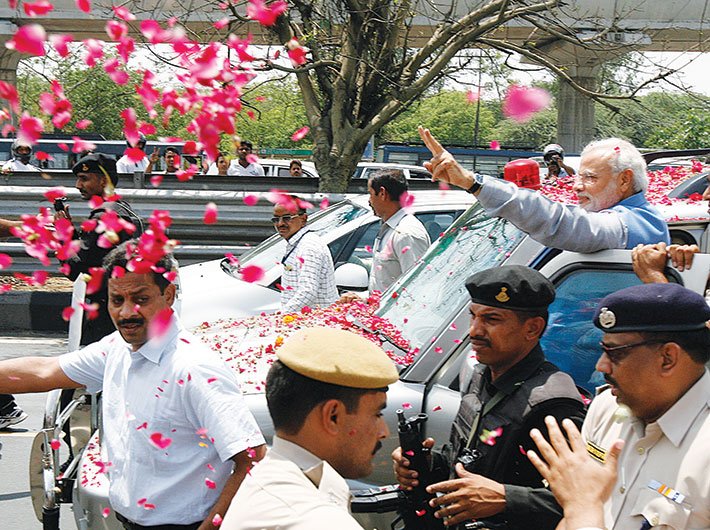
Don’t blame Modi for his slide from winning the historic mandate to becoming the object of ridicule. Blame our credulity
People of Bihar have sharp political acumen, and people of (the rest of) India can learn a thing or two from them, said Narendra Modi during one of his 31 rallies in the state. They have given their verdict now. Earlier this year, people of Delhi too had given their verdict, but they are apparently a special case even if the national capital is the very microcosm of India in most senses.
Is it the case, then, that Gujaratis are somewhat naïve in politics, given that it backed Modi for 12 years? It’s a foolish question, but think about it, and all of Modi’s strengths and weaknesses will become clear. For more than a decade, his only direct rivals were the three individuals who served as state Congress chiefs whose names most of us won’t be able to recall. At the national level, it was the period of Sonia Gandhi, Manmohan Singh and Rahul Gandhi, who were no match for Modi’s street-smart politics and fiery rhetoric with a dash of Hindutva. So, Modi won three terms. Of course, there are several chief ministers who have won three or more terms, but they have/had no private PR agencies and armies of digital foot soldiers, so the likes of Manik Sarkar won’t have a buzz factor and won’t be considered PM material. Modi had done his homework enough to be considered PM material after his third win. Just when the Congress was desperately crying out to be defeated, an equally desperate BJP happened to find its saviour in no one else but Modi. That was also the moment, when a nation tired of the Congress wanted to believe in an alternative destiny. Modi was smart enough to offer brand-new dreams. The result: a historic win. Nothing succeeds like success, and his supporters started seeing all sorts of epic qualities in the man with an outsized chest.
The next 18 months, however, have repeatedly shown the tragic gap between the nation’s needs and the prime minister’s abilities. Also, every time he has met with a rival slightly smarter than Rahul Gandhi, he has been defeated, be it Delhi or Bihar.
Blame it on Siddharth Patel, Arjun Modhvadia and Bharatsinh Solanki, blame it on Shankarsinh Vaghela and Ahmed Patel, if you bought into the dream that Modi was going to change the destiny of the country, when all he was going to change was his Twitter profile.
Two hundred and eighty-two is a gigantic number. The nation had strongly expressed its support in the dream that Modi was offering: sabka saath, sabka vikas; or inclusive development, with equal emphasis on both words. Instead, he has wasted both the colossal mandate and the historic opportunity it had created.
He had also promised to end policy paralysis, control inflation, create jobs, bring back black money, and curb corruption. Some still believe he certainly has the ability to deliver all this, though of course he is yet to put his enviable abilities to some use.
Apart from giving fancy abbreviations for the pre-existing schemes and adding some of his own, apart from a record number of foreign trips and a change in the wardrobe, what little has been accomplished is not good enough to win even one-fourth seats in Bihar.
In the process, the chronology of the Gujarat model has been inverted. There, it started out with hum-paanch-hamare-pachis in 2002, which was replaced by vikas, or at least the talk of vikas. But in 2014, it started with the talk of development, and in no time has run into raamzade and Kalam-despite-being-Muslim. In one year flat, development talk has been replaced by divisive discourse.
In one year flat, Modi has also accomplished something his predecessor took seven-eight years to accomplish: becoming the butt of jokes everywhere, even on the extra-guarded FM channels. If that sounds like a funny punch line, it is not. It is sad for the nation. Bihar may or may not go back by 25 years; India is going back by 40 years. Towards 1975.