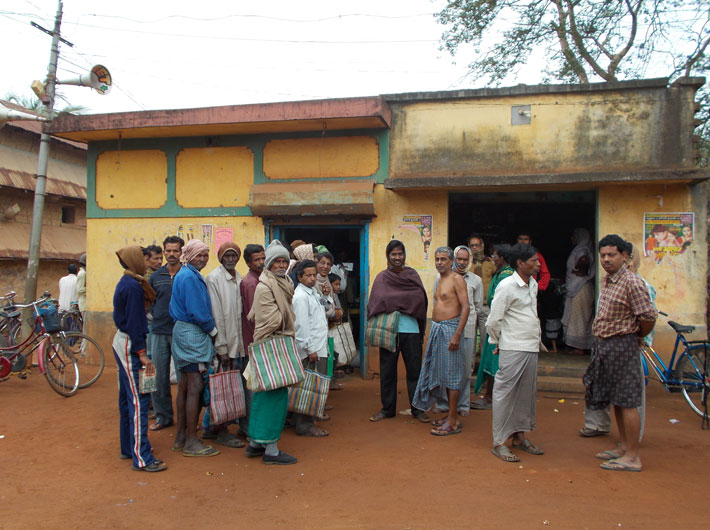
In a quaint village in Bengal’s Medinipur district, people lining up outside a ration shop tells a pan-India tale of corruption and irregularities at all levels, and proper administration at none
On a balmy late-March morning, tens of people stood in a line outside a ration shop in Benachapra village, under Bakibandh number 4 gram panchayat in Salboni block of West Medinipur, to collect their quota of weekly ration. It could have been a nice opportunity for the people to interact and catch up with each other while awaiting their turn, but for a miserable downer: none of the villagers in that queue knew what their weekly entitlement was.
So little wonder, then, none received it.
“We are uneducated. We don’t keep track of these things,” said a man at the head of the queue. “We get what we are given; we believe in our ration dealer.”
Sanjay Ray, the dealer, said families below the poverty line (BPL) get whatever they are entitled, barring sugar. “We are not receiving any shipment of sugar for the last four months,” Ray said.
Ray could well have found a long-lost brother in Bhaktipada Mahato, the dealer of the ration shop at Dhanyasol, who said, “The kerosene allotted does not come on time. People have to come here two or three times to buy their quota.”
The food inspector of Salboni block, Tapan Kumar Senapati, acknowledged that claims about kerosene and sugar shortage are genuine, but failed to explain and, instead, put the onus on the state and district.
While a case could be made out for the direct cash transfer, and its benefits in reaching out at least the cash component to families that actually need it since subsidised ration is anyway not reaching most, this is a problem with a bigger magnitude. It is one of corruption and irregularities at all levels, and proper administration at none.
In that sense, the snag does not end at the boundaries of Benachapra Salboni, Medinipur or Bengal — it is a pan-India crisis.
According to rules, each adult member in a BPL family in Maoist-affected Jangalmahal area is entitled to 2 kg rice per week, while those below 18 are to get 1 kg rice. But the ration shop in Bhadutala was found giving 1.5 kg rice to adult members and 500 grams to children of BPL families.
Asked why the people were being half 500 grams less than their entitlement, a ration shop employee said that once you factor in loading expenses and labour charges, there is very little profit remaining.
And Bhadutala, by the way, is no exception.
Explaining an art called cheating
While Governance Now’s visit and subsequent probing about PDS created a stir of sorts, Ray, the ration dealer at Benachapra, said MLAs routinely make rounds of his shop alluding to his political connections.
This correspondent subsequently got a call from a dealer, who said the visits had ruffled some feathers, and that dealers and officers at the food distribution officers were worried. Inviting this correspondent to give his side of the story, the dealer, who spoke on conditions of anonymity, alleged that the distributor forces them to leave some ration behind. “The ration delivered to our shops is less than the amount officially allotted. But we cannot protest. If we do, we are harassed in the name of inspections and punishments,” he claimed.
Besides, he added, “I alone cannot protest when everybody else has given in.”
Calling inspections “further harassment”, and in an effort to justify cheating the uneducated and gullible villagers, the dealer alleged: “We have to bribe the officials. But we, the dealers, are helpless. We are entitled to monetary compensation in case food grains fall short, but are never given the money. We have to hire labourers to operate and distribute the ration, but we do not get any additional funds to run the shop. That’s why we are forced to give about 500 grams of ration less to the people.
“I pay my workers with ration the ration that remains uncollected for the week, hence the shortage.”
Few checks, little balance
But rejecting all these allegations, food inspector (Salboni block) Tapan Kumar Senapati said ration is allotted on the first working day of each month. “The distributors are monitored by inspector, chief inspector at the district level and sub divisional controller,” he said.
Stressing that surprise checks are conducted on dealers, Senapati said errant ones are punished as per the rulebook. “The food office at the block level is authorised to give only APL (above poverty line) ration cards. BPL ration cards are given after a claimant is identified by the block development office as belonging to the BPL category,” he said.
As a further level of check to ensure ration is given properly to people, a shop level monitoring committee is selected from the gram panchayat, the food inspector said.
Bakibandh gram panchayat number 4, for instance, has seven ration shops, each monitored by a committee. “A monitoring committee was formed this January after we received orders from the block,” executive assistant of the panchayat, Sujata Biswas, said. The committee, she said, comprises headmaster of a local school, members of a local government club, retired government employees, a panchayat member and a member of the opposition.
“This committee is meant to oversee whether foodgrain under PDS is distributed properly to both the dealer and to the people. The food supply department sends a list of ration allotted, and their job is to tally that list,” Biswas said.
The gram pradhan is supposed to oversee the committee’s functioning and report to the BDO, she added.
But asked whether the committee is making any difference, Biswas replied: “The committee is not functioning,”
And why is that? “The members are under a lot of political pressure. Since the panchayats are still under the CPI(M), the ruling party (Trinamool Congress) does not allow the committee to function properly,” she alleged.
In the interim, she added, the BDO has asked the food supply officer to oversee the monitoring committee.
(Puja was stationed in Salboni for six months, till April 1, as part of a Governance Now-ANSA-SAR project)