
There’s a challenge and also an opportunity. Educators, institutions and AI pioneers must join hands to ensure that academic authenticity thrives in this changing landscape
Ashank Mittal and Dr Palakh Jain | August 22, 2023

This article delves into the transformative influence of AI on academic integrity, specifically focusing on the deployment of AI-based tools in detecting and addressing plagiarism. The ensuing sections expound on the evolution of plagiarism detection, the implications for education, and the concurrent responsibilities of educators and students in this new paradigm.
Evolution of Plagiarism Detection and AI
The Indian education system has long been characterised by rote learning, which, in turn, has led to assignments primarily consisting of verbatim reproductions of authors' texts. However, a pivotal shift occurred in November 2022 with the introduction of a Generative Pre-Trained Transformer Tool, shaped by ‘Open AI’, an influential foundation with investors like Elon Musk. Trained with an astonishing 75 billion parameters, this tool has democratised access to AI-powered text generation for students worldwide. An ensuing consequence has been the emergence of the term ‘High AI Similarity’, flagging a significant proportion of student reports submitted for assessment.
Table 1: Diagnosis of 13.8 lakh student reports by TurnItIn in July 2023
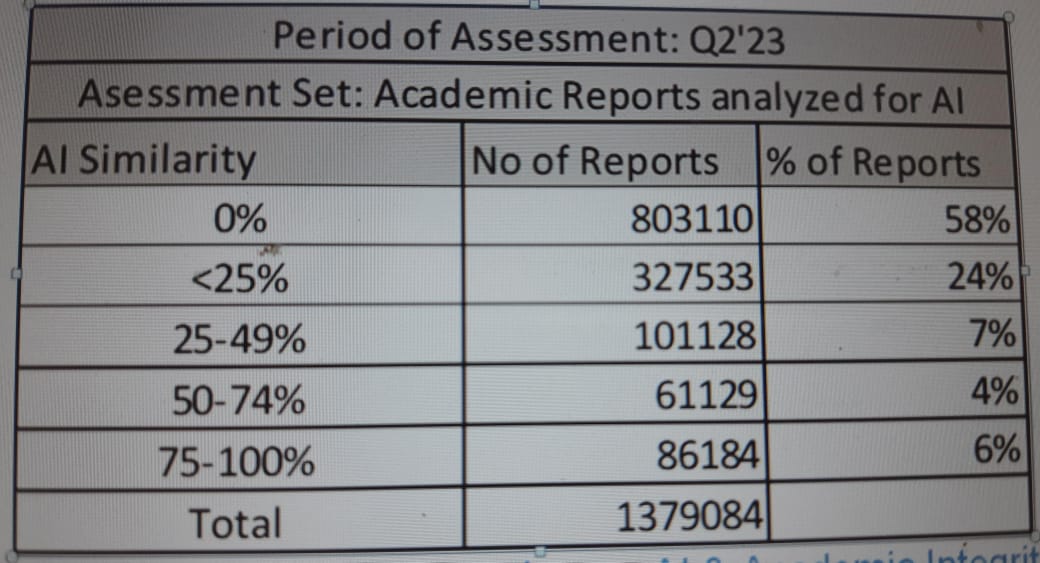
Source: TurnITIn Presentation on AI & Academic Integrity
Plagiarism Detection with AI Tools
In Q2’23, TurnItin estimated that of the 13.8 lakh academic reports, about 1.5 lakh could be flagged for high levels of AI similarity. TurnItIn is an AI-powered EdTech Venture established in 2014 to authenticate the authenticity and originality of texts in academic contexts. With a substantial presence across UK and European universities, TurnItIn's significance amplifies when examining the recent developments in AI-enabled plagiarism detection. As educators, it is imperative to seek insights from the creators of such tools, understanding their motivations and objectives.
AI's Disruptive Impact on Academic Writing
The realm of academic writing faces a dual disruption from AI. Automated essay writing tools offer the prospect of generating content with minimal prompts, while plagiarism detection software like TurnItIn enhances the precision of identifying text similarities. These tools, while transformative, necessitate a nuanced perspective. They should serve as diagnostic aids rather than definitive arbiters of academic misconduct.
Promoting Academic Integrity in the AI Era
It is crucial for educators to leverage AI-powered tools to foster a positive learning environment. Encouraging self-reviews centred on grasping the concept of 'Original Authorship' can enhance contextual understanding and holistic engagement with assignments. The evolution of peer reviews also gains significance in this context, where AI aids as a supporting tool, augmenting human judgment in deciphering academic misconduct and maintaining the spirit of original authorship.
Balancing Human Judgment with AI Precision
The integration of AI-based plagiarism prediction tools into the peer review process bolsters consistency and transparency. While AI efficiently detects textual similarities, human reviewers possess the capability to grasp content nuances, intents, and contexts. The distinction between legitimate citations and plagiarism hinges on this dual assessment, reinforcing the notion that appropriately cited content, even with high text similarity, should not be immediately labelled as misconduct.
Long-Term Impact and Evolution
In the foreseeable future, AI's role in academic integrity remains twofold. In a setting where rote learning prevails, AI aids in upholding academic standards through plagiarism detection. However, the trajectory of education is poised to evolve. AI-generated content could become a tool for enhancing learning, where students engage with AI-generated text for analysis and commentary, fostering critical thinking rather than memorization.
Conclusion: A Dual Perspective on AI and Academic Integrity
In conclusion, the advent of AI-driven tools has spurred a profound shift in academic integrity paradigms. As AI redefines the boundaries of education, its influence on academic integrity remains both a challenge and an opportunity. This dual perspective necessitates an ongoing dialogue between educators, institutions, and AI pioneers to ensure that academic authenticity thrives in this changing landscape.
Ashank Mittal is a Phd scholar at Bennett University. Dr Palakh Jain is Associate Professor at Bennett University and Senior Visiting Fellow, Pahle India Foundation.
The Gandhian movement in India, after Gandhi’s death, failed, says Ramachandra Guha, and blames Vinoba Bhave for it. But the movement found new, fertile grounds around the world and succeeded in bringing about a change in South Africa, the US and elsewhere. It is high time it returned home. Of cour
Tavleen Singh, noted journalist and political commentator, has turned to fiction, with her debut novel ‘The Actor’ (HaperCollins India). Set in the near future, it has a superstar, Amit Singh, turning to politics, when the political landscape is dominated by prime minister Guru Gaynendraj
The union cabinet, chaired by prime minister Narendra Modi, on Tuesday approved the setting up of a Special Purpose Vehicle (SPV), called Integrated Transport & Logistics Authority (ITLA), to strengthen research, planning, appraisal, monitoring and impact assessment within the broad domains of Transp
Foundational Literacy and Numeracy (FLN) are often described as the building blocks of education. Yet, their significance goes well beyond a child’s ability to read a sentence, write a response or solve a basic mathematical problem. These foundational skills shape how children understand the world,
For decades, policing has followed a familiar sequence: a crime occurs, the police respond, an investigation produces records and those records become part of the institutional memory of the criminal justice system. Artificial intelligence is beginning to alter that sequence. Instead of merely recording
“We are making a Constitution forever and not only for today.” Shibban Lal Saksena said this in the Constituent Assembly on June 15, 1949. He was warning that a ruling party might one day choose a loyalist to run India’s elections. Seventy-seven years later, the Supreme Court is wrestli










