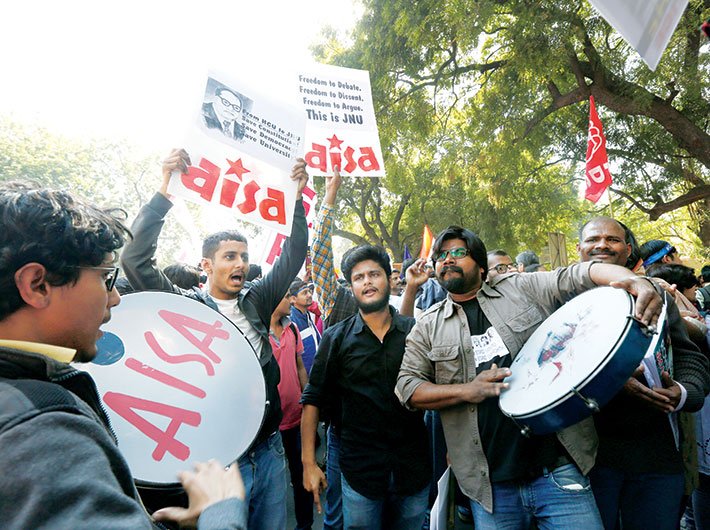
JNU has a history of making rulers – of different hues – uncomfortable. The latest attack on it is unprecedented, but it will survive and continue its job in democracy
Students, faculty and staff drawn from all classes, castes, regions and religions make JNU a microcosm of the country. The institution reflects a rich diversity of cultures, languages and lifestyles prevailing in the country. JNU is a great leveller: Differences never translate into hierarchies. Students from Africa, Palestine, Middle East and other parts of the world add to the multicultural and cosmopolitan context of the campus. This ambience itself inspires a democratisation of personality, a broadening of mental horizons and freedom from inhibitions in a student.
Many a time, this transformation is not smooth – it rather entails a deep struggle within. Running such an institution calls for a collaborative effort of teachers, students and staff with maximum democracy, tolerance, acceptance and accommodation of diverse views, which has got institutionalised in the course of time. Elective principle is the key to all structures. It is well known that students-faculty committees discuss all aspects of academic life and the inter-hall association represented by hostel presidents, dean, provosts and wardens formulates policies on all aspects of hostel life. The students union has representation in the academic council.
Students themselves conduct union elections. Each candidate has to go through a debate with rivals at the respective school or at the university-level general body meetings (GBMs) before voting takes place. Anything under the sun can be debated in these meetings which represent the collective will of the students. There is a right to recall or impeach the elected representative in the JNUSU constitution.
A fierce struggle of ideas with maximum nonviolence has been the hallmark of the JNU culture. Democratic resolution of all conflicts and contradictions in the corporate life of an institution is a unique feature of JNU which has a lesson or two for the political classes of this vast country.
In JNU, one learns not only in classes, but also by participating in lively political debates in post-dinner mess meetings in which everyone has a right to question any speaker and put an opposite view without fear, through pamphlets and posters and through mass mobilisations on different issues.
I stayed in the JNU campus as a student from 1990 to 1995. The Soviet collapse, the anti-Mandal agitation, Babri demolition, neoliberal reforms, mass movements across the country and the emergence of new caste-based and regional outfits … all this had impacted JNU in no uncertain terms. Student outfits affiliated to Samajwadi Party, Bahujan Samaj Party and even Shiv Sena were formed on the campus and they participated in elections too – in addition to all left organisations, NSUI, ABVP and Free-Thinkers which were already there. Leaders from the left parties, BJP, and Congress visited the campus on regular basis for the mass meetings. From AB Bardhan to Arun Shourie and from Uma Bharati to Phoolan Devi, they all came to JNU and got audience. The role of the student movement was fiercely debated on the campus.
The JNUSU chose to represent and become a rallying point in the national capital for many mass movements across the country. Hitting the streets to protest communalism and other oppressions, working in riot-torn areas such as Seelampur in Delhi, sending student teams for post-disaster relief work in far-flung hilly areas of Uttarakhand, JNUSU functionaries leading delegations to investigate and protest rape and murder at Rampur Tiraha during the Uttarakhand agitation, oppression of dalits at Bargarh in Odisha, rape of adivasi women in Jagatsinghpur district of Odisha and of Bhanwari Devi in Rajasthan were all part of JNU politics apart from the regular campus issues. The JNUSU office-bearers formed solidarity groups for various workers and peasant movements. Movements led by Medha Patkar (Narmada Bachao Andolan), BD Sharma (Bharat Jan Andolan) and Shankar Guha Niyogi in Chhattisgarh had a support base in JNU for a very long time and many students in the 1990s too worked for these movements.
Politics in JNU ranged from mundane to sublime. Could politics ever be sublime? I remember an episode when a student tried to immolate himself on the campus. He was from a jat family and had married a dalit girl, daughter of a security guard on the campus. Ex-communicated from his family, he couldn’t secure passing grades and was asked to vacate the hostel room. After his immolation attempt, he was rushed to the nearby Vasant Lok hospital. He needed to be operated upon immediately, but this was a private hospital and who would pay the charges? We requested the doctor, Dr Dua, to start the operation, promising that the JNUSU would bear the costs. Now, few people know that JNUSU has a shoestring budget for its administrative affairs, less than that of even a small-time college students union. But the entire campus contributed money and stood for him – with no support from either the administration or his family. The operation was over, but what about the follow-up care? The costs were prohibitive, and for the next two months, he was shifted from one hospital to another to reduce costs. Finally, when all resources dried up, Dr Dua took him home, overwhelmed and moved by the spirit of the entire student community led by the union. The doctor did not take his fees thereafter.
‘Poetry, passion and politics’ was one of our slogans. Poetry and philosophy pervaded the political atmosphere of high idealism in our JNU days. Political adversaries could be friends at personal level.
JNU today is under siege. The issue at stake is ‘nationalism’. Notwithstanding the unfortunate anti-India sloganeering on the campus allegedly by some outsiders, JNU has always had its own robust sense of patriotism. Many years after I left the campus, the students showed black flags to prime minister Manmohan Singh to protest against his remarks, made in 2005, expressing gratitude for the British rule. They expelled MNCs like Nestle from the campus. Of many ‘nationalisms’, most students of JNU have consistently embraced the ‘anti-imperialist’ variety over generations. Their activities have broadened the notion of ‘patriotism’.
Nothing symbolises it more than the martyrdom of Chandrashekhar Prasad, twice JNUSU president – in 1994 and 1995, who got killed for mobilising public opinion against dalit massacres in Bihar. He was the son of an army man and was himself trained at the National Defence Academy. Those who die defending people’s rights are no less patriots. At a time when statistics are being rolled out about per-capita expenditure on JNU students, national interest would be better served if the list of corporates which have sucked the common man’s hard-earned money and bled our banks white through bad loans is prominently rolled out on our TV screens. People’s interest is the national interest.
JNU has braved many assaults on its character and culture in the past. It survived the onslaught of emergency in 1975. It survived a sine die closure and police action in the wake of the 1983 student movement after which the new admission policy was brought to change its character and deprivation points were done away with, only to be restored partially in 1993 after a vigorous student movement. It survived privatisation attempts in 1994-95. It survived the Lyngdoh committee recommendations on students union elections. The entire political-academic edifice of this institution has made ruling dispensations of different hues hugely uncomfortable from time to time. This time the attack is unprecedented, but I am sure the JNU culture would definitely survive and resist this too. n
Krishna, JNUSU president in 1993-94, is professor of Hindi at Allahabad University.