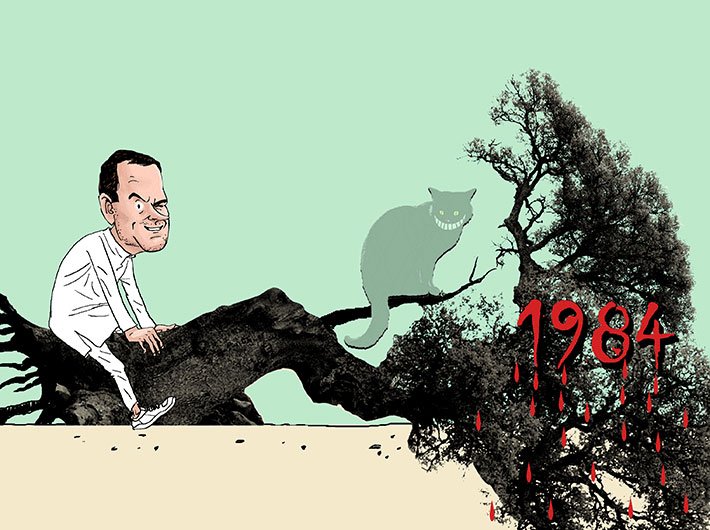
For the 1984 anti-Sikh riots, we have blame that is not blame, an apology that is not an apology. Also an apology without blame and blame without an apology
You needn’t be thoroughly familiar with Lewis Carroll’s Alice’s Adventures in Wonderland to know about the Cheshire cat. Characters like Humpty Dumpty, the Red Queen and the Cheshire cat are part of the kit of popular idiom. Alice encounters the Cheshire cat sitting on a tree, fading into and out of view, leaving only a lingering smile, prompting her to say, “I’ve seen a cat without a grin but never a grin without a cat.” Physicists have taken subatomic particles and separated them from one of their innate properties such as spin or magnetic moment and nicknamed them 'quantum Cheshire cats'. Congress president Rahul Gandhi has gone beyond that. Here’s how.
Speaking recently in London, Rahul, not exactly known for making well-judged statements, told a news channel the Congress was not involved in the 1984 anti-Sikh riots. After the assassination of prime minister Indira Gandhi by her Sikh bodyguards, some 3,000 Sikhs were killed in over three days of rioting in Delhi alone. Over 400 rioters have been convicted so far, but none of the big names accused of inciting, leading, and directing the mobs. H K L Bhagat, Sajjan Kumar, Jagdish Tytler, Brahmanand Gupta, Rampal Saroj – these are among the Congress leaders survivors of the carnage pointed to. The only two politicians convicted are ex-municipal councillor Balwan Khokhar and ex-MLA Mahendra Yadav. Both were Congressmen.
Report after independent report has highlighted the involvement of Congress leaders in the rioting. They have also alleged that the police force was coerced into inactivity. Even judges were constrained to observe that investigations of riot cases were wanting in quality. Allegations of gang-rape of abducted Sikh women haven’t been looked into. One judge, S N Dhingra, observed: “A system which permits the legitimised violence and criminals through the instrumentalities of the state to stifle the investigation, cannot be relied upon to dispense basic justice uniformly to the people. It amounts to a total wiping out of the rule of law.”
Tie that to the following facts. One, the Congress was in power at the centre and in control of the Delhi administration. Two, Rahul’s father Rajiv Gandhi, who took charge as prime minister on his mother’s death, had notoriously said of the violence: “When a big tree falls, the earth shakes.” From the action-reaction implications of that statement, it follows that the state failed to prevent what it should have been prepared for. And the agency of state action stemmed from the Congress. So, pray, will Rahul tell us who exactly was involved?
Rahul’s denial casts a shadow, once again, on two apologies for 1984. For long the Congress has maintained that Sonia Gandhi and Manmohan Singh (as prime minister) have apologised for the 1984 riots. When Rahul said, in March 2014, that “the prime minister of the UPA has apologised and the president of Congress party [Sonia Gandhi] expressed regrets,” journalist Karan Thapar subjected the Sonia part to dogged scrutiny. He concluded, in his Hindustan Times column, dated March 23, 2014, that: “Sonia Gandhi has expressed regret for Operation Bluestar and could be construed to have done so for the 1984 Sikh killings but it seems almost certain she hasn’t apologised for either.”
Now for the Manmohan Singh apology of 2005, delivered by the then prime minister in the Rajya Sabha. The occasion was the tabling of the action-taken report on the Nanavati Commission report. It won high praise equating it with Gandhian moral clarity, but who exactly was Singh apologising for? His words: “On behalf of our government, on behalf of the entire people of this country, I bow my head in shame that such thing took place.” With hardly any justice delivered and none of the orchestrators of the violence punished, doesn’t that grandiloquence become a cruel joke on millions of law-abiding citizens who had no role in the riots?
In the same speech, Singh said, “One thing the report conclusively states is that there is no evidence, whatsoever, against the top leadership of the Congress party.” This is questionable. Witnesses to the rioting have spoken of motorcycle-borne men moving about with lists of Sikh homes to be targeted. Like in other riots, this could not have been possible without the connivance or participation of the administration. Or the lists could have come from parties, which have them for election work. It doesn’t take great deductive skills to work out where, in 1984, those lists could have come from.
The commission records evidence from some senior defence officers who met then president Zail Singh, a Sikh with a Congress background, and asked him, as head of the forces, to order the army to end the rioting. They were sent to home minister P V Narasimha Rao, who in turn is recorded as having given them an indifferent hearing and done nothing. So what “top leadership” of the Congress was Singh referring to? No prizes for guessing.
There’s more. Singh refers to a “valued colleague” tendering his resignation. This of course was then minister of state for overseas Indian affairs Jagdish Tytler, who went out kicking after pressure from within his party, from the Left allies of the UPA, and the opposition. After resigning, he said, “The Nanavati report is rubbish and should be thrown into the dustbin.”
Which, in a sense, applies to all reports of commissions of inquiry. Commissions are strange beasts: they work like courts, gathering and weighing evidence and putting on record only that which passes scrutiny, but they cannot prosecute. None of their recommendations or the implications of their findings are binding on the government. Governments are wont to appoint judges who will produce a report that suits them; else, judges are replaced or new commissions appointed. The anti-Sikh riots saw ten commissions before the one headed by Nanavati. If there was one conclusion that the Nanavati commission arrived at – other than those claimed by Singh – it was that things needed further investigation!
So what do we make of this long and cruel travesty? The Congress-led UPA-1 government of 2004-09 has apologised. The people of India have had an apology extracted from them willy-nilly. And the Congress itself can be said to have both apologised and not apologised. When it comes to riots – Delhi 1984, Gujarat 2002, or the many others that are our dark history – leaders on the watch have always expressed regret, whether or not they apologised. Always after subverting processes to allow the violence. Blame for the carnage becomes a quantum entity. There’s no blame but regret, and there’s regret but no blame. It’s there and not there. Think of the Cheshire cat and quantum Cheshire cats. See the connection?