Their divergent world perspectives along with trade rivalry come in the way of a détente
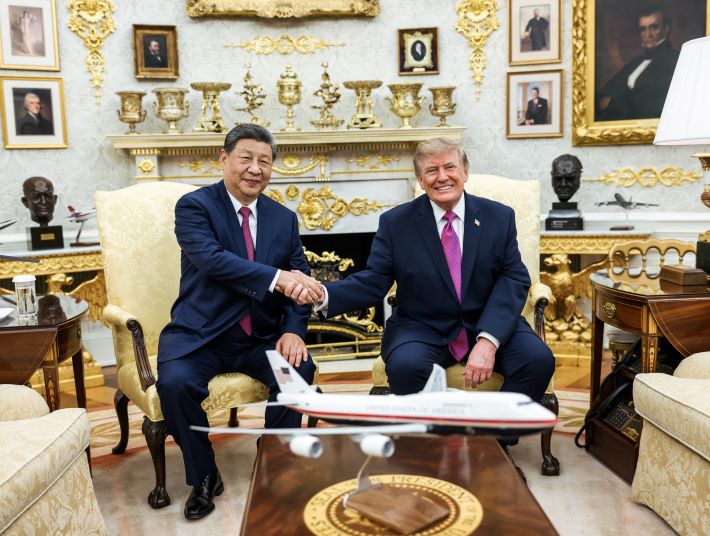
Diplomacy is akin to an art, wherein the summitry, conflict resolution and negotiations form apt constituents of the entire context of deal making and “playing for keeps” in the international arena. The Xi-Trump summit in Washington last week, in which the American president broke all considerations and protocol to welcome the Chinese premier on the tarmac of the Andrews military base, was a “first” as far as diplomatic tradition in the United States is concerned.
Beijing and Washington have been home to a kind of cut-throat rivalry since the initiation of PRC inside the matrix of the World Trade Organization in 2001. Then, president Obama too initiated a kind of economic, trade and investment thaw with the Chinese nation being in line with the trend of convergence, interdependence and globalisation. Also, Obama was moved to do so as the world faced an economic crisis and the American economic juggernaut too faltered within the larger facet and factor of a much talked about “American decline”. Since then, largely, the trade tug of war persists in the bilateral transactions between both the besieged and rival nations through an ilk of international relations observers have gone on to nomenclature the China-US conclave in the post Operation Epic Fury phase as a newly hewn G2.
Also, as an attendant fact, it can be argued that during the Xi trip, Taiwan and the AI cooperation between the rivals were the core elements of the summitry which ensued. In the early 1970s, the US Congress passed an Act which had a provision despite of the Chinese claim of sovereignty over Formosa that is Taiwan and the Chinese conceptualisation of “One China theory”. Also, in the current times, the visit of the US Congress women, Nancy Pelosi to Taiwan, the Chinese show of force over the Taiwan Straits drew a great deal of American opposition and consternation. What can be stressed over here is that Chinese combativeness over the “special autonomous status” which the US law accords to Taiwan, happens to be the single most significant fly in the ointment in the health of the bilateral relations between the two dueling nations.
The other realm which was deliberated upon with great finesse was the pertinent poser of AI and its myriad applications in different sectors. It has been observed by several commentators that though the US is the global leader in the sphere of AI and its varied applications, the Chinese are fast catching up with a breakneck pace and dexterity. It’s this race to hold the AI trophy that once again pits the two nations to develop antagonism towards each other. In the recent Xi visit to Washington, both sides agreed to establish an AI safety channel. Still, it needs to be comprehended that this tete-a-tete led to no major breakthroughs and only the theme of further cooperation was reiterated along with the spawning of working groups that can serve as speed-breakers. It’s these smoothening instruments which will serve as guard rails so that simmering disputes in the bilateral tryst do not escalate beyond manageable points. A consensus was reached which led to the creation of a Trade Board, which could once again diffuse misunderstandings and smoothen the trade confrontation between both the countries.
Still Trump expressed in his style that “They want to block our progress and development because we are leading China by a great distance and we want to make it an unassailable lead.” Thus, along with the protocoled dinner and the generous hospitality by the White House, the rankling tenor of “Trump talk” still persists with an acerbic reality check for Beijing. As far as trade issues are concerned, both the sides have agreed on a tariff cut for 30 billion dollars of goods despite the recent call on the part of Trump to swamp countries such as India and China with meteoric tariffs. One may not like it, but the US remains a stereotypical net security provider to several West Asian nations but the mighty showdown with Iran has seemingly spoiled the concoction in West Asia as nations once under the expectation of a regulator role being played by America, seems to be looking askance for other options in a bid to have ready alternatives in the case of an betrayal by Trump. Thus, vis-à-vis the China-America offers, the slew of nations are adhering to multifarious strategies of bandwagoning, hedging and balancing and they need to be prepared for an uncertain future in the light of the America and China’s institutional rivalry.
Still, a look at the National Security Strategy 2022 in US highlights the fact that America considers itself being confronted with a global destiny to lead the world in tandem with a need to satisfy the requirements of the global hoi polloi. All in all, the American establishment asserts its notion of Mount Sinai Nationalism and its exceptionalism, which militates against the Chinese notion of “peaceful rise” and its dominance in several supply and value chains in the larger global context. It’s these divergent world perspectives along with the trade rivalry which militates against reaching a détente between Beijing and Washington in the larger sense of the term.
Dr. Manan Dwivedi, Faculty, IR and IO, IIPA and Anirudh Singh, Ara University Bihar