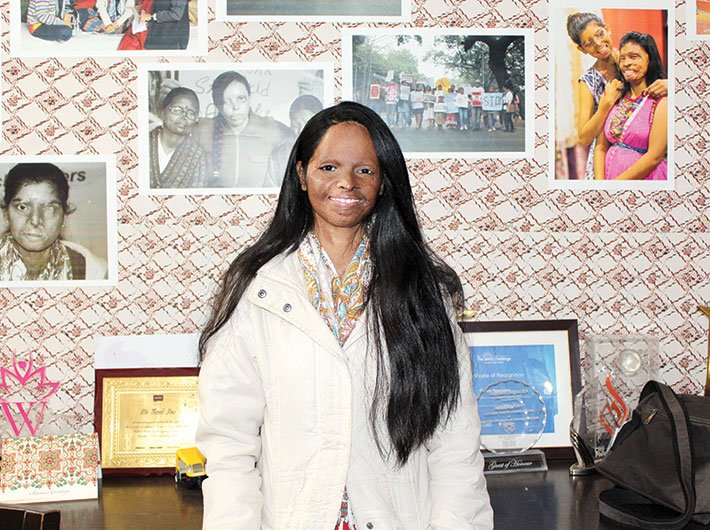
Ten years ago, Laxmi was only 15 when a self-styled lover had thrown acid on her face to avenge her for ignoring his romantic overtures. The acid had left Laxmi’s face scarred and also inflicted deeper psychological wounds. However, soon Laxmi met many other women with similar pain and scarred faces in the NGO Chhanv Foundation in Delhi. Together, they fought pain and their tormentors and none of them now cover their faces. Their fight – against their attackers and laws which permit sale of acid as if it were water – has changed attitudes all around. Looking at these women, beauty is no longer skin deep but associated with courage and grit. Accepting this, when the women apparel line Viva N Diva picked Laxmi as the face of its brand recently there was a moment of euphoria at Chhanv; even the fashion world greeted the news with aplomb. Laxmi is also a recipient of the 2014 International Women of Courage award given by US first lady Michelle Obama. Swati Chandra met Laxmi as she was juggling between looking after her 11-month-old bouncy baby and work at Chhanv. “I’m excited about the upcoming shoot,” she said. Excerpts from the conversation:
You are the face of a fashion brand. How do you see this development?
I, along with other [acid attack] survivors, had first walked the ramp two years ago. On that day I felt the definition of beauty had changed for many of us and also for those who saw us walk like models. As such I love getting dressed up. Every woman loves to, no matter how she looks and how old she is. The contract with Viva N Diva will give a message to society about the real meaning of being beautiful. Besides, it will also empower the survivors and change their mindset. It will break the stereotype.
What changes have you noticed in society ever since you decided to fight?
The change is visible. People are now more aware [about acid attacks]. Earlier news of acid attacks used to figure in a corner column of the newspaper; now such kind of news appears on the front page. Many survivors have contacted us using social media. A lot of acid attack survivors, who were hiding in their homes and wailing in self-pity and shame, are coming forward with their stories. Now awareness has increased to the level that those intending to throw acid on a woman’s face must fear that their victim is not going to sit quiet and live under trauma and humiliation. They should know that she will fight. Things are changing but we still have a long way to go.
Acid continues to be easily available despite the supreme court order. Isn’t that a major issue?
Firstly, acid is in our hearts. Acid throwing is a cold-blooded and well planned crime. If the person has decided to attack a woman, for whatever reason, he would somehow manage to get the acid from some source. This is where upbringing matters. We live in a society where boys and girls are brought up differently; under different set of values, this builds up the ‘male ego’ in boys right from very young age.
Men cannot take a ‘no’ from women, whom they feel they are in love with. They see a no as a major attack on their male ego. We have cases where the attacker had got married [to a different woman] in an arranged setup but kept his feeling of revenge burning. Even my attacker had got married a month after throwing acid on me. The mindset has to change. It is more important than the law. As far as availability of acid is concerned, yes, even I and my colleagues [at Chhanv] have purchased acid without any hassle. The law is not being properly implemented as there is no will to do so. Why is it that we have to stage a dharna to demand a ban on its sale? Doesn’t the government have a conscience to do it on its own?
Do you get any support from the government?
Yes, some action [to help acid-attack survivors] is visible but things are happening at snail’s pace. Earlier, survivors were not getting compensation on time. However, due to our constant interventions, it has now become easier. What the government is neglecting is the rehabilitation of survivors. For example, going by the central government’s figures, only three percent survivors are offered government jobs which are linked to their education and qualifications. But what about those who are not qualified to find a job? Many survivors lose their eyesight in the attack; many girls need counselling to get back to normal life. The government should look at an integrated approach. Give us some vocational training, provide us counselling, educate us and provide employment or livelihood and shelter as per our capabilities.
What difficulty do survivors face during treatment?
There is a scarcity of trained doctors to handle acid attack cases. We, at Chhanv, have visited many spots of acid attacks. We found that in most cases no nearby hospital had a burns unit. A separate hospital is needed to take care of the fresh cases of attacks. Common people are not aware or trained in giving first aid to the acid attack victims. In fact, we see many misleading social media posts which suggest application of milk in case someone is attacked with acid. Such posts should not be allowed. Instead, as per science, in such cases, water should be poured over the affected areas to provide the best first aid to a victim.
What is your message for acid attack survivors?
Survivors are not victims. They must know this fact. But they become fighters only when they want to be one.