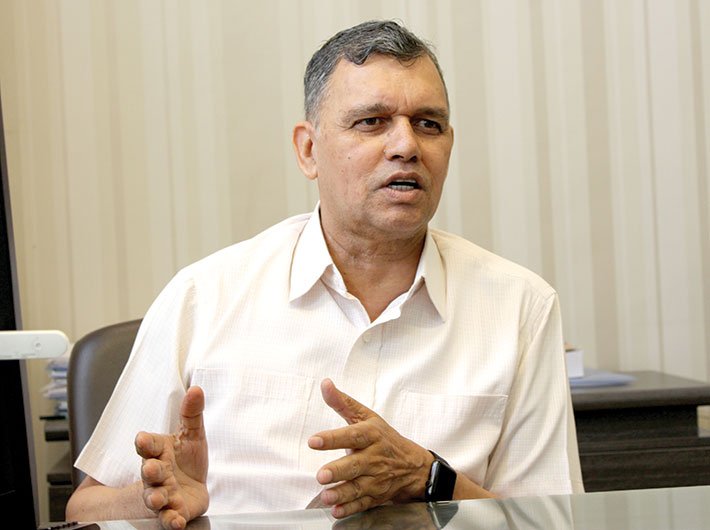
Ramanath Jha¸ OSD, Mumbai Development Plan, talks about ways to make Mumbai a sustainable city
A 1977 batch IAS officer, Jha has written a book, ‘Urban Essays’, and co-authored ‘Towards People Friendly Cities’ published by the UNICEF. He was the editor of the ‘City Development Strategy for Hyderabad’ published by the UN-HABITAT. The urban development expert talked to Governance Now about ways to make Mumbai a sustainable city.
What makes a city citizen-friendly?
A city has to be a multi-product organisation. We need to address the requirements of the entire gamut of citizens who live in a city and then make it citizen-friendly. You have old people, men, women, children, professionals, people with different abilities and people with disabilities who need services. Since 2000 the world has moved ahead in terms of thought process by imagining how a city ought to be. In India, 30-40 years ago we never thought of having development control regulations (DCR), now called Development Control and Promotion Regulations (DCPR), that would especially factor in the requirements of differently abled people. Now it is mandatory. If we are not able to do that we cannot be called a citizen-friendly city.
How can we make Mumbai sustainable?
We are talking of a city which is already totally built. While doing Mumbai’s development plan (DP) the factor which came to light was that almost 95-96 percent of the city that can be built is already built and there is very little vacant land available. In terms of sustainability what has happened has happened. Now you have to see how you can make the city better in terms of liveability, which is a difficult proposition after you have gone this far.
How can we talk of city sustainability as a whole – that is a question that has been disturbing me. I have got a few answers. A city is the most complex entity that humans have created. It is difficult to find how exactly you intend to create a sustainable city.
If a city is not economically sustainable then it collapses. For example, Detroit in USA was a car manufacturing hub. But after inroads were made by the Japanese and German cars, the American cars got sidelined. As a result, Detroit’s own market collapsed. Economically, a few years ago it had to declare itself as a bankrupt city. And as soon as the economy collapsed the crime rate increased, people did not have jobs and started moving out. Therefore, economic sustainability is an essential part of any city.
However, if you are only economically sustainable and not environmentally sustainable it is again a huge problem. You can do your job but if there is no conducive environment for quality of life then the city will get hit. There has to be a balance for economic and environmental sustainability.
You have to go further. For instance, you make the city economically viable and give good quality of life, but you are not able to make it available to all citizens. Like the middle class and the rich have what they want but the poor do not have what they want, then it becomes a situation, which many global cities face, where the poor work in cities but end up living in slums. This is not the right environment to live and has implications in terms of city sustainability as it affects hygiene and density where a whole group of people live in inhumane conditions. The fact that you did not balance the economy with the environment and equity makes it an imbalanced city. So you have to have a proper balance between at least these three things – economy, environment and equity of the city.
At the organisational level Indian cities are highly centralised and citizens have little say in their administration. Also there are too many agencies that don’t speak to each other. Your views?
When we talk of cities we have to talk of the constitutional framework in our country. We begin with the 74th amendment passed in 1992 and its statements of objects and reasons. The constitutional amendment stated that we have to deliver cities that are self-governing institutions and empowered. It said that in India cities are not empowered because states have a stranglehold over cities and they merely work as agents of the state. Therefore, the amendment was an attempt to deliver the cities from stranglehold of the state.
Unfortunately, it did not go far enough in terms of provisions that would deliver such self-governing institutions. In terms of planning, strengths of city have been taken away in chunks. We have a huge number of planning authorities. Maharashtra is slightly better off as functions are performed more or less in fullness compared to other states. So the immediate fact is that our cities are not empowered enough to govern themselves. In such a centralised system where every time you have to go up to ask answers or seek permissions to do certain things, governance becomes extremely difficult. Huge population keeps coming in, every city is growing at breakneck speed and despite that your ability to take decisions is dependent on so many other people. This has to stop. There is no point in blaming the cities alone because the responsibility lies at all levels.
Then what is the way forward?
As the amendments were not able to deliver what was intended, there are only two options. Go back to the constitution and amend it in a manner so that it really delivers empowered institutions of self-governance at urban local bodies (ULB) level or enlightened states can walk that path because urban development is a state subject. So it is up to the state to amend its statutes and create a system where you have self-governance. We have plenty of literature and many examples around the world. We can do it with our own genius and own social and economic context, but this has to be done.
While the DP is yet to be released in its entirety, it has various provisions – like using floor space index (FSI) as a fiscal tool and opening up 2,100 hectares of no development zones – that may not help in holistic development of the city. Your comments?
Housing is one of the major issues in Mumbai and if it is not fixed Mumbai will lose out to other cities. It’s already happening. Mumbai’s total contribution to the economy is going down. People are moving out of Mumbai and coming for work [only].
Mumbai has a shortage of one million affordable homes. The unsold inventory is not affordable housing. No one is building affordable homes except partly by Slum Rehabilitation Authority (SRA) and by Maharashtra Housing and Area Development Authority (MHADA) in small numbers. To fix this you need land and that is what the DP is all about. It is about land special planning. We have said that whatever land is buildable and available in the city will be released only if you build affordable housing.
For nomenclature [purpose] it is called NDZ [no development zone] but that does not mean it is un-developmental environmental land because all environmental land has been put into natural area. So erstwhile 75 percent of NDZ land has gone into natural areas because it is environmentally sensitive and you cannot build on it. In the DP we have put conditions for coming out of it, otherwise it will remain NDZ.
The government of India has already decided on which environmental salt pan land no construction can happen and on which it can. We have picked up only a part of that land, as the government has plans to build affordable housing. The PM Awas Yojana is going to be implemented on the government land as well as on salt pan land, the MbPT (Mumbai Port Trust) land. It is in this sense that the centre, the state, local bodies and the citizens who own land have to get together and deliver affordable housing in the city.
To acquire the said land from the central and state governments will require a change in law. Second, the land in private hands demands a great deal of lobbying before it can be secured. Your views?
Why should we take the land from the government? It should build homes for people. For example, MbPT can build and develop housing for slums that were within its own premises, because we are not saying that affordable housing is for people who come from anywhere. There will be a definition of who can own this affordable housing. It is to resettle people who are already part of Mumbai and participating in its economic life.
For private land there is a formula. For instance, if you want to come out of the NDZ land which is private then 34 percent of the land would be of the owner, the rest comes into the public kitty. But the owner who is going to build homes will be paid in terms of FSI and housing is to be handed over to us. For preparing housing of this kind he will be given 20 percent of the cost of sale for he will have to raise loans, make preparations and have management costs. Since land cost becomes zero, the only cost that will go into affordable housing is the cost of construction and some management cost. For a 30 sq metre house under PMAY, I believe, would be sold for little less than Rs 10 lakh per home.
But this will add to the existing pressure on infrastructure and utilities besides making the city denser.
This will obviously have infrastructure around it and land will be provided for arterial roads. For the rest, only if the development happens as per DCR then you get permission. So infrastructure goes hand in hand. In western countries, currently the planners are debating and asking cities to densify as they are economically viable yet there are not enough eyes on road, danger of security and safety in cities. But they are talking of densities of 500-1,000 persons per sq km. Their larger cities are not more than 10,000 people per sq km whereas Mumbai has 30,000 people per sq km. It is time we start thinking what kind of densities we should allow in a city as it is obvious that when the densities go high, cities become unliveable. We are reaching at a situation where some cities have densities which they will not be able to sustain.
[email protected]
(The interview appears in the June 15, 2018 issue)