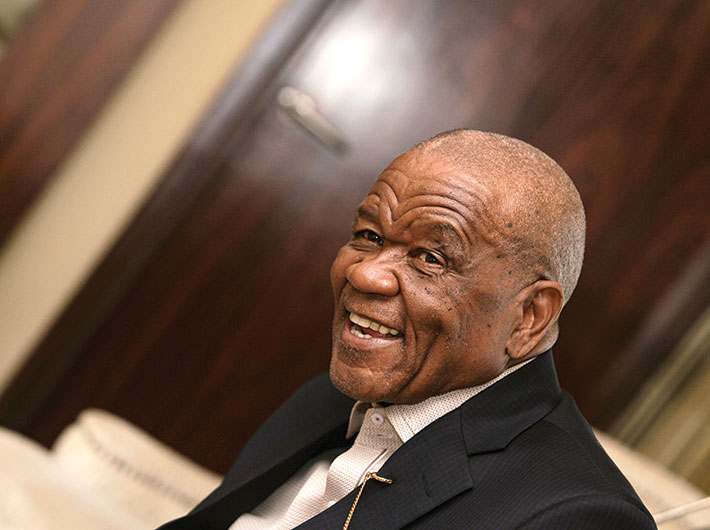
Kingdom of Lesotho, a landlocked country within South Africa, was the partner at the 10th CII-EXIM Bank Conclave on India-Africa Project Partnership held in March 2014. After years of single-party rule since independence from the UK on October 4, 1966, Lesotho saw the first coalition government in 2012 headed by the Rt. Hon. Dr. Motsoahae Thomas Thabane of the All Basotho Convention (ABC). Soon after meeting the Indian prime minister, Dr. Thabane spoke with Shreerupa Mitra-Jha on his vision for Africa and his expectations of India. Edited excerpts from the interview
There has been a perceptible turnaround in Africa’s politico-economic situation. The first decade of the new century witnessed some of the fastest growing economies in the world coming from sub-Saharan Africa. Do you believe that this is a sustainable and irreversible trend? If so, why?
It is irreversible. That is something non-negotiable. Because the future generations would wonder what happened [if we don’t move forward]. The future generation wants a different Southern Africa—a more developed Southern Africa where schools function to enable every child to learn to the best of her ability, where businesses prosper, where poverty will be a thing of the past. And these goals are now within our reach. However, what we have to do is to strengthen the democratic norms in the region. That is critical. If we get that right; have regular, free and fair elections, where the army is answerable to the executive, well-functioning law enforcement agencies, we will move forward. And that is the agenda of SADC (Southern African Development Community). In all our SADC meetings, we push the aforesaid agenda so we become modern states.
I don’t know where the term ‘Third World’ comes from and I am not particularly comfortable with these categories though probably there were reasons then to categorise countries as such. If being the First World means becoming like the US, then probably it will take some time for us to get there. But for heaven’s sake, let us at least be the Second World! Particularly Southern Africa presents unique opportunities to become more developed. And I believe we can do it.
The re-emerging economies are being talked about as the engines of a new economic global order which would shift the balance of economic power to the developing world and specifically to Asia. How is Africa positioning itself to benefit from this momentous change?
We have to do what Asia has done, that is, get our politics right. Politics will determine the way forward. I cannot emphasize enough the importance of free elections, good governance, honest leaders who don’t steal from the national coffers and so on. These pre-requisites are no longer a subject of negotiation. Otherwise we are a long way off. Issues of good governance, economic development, women’s empowerment dominate our meetings of the African Union (AU). These issues are aligned with the goals of the United Nations. We ought to be on the forefront of such goals in Africa. Instead of pointing fingers and blaming others for our problems, we must point the finger towards ourselves. [Laughs.]
India’s relations with Africa are historical and deep-rooted. However, it is only in the last 8-10 years that there has been a structural change in the India-Africa interactions, especially in the wake of India-Africa Forum Summit. During this period there has been an enhancement of co-operation between Africa and other major economies such as China, Brazil and Turkey. India’s trade with Lesotho ($22 million) is way below its potential. How do you see India’s growing engagement with Africa in general and Lesotho in particular?
If I may say, the Chinese have almost displaced India. We urge the Indians to come back because we have a common language, a common British-based educational system and a lot more. Institutionally, your parliamentary system and our parliamentary system are exactly the same. Yours is just a bigger democracy but with the same systems as us. So this visit of ours here [to India] should not be seen as a ‘stroll in the park’. This is a most serious endeavour to strengthen our historical relationship and agree that we have wasted enough time [in not building this relationship]. We must take advantage of the presence of leaders of the calibre of the present Indian prime minister. We don’t get leaders like that any more. They come once in a generation. We should exploit their presence.
The youth should get influenced by such leaders and have them as role models. When I was young, almost none of the African countries were independent and we did not have obvious African role models. But Indians already had Gandhi, Nehru et al. and the present leader is walking the same path as the founders of this nation. That is why we are here. We have come here to celebrate that which we have and that which we must cherish. Personally, I am looking forward to a very, very close relationship between my country and India. I hope for exchanges between the countries not only at the political level but also at the technical level, for postgraduate students to come to Lesotho and so on and so forth. There must be an exchange at all levels of society so we can make the relationship cross-pollinate. By doing so, we will not pull you down but you will pull us up.
It is often said that global financial institutions were founded in an era predominantly reflecting Western and especially European supremacy in the wake of World War II. Do you believe that these institutions have stopped reflecting the current global reality? If so, what would you suggest in terms of measures for rectification and balance?
The situation has changed very nominally. They [developed nations] still call the shots. They think theirs is the right model and they do not think that there is an alternate model. Our [South-South] unity is going to win that war for us. We have produced a kind of leadership that can match any leadership in the world. We have everything that we need to analyse our situation and scientifically resolve problems that affect our lives; in medicine, in engineering, in communication. If we make an effort to intermingle and allow talent to flow through the developing regions, then very soon we could become leaders of the world in our lifetime.
What are the development priorities of Africa today? Do you think in the swiftly interconnecting world, being a landlocked country poses unique development challenges? How has Lesotho in particular tried to address this challenge?
We have not exploited our children’s talent enough through developing the IT sector. We ought to develop such modern sectors throughout Africa, particularly Lesotho, because Lesotho has a very young and educated population. Our literacy levels are very high. We need to go from English and Sesotho and bring in French. And maybe some children should learn Hindi as well. [Laughs.]
This is your second visit to India. What are your impressions on the country and what would be your most important takeaways from this visit?
Your prime minister has changed. [Laughs.] He loves the country. He loves the world. He is democratic. He is older than I so I am going to adopt him as my mentor. [Laughs] I mean it.