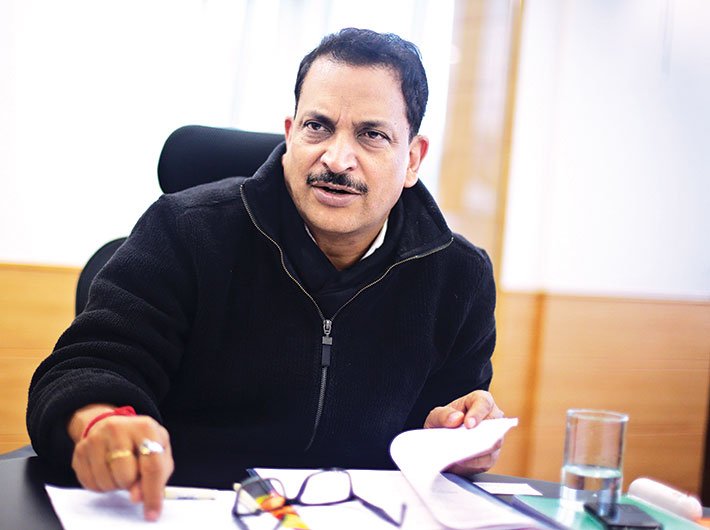
Entrusted with the task to create a resource pool of 500 million skilled workers by 2022, Rajiv Pratap Rudy, minister of state (independent charge) for skill development and entrepreneurshipis on a mission. In an interaction with Jasleen Kaur, Rudy talks about the newly created ministry and challenges ahead.
What is the purpose of a separate ministry for skill development?
The country has just 2% skilled workforce compared to 68% in the UK, 74% in Germany, 80% in Japan, and 96% in South Korea. All these countries started their work in skill development 50 years ago. The UK brought legislation in 1944, Germany started as early as 1869. Japan started in 1950 and even South Korea which has the highest skilled force started in 1980. Australia started in 1970 and China in 1996.
How can we expect India to match the world with this kind of skilled workforce? We are 50 years behind. We must admire the thought process of our prime minister. Earlier it (national skill development) was part of the department of economic affairs and subsequently it was formed as separate department when the new government came to power. But the prime minister was not happy with it. He felt there was enough to be done so it should be formed as a separate ministry. And the ministry was born the day I was inducted into the government, on November 9, 2014. The ministry (as a concept) is 50 years old. But under the policy I have been given this challenge to train around 500 million people.
From only 2% you want to scale up skilled workforce to 8%. How do you plan to do that?
The rate of training since 2009 has been very less. From 2009 to 2014, just about two crore people were trained, and the training was not even outcome oriented. From 2014, we are focusing on outcome-oriented training and taking this [figure] to around 30 crore in next five years. This would require huge resources, infrastructure and training partners, process of certification, rationalisation and, of course, employability. This in itself is a big challenge for us.
The work was earlier divided into various ministries and departments and there were over 70 schemes in operation. How do you plan to converge it all?
Earlier, it was a freelance affair. Every minister was doing some work in whatever way they could. The role of our ministry is to standardise and rationalise them.
All these ministries, through various schemes, were spending around '6,000 crore. All these have to become responsive to a standardised pattern. There are some issues (that need to be addressed). For instance, similar work is being done by the ministry of labour.
Along with the secretaries of labour, MSME, and higher education, we recently met the prime minister, and discussed these issues. It is a passionate programme of the prime minister; we are working to streamline it. We are trying to chalk out a framework for this.
Is there any special role envisaged for the HRD ministry?
There is some duplication, but the HRD ministry would primarily look into developing cognitive skills essential for skill development. We have to sync ourselves. Beyond that, higher education or training in higher education, which is [for our purposes] engineering, is different. We are talking about a bracket in between, which may not necessarily be a five- or three-year course. It could be even for three months, but good enough to ensure employability.
I am talking about the informal sector. I am talking about 470 million people. Out of that about 200 million would be in the agricultural sector. So, the remaining over 270 million people are the target area.
The HRD ministry has already started its work (on developing cognitive skills). They have their own budget and they will work on that.
What is the national policy on skill development about?
The policy of 2009 had to be reviewed in 2014 (after a five-year period). We are already working on it, and we would like to give it a new framework according to the new situation. We are examining it.
You have said at various platforms that the target of training 50 crore people (set in 2009) was impractical. But you have set a much bigger target (500 million people) for 2022.
We have to be rational as far as the target is concerned. That is the demand (of the market) we are talking about. But, actually that target can be achieved in five years; it is something which we need to address. We have a backlog of 50 years.
This is seen as a key portfolio in view of the PM’s Make in India campaign and his attempts to make India a production hub. What is your mandate?
The Make in India campaign is a manufacturing campaign. Today, most of the training in vocational education is for the service sector (60%). We now have to shift from services to manufacturing and for this we have to scale manufacturing, currently at 12% level, to 25%. For this we need huge skilled manpower. Make in India will not happen unless and until we have a trained skilled force.
Do you see this as a huge responsibility?
This is a completely different ball game. Apart from setting up a macro vision, we also have to see the implementation and the outcome. It is a task which I am sure, with the guidance given by the PM, we will be able to achieve.
You have been examining a lot of presentations from different sectors. What is the assessment?
I am looking at the potential sectors, where they actually stand, how much they have done and what is the possibility ahead. We are looking for quality and scale, the two key words. These two things will be fundamental [to skill development].
Quality will give employment and productivity and it will take care of standards. Scaling would mean the aspirational growth.
Is there any plan to collaborate with the private sector?
A huge plan has been rolled out. The 31 sector skill councils [SSCs, like beauty and wellness, power, handicraft] are going to establish the curriculum, standardisation, certification and employment. They are the key strength under private partnership, which will set standards of skill training and aligning them with the requirements of industry.
Are you also calling for investments for opening training centres?
Huge investments [are needed]. Some will be in partnership, some in the form of loan, debt and equity. We are trying to talk about CSR [corporate social responsibility], which has already been mandated under new rules.
[email protected]
(The interview appeared in March 1-15, 2015, issue)