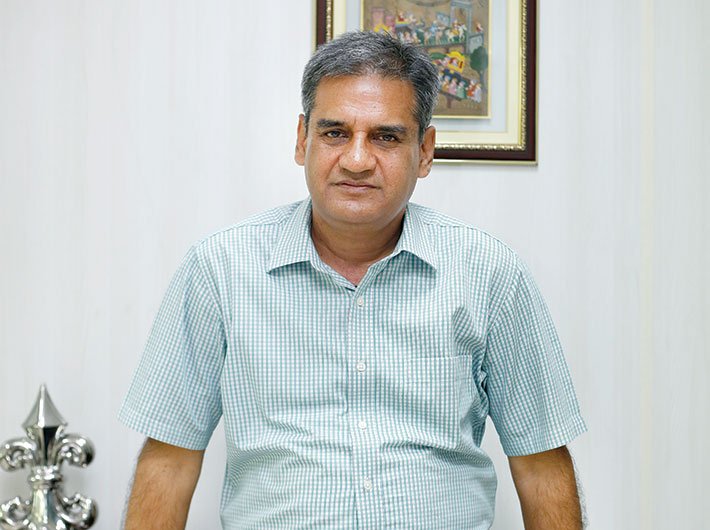
The Narendra Modi government has set an ambitious target of '58,425 crore for disinvestment in 2014-15. Disinvestment secretary Ravi Mathur, who has the responsibility to earn the largest chunk of revenue for the government, is, however, confident of meeting the target. In an interview with Jasleen Kaur, the 1979-batch Rajasthan cadre officer explains why
How soon can the government start the next phase of disinvestment programme?
We will start as soon as possible, once all approvals are in place.
How would you define the new government’s disinvestment plan?
The policy remains the same. First, we will divest minority stakes in listed profitable central public sector enterprises (CPSEs). Second, we will try to get more CPSEs listed on stock exchanges. Third, we have to bring down the government shareholding in all listed CPSEs to 75 percent, as per the guidelines of the securities and exchange board of India (Sebi), within the next three years.
These three parameters will broadly define our disinvestment plan for this financial year. And, the government will continue to hold majority stake in all cases.
Will meeting the Sebi directive be in addition to the set target?
It will be inclusive of the entire disinvestment programme.
How hopeful are you of meeting the target this fiscal?
The market capitalisation of CPSEs has increased. Last year we could not meet the target because of the circumstances prevailing at that time. This year we are quite confident of meeting our target.
Which companies are shortlisted for sell-off?
I cannot share the full list at present. But we have got approvals for initial public offerings (IPOs) of Hindustan Aeronautics Limited and Rashtriya Ispat Nigam Limited and for residual stake sale in Hindustan Zinc and Balco. We also have some percentages, which are leftover from earlier approvals, such as the remaining 5% in SAIL. These approvals are already in place. As and when we start getting more approvals we will start disinvesting in other companies as well.
What about maharatnas, such as ONGC and Coal India?
All these are proposals under consideration. Unless we get approvals from the cabinet committee on economic affairs (CCEA), I cannot really comment. Once the department of disinvestment (DoD) receives a nod, we can pursue further. The preparatory work is on.
Is there any plan to exit sick firms?
As of now we are dealing with only one sick company for complete selloff, which is Tyre Corporation of India Limited. It has been held up because of some litigation. We come into the picture only after the department of public enterprises and its board for reconstruction of public sector enterprises (BRPSE) decides that a particular CPSE cannot be revived and it needs to be sold off.
What is the preferred route for disinvestment this financial year?
When we have to list any company, it’s the IPO route that we take. When we have to go in for further divestment or to sell a minority stake, then two options are available with us – follow-on public offer (FPO) and offer for sale (OFS). In its recent board meeting, Sebi approved certain changes in the OFS mechanism. The prominent change being a minimum 10% retail sale in all such sales. We can go beyond that. Therefore, in all these we would like to see as much retail participation as possible.
Is there enough interest among foreign investors?
Yes. In some of the CPSEs there is enough interest by foreign investors. Our past experience shows that some CPSEs attract a lot of foreign investors.
Earlier, the government had resorted to the cross-holding route to shore up its revenues. Is there anything planned for this year?
In the past also whenever this route was resorted to, it was the decision of the EGoM (empowered group of ministers), depending on the then circumstances. Now, EGoMs have been abolished, so we have to put in place a new mechanism which will approve the method of disinvestment.
Earlier, CCEA approval itself authorised the EGoMs to decide upon the method of disinvestment, should the market conditions warrant. I cannot say which route we will go in for this time. Our preferred route still remains IPOs, FPOs and OFS.
The PSU exchange traded fund (ETF) has been a success. Will you add more companies this year?
Worldwide in stock markets of developed countries, ETFs are the most preferred route. In India, the ETF route was available only in commodities, such as gold, and there were some ETFs related to index. For the first time we brought out the PSU ETF.
We divest very small share holding in profitable companies. But the returns are attractive. Last year, the total amount of money that we managed to generate through ETFs was '4,500 crore and that too in a market, which was already depressed.
For an investor ETF is attractive, because first he gets the basket of share and, unlike a mutual fund, ETFs can be easily traded in the market. We have an option of tap mechanism, where we could offload some additional shares of the same companies. Both options are under consideration.
Will you offer discounts and loyalty bonus?
Last time we offered loyalty bonus to retail investors. It will be too early for me to say what discounts we will offer, because all these decisions will be taken by the authority, which fixes the basket and the price of the ETF. But definitely we would like to see a lot of retail participation.
Last year Coal India and IndianOil chiefs had resisted divestment efforts. How do you plan to handle it this time?
We only go for disinvestment when all the stakeholders are on board, including the administrative ministry and the company. There were certain issues which were flagged for various reasons and we took care of them.
For instance, in the case of BHEL, the administrative ministry wanted a block deal with Life Insurance Corporation (LIC) and we went ahead with that. So, it is not as if we are pushing everyone to follow us. We try our best to take every stakeholder on board. There is a big process that goes on – there is inter-ministerial group and a high-level committee in which administrative ministry and department of disinvestment are represented. It is this combined consideration process that helps finalise everything. We try our best. But then we have targets set and we have to meet them.
The interview appeared in the August 1 to 15, 2014 issue of the magazine