
World needs to move fast to achieve modern renewable energy goals
GN Bureau | May 20, 2015

While the world becomes more connected through all kinds of communication modes, around 1.1 billion people across the globe still live without electricity, reveals a World Bank report.
The report, ‘Progress Towards Sustainable Energy: Global Tracking Framework 2015’ reveals that around 2.9 billion people (which is more than the population of India and China combined) have no access to clean and modern cooking fuel.
READ: Key findings of the report
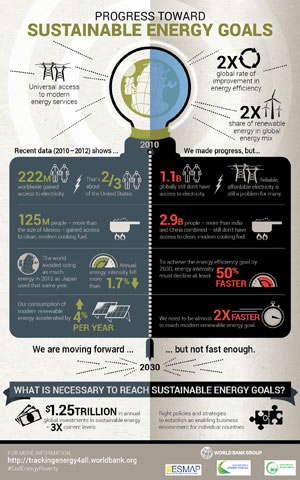 However, the reports charts out development and said the world has made sufficient progress to achieve sustainable energy requirements for all by 2030. But the world needs to move twice as fast to achieve modern renewable energy goal. At present the consumption of modern renewable energy is accelerated by 4 % per year.
There have been advances in electrification drives primarily by India but progress in Africa remains too slow. In India, 55 million people gained access over 2010 to 2012.
The global electrification rate rose from 83% in 2010 to 85% in 2012 with an additional 222 million people mainly in urban areas gained first time access to electricity (which is more than the population of Brazil, and well ahead of the 138 million population increase that took place over the same period). Overall, the global electricity deficit declined from 1.2 billion to 1.1 billion.
The report provides an update on how fast the world moved towards sustainable energy goals between 2010 and 2012. It tracks progress towards universal access to modern energy, doubling the rate of energy efficiency improvements and doubling the share of renewable energy consumption in the global energy mix.
The government has reduced the Basic Customs Duty (BCD) on major imported crude edible oils with a view to moderating domestic edible oil prices, providing relief to consumers and mitigating inflationary pressures arising from the sharp increase in international edible oil prices.
In his opening address at the 18th BRICS Summit in New Delhi on September 12, prime minister Narendra Modi did something India`s diplomacy has been building towards for three years: he moved the ‘Voice of the Global South’ from a slogan to a work plan. Addressing the leaders, he argued that t
The Pradhan Mantri Jan Arogya Yojana (PM-JAY), a welfare scheme which covers approximately 45 crore beneficiaries across India, provides cashless health cover of Rs. 5 lakh per family per year. It is the largest health insurance scheme which helped crores of poor families by reducing out-of-pocket expend
Every pregnancy requires two people. Yet India`s family planning programme continues to ask only one of them to bear almost all of its medical consequences. The newly released National Family Health Survey-6 (2023-24) confirms just how entrenched this asymmetry remains: 36.5% of currently married women a
Delivering the IXth Chief Justice M.C. Chagla Memorial Lecture on ‘Human Rights and Sustainable Development Goals’, in Mumbai Friday, former Chief Justice of India Bhushan R. Gavai questioned whether conventional economic indicators such as gross domestic product (GDP), national income,
Seventeen years after the centre first approved the widening of National Highway 66 between Mumbai and Goa into a four-lane highway, a fresh RTI reply has revealed a sharp escalation in the project`s sanctioned cost. According to the RTI reply obtained by activist Jeetendra











