A smartphone-based app is boosting the efficiency of immunisation logistics, cutting wastage, keeping the vaccines safe, and making sure every child gets timely doses
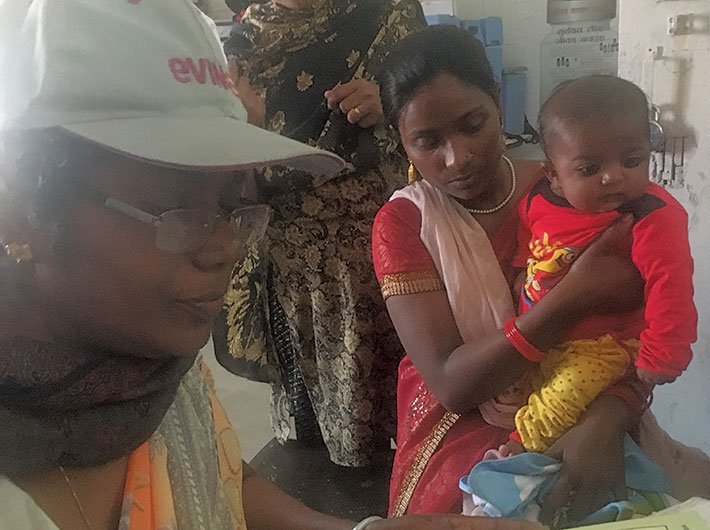
A long queue of women, infants in their arms, extends outside the immunisation room at the community health centre (CHC) in Bhangel village, Noida, a pink double-storey building beside a bustling market. Unmindful of the chit-chatting and baby babble, Mariamma Samuel, an auxiliary nurse-cum-midwife, administers vaccines to infants and pregnant women. It’s 12:30 pm on an immunisation day, so although she’s been busy since morning, she is expecting many more to turn up. But she doesn’t have to worry about running out of BCG or other vaccines: she has already checked stock levels by using the eVIN app on her smartphone. “Thanks to this app, we now receive real time information on stocks, supplies and storage temperature,” she says.
eVIN, short for ‘electronic vaccine intelligence network’, is a module-based technology for real-time tracking and monitoring of stock, location and storage temperature of vaccines to make sure the supply is safe and reliable. It’s an initiative of the ministry of health and family welfare, being implemented by the United Nations Development Programme (UNDP) with financial support from Gavi, a Geneva-based organisation that brings together the public and private sectors to take immunisation to children across the globe. Beginning October 2015, eVIN has been rolled out in 12 states: Assam, Bihar, Chhattisgarh, Gujarat, Himachal Pradesh, Jharkhand, Madhya Pradesh, Manipur, Nagaland, Odisha, Rajasthan and Uttar Pradesh.
It’s an enormous problem that eVIN aims to address. Some 27 million children are born every year in India, and nine million immunisation camps are held annually across the country. Even so, every year, 7.2 million children in the country do not get immunised. Widespread campaigns have been launched to ensure that people get to the camps; equally important is ensuring that the right number of doses reach these camps on time and they haven’t spoilt. So vaccines are transported through what is known as a cold chain: the starting point is the manufacturer, the end point the immunisation camp, and at every stage the vaccine has to be kept under refrigeration. As Dr Pradeep Halder, deputy commissioner at the ministry of health and family welfare, says, “To provide vaccination, staff have to travel across hills and mountains, deserts, rivers and seas. Not only does the vaccine have to travel far, it has to travel safe. We need a very robust supply chain system and decision makers should have access to data on vaccine movement.”
Cold chain handlers have smartphones with the eVIN app, and after every immunisation sesssion, they enter stock positions. Similarly, nurses like Mariamma enter stock positions after each session. The information gets uploaded to the cloud and officials at the national, state and district level can access it. Besides, there are SIM-enabled temperature sensors in storage areas. Information from them is logged and updated every 10 minutes. If the temperature standard (2-8 degrees Celsius) is breached, an alarm goes off, and e-mail and SMS alerts are sent to managers, technicians and cold chain handlers. Similarly, expiry dates are also monitored.
“Previously, we would not know when the vaccine had expired or when we need new supplies,” says Mariamma, who has been working as a nurse for 25 years. “Many vaccines were wasted for this reason and there can be grave consequences from injecting expired vaccines. We would also not know when new batches of vaccine would arrive.” She also says the stressful job of maintaining registers of stocks received and used, along with expiry dates, which used to take two hours, is now done in no more than two minutes. Wastage, too, has reduced immensely.
“The whole process of immunisation is supply chain driven,” says Halder, “and if the vaccines are not available, one cannot carry out immunisation. At cold chain points where there is less usage, there’s a dead stock. Since vaccines are biological material, they have a short shelf life compared to medicines. This not only leads to loss of huge amounts of money, there’s also the lost-opportunity cost of vaccinating some more children. With eVIN, we get logistics data. What’s more important is to use the data so that we can save money and also reach out to the child at the last mile.”
Nepal Singh, the district immunisation officer for Gautam Buddha Nagar (Noida), says, “We get to know when from the server that a cold chain point is going to be out of stock and where the vaccine are about to expire. We can then easily transfer vaccines from one cold chain point to another and ensure there is no wastage. We know the condition of vaccines sitting at home.”
There are vaccine logistics and cold chain managers (VCCMs) who work under the supervision of district immunisation officers and report to the UNDP. Their job is to plan and implement immunisation programmes and monitor and report on all eVIN interventions. Farzana, the VCCM for Gautam Buddha Nagar (Noida), says cold chain handlers have gained confidence with the arrival of the eVIN app, and Dr Manish Pant, senior national programme managare at UNDP, says it has led to their developing a new attitude towards their work.
“If there’s a power failure, the alarm rings and we get an SMS. Even if we are at home, we can call the staff,” says Santosh Arora, a lady health visitor at a CHC. “If there is any problem with the app or the fridges, we can call the VCCMs. They visit the cold chain point every week and also provide training.”
But there are minor glitches. Says Nepal Singh, “More posts of cold chain handlers should be created. This will make the programme more successful. The nurses work day in and day out and are harried.” Another botheration, he says, is that only Rs 1,500 is provided for each district annually for maintenance of deep freezers, while it actually comes to Rs 750 per cold chain point per year. “Electricians charge more than what we receive, so right now, we pay from our pockets.”
Even so, as thousands of hard-pressed nurses like Mariamma attest, eVIN has made a major difference. As Mariamma put it: “Now, we no longer have to send a child back home for unavailability of vaccines.”
(The story appears in the March 16-31, 2017 issue of Governance Now)