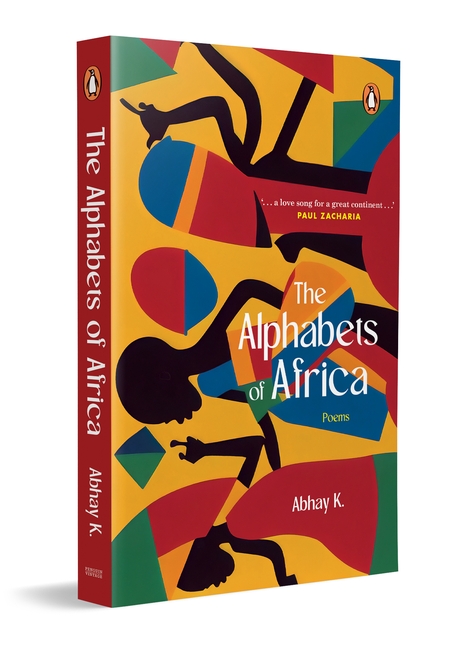
An ode to the cradle of humankind

Diplomat Abhay K.’s latest collection of poems explores Africa in all its diversity

GN Bureau | May 14, 2026


#Literature   #Culture  
(Photo: Courtesy https://commons.wikimedia.org/wiki/File:Africa_nature_16.jpg)

The Alphabets of Africa: Poems

By Abhay K.
Vintage Classics, 280 pages, ₹499.00
 
Abhay K. is a poet with a difference. In recent years, he has given us a number of translations (for example, Kalidasa’s Meghaduta and Ritusamhara), poetry collections, edited works, and more. His latest offering, The Alphabets of Africa, is “a cultural and literary exploration of the continent in verse.”
 
Reminiscent of his The Alphabets of Latin America (2020) in conception, this collection is an ode to a continent that cradled humankind and continues to define its story. Having often travelled across it during his diplomatic assignments, the poet recreates in exquisite short poems the myriad feelings of being in Africa. Through time, space, and memory, these poems map Africa, celebrating its vast and vibrant tapestry. From the splendour of its ancient civilizations to the pulse of contemporary African cities, this book summons the continent in all its depth and glory.
 
For most of us, Africa calls to mind many images and many stereotypes, but these alphabetically arranged 180 poems nudge us to see the continent afresh. The structure itself is a marvel of compression; Abhay employs a ‘monocle’ poetic style—brief, precise, and illuminating. In a unique stylistic choice, many of these poems are written in the first person. Rather than writing *about* his subjects, Abhay allows the icons and elements to speak for themselves. We hear from Shaka Zulu, narrating his rise from a mocked child to a brilliant military tactician, and even from the Coffee bean itself, describing its journey from the Ethiopian highlands to the cafes of the world.
 
“Africa is a continent with a rhythm of its own,” the poet notes. “Its diversity is immense. To know more about ourselves, we must learn more about Africa.” This sentiment is the heartbeat of the collection. Abhay consciously uses his verse as a rebuttal to the "Dark Continent" myth famously perpetuated by Joseph Conrad. In poems like “Light of Africa”, he uses an incantatory rhythm to flip the script, framing the land not as a place of shadows, but as the source of human enlightenment.
 
Abhay is as inspired by the sights, sounds, and smells of Africa as he is by its literary torchbearers—from Chinua Achebe and Wole Soyinka to Chimamanda Ngozi Adichie and other contemporary practitioners. In fact, the opening poem is on Abdulrazak Gurnah (I began writing/ out of homesickness…). There are poems on other great icons too—Nelson Mandela (I rose/ with the resolve/ to fight apartheid…), Desmond Tutu, and the legendary wealth of Mansa Musa.
 
Beyond the people, the collection performs a vital historical reclamation. It highlights achievements often overlooked by Western textbooks, such as the Narmer Palette and the peace treaty of Ramses II. By doing so, the book transcends being a mere travelogue; it becomes what critics have called a "biological pilgrimage." It reminds the reader that since *Homo sapiens* evolved in Africa, we all carry its genetic legacy within us.
 
The collection takes the reader on a safari through not only the continent’s history and geography, culture and politics, but also offers an opportunity to pause and wonder about the story of our race over the last 2,00,000 years. It is, quite simply, a homecoming in verse.

Comments


Other News

Beyond toilets: Why open defecation persists in rural India

Despite the awareness campaigns on sanitation across India, open defecation (OD) is practised openly and widely in both rural and urban areas. Research shows that rural respondents are well aware of the negative impacts of OD, yet this awareness does not lead to toilet construction or use. In rural North I

What unpaid nation builders want from policymakers

The Supreme Court recently described homemakers as “nation builders” and fixed a notional monthly income of Rs 30,000 for them in motor accident compensation cases. The judgment was not about wages. It was about compensation. Yet it inadvertently raised a larger economic question: If a homemake

What the US–Iran peace deal means for India

After months of rising tensions, the United States and Iran have reached a memorandum of understanding called the "Islamabad Agreement." This agreement allows for the immediate reopening of the Strait of Hormuz without tolls and provides Iran with relief from sanctions, depending on its complianc

V. M. Tarkunde: A legal luminary par excellence

14 Lawyers: Portraits from The Bar By Raju Ramachandran  Juggernaut, 248 pages, Rs. 799  

The Cost of Obesity

The latest episode of Checks and Balances focuses on the ticking time bomb of obesity in India, and Geetanjali Minhas of Governance Now spoke with a panel of experts. You can watch the episode here: https://youtu.be/mH

US-Iran deal: Path to peace or prelude to deeper regional quagmire?

In the midst of deep mistrust, the US and Iran are reported to have reached a framework deal for ending the West Asian conflict. But whether it will result in any meaningful breakthrough or pave the way for any lasting peace in the region, is in the realm of speculation.   During


Archives

Current Issue

Opinion

Facebook Twitter Google Plus Linkedin Subscribe Newsletter

Twitter