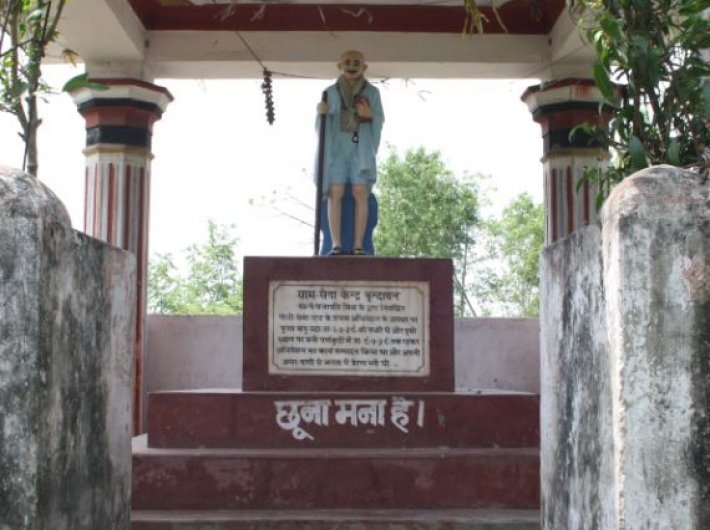
On April 10, 1917, Gandhi arrived in Champaran division of Bihar, to take up the cause of the indigo farmers. This was not only his first satyagraha after returning to India in 1915 but also his first major political campaign.
Read: Champaran Satyagraha and a long lost diary
It is as good an occasion as any to study this innovative method of political resistance which went on to be successfully replicated around the world. For help in that endeavour, here are some resources on Champaran:
BOOKS
‘My Experiments with Truth or An Autobiography’ by MK Gandhi
Gandhi devoted an unusually high number of eight chapters to this episode, narrating his side of the story. It takes barely an hour to read the first-hand account.
Read it online at the authentic Gandhi Heritage Portal
‘Champaran Mein Mahatma Gandhi’ by Rajendra Prasad
‘Satyagrah in Champaran’ by Rajendra Prasad
‘At the Feet of Mahatma Gandhi’ by Rajendra Prasad
Rajendra Prasad, who would become India’s first president, was the chief among the local leadership, in support of Gandhi’s movement. He penned his account of the campaign, Champaran Mein Mahatma Gandhi (in Hindi, translated into English as Satyagrah in Champaran). Also, his memoirs, At the Feet of Mahatma Gandhi, is a key resource.
‘My Times: An Autobiography’ by JB Kripalani
Kripalani, a one-of-a-kind political leader, first met Gandhi in Santiniketan where the Mahatma had gone soon after his return to India, but it was during the Champaran movement that the two came together and worked shoulder to shoulder. Kripalani was to join Gandhi in Ahmedabad after this, and take charge of his new university, Gujarat Vidyapeeth. The autobiography has only two chapters on Champaran but gives a unique perspective.
‘My Life is My Message’ By Narayan Desai
Any of the ten-odd better Gandhi biographies will do, but Narayan Desai’s four-volume work, translated from Gujarati into English by Tridip Suhrud, is more comprehensive – not only by its sheer size but also thanks to its holistic perspective. One chapter on Champaran in the second volume provides the best narrative, with some gems of information not found elsewhere.
'Gandhiji ke Champaran Andolan ke Sutredhar Rajkumar Shukla ki Diary' edited Bhairab Lal Das
Rajkumar Shukla, an indigo farmer, appealed to Mahatma Gandhi to visit Champaran. He maintained a diary that gives a fascinating and precise historical account of what happened then. From 2011, Bhairab Lal Das took one and a half years to translate the complete diary from Kaithi script to Devnagiri. “No publisher was ready to publish the edited diary and it was only in 2014 that a publisher agreed to publish it in the form of a book,” says Das. It is a rare first person account of an indigo farmer.
It is published by Kalyani Foundation
ONLINE RESOURCES
The Gandhi Heritage Portal, the authentic source on all things Gandhian, has a section devoted to the timelines of two Satyagrahas, Champaran and Kheda [apart from the Collected Works of Mahatma Gandhi, where a reader can follow Gandhi’s speeches, correspondence and much more through those eventful months].
The chronology of Champaran can be accessed here
The Bihar government has also done its bit (it is organizing a two-day seminar in Patna on April 11 and 12, which would start year-long celebrations of the historic event).
Here is what the East Champaran district website has to offer a curious reader.
Though he has nothing to say specifically on the Champaran satyagraha, he was born there, in Motihari, and remains a uniquely placed critic-yet-admirer of the Mahatma. George Orwell on Gandhi:
By the way, Gita V. Pai, a US-based historian, has an interesting take on Orwell’s essay on Gandhi, with nuggets of forgotten details:
Nehru Memorial Museum and Library is organising a two-day
seminar on the occasion on April 11-12, and also on April 27-28
The Indian Institute of Advanced Study, Shimla will
discuss Champaran on May 29-31.
ALSO READ MORE @ Governance Now