
Clean Money: Yet another follow-up to make the most of demo

Jaitley launches portal aimed at involving people in better tax administration

GN Bureau | May 17, 2017

#Arun Jaitley   #Finance ministry   #Economy   #Black Money   #Demonetisation   #Clean Money Portal  


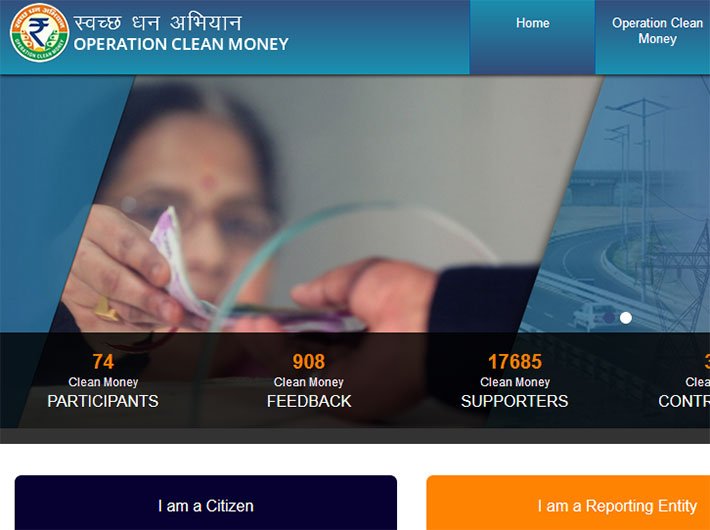
Trying to make the most of the demonetisation drive, the government has taken yet another follow-up step and launched an Operation Clean Portal. Its aim is to “enable citizen engagement for creating a tax compliant society and transparent tax administration”.

Finance minister Arun Jaitley launched the portal on Tuesday.

Citizens are invited to become ‘clean money participants’ (there have been 69 so far), and ‘clean money supporters’ (17,586 so far). Also, the government will share ‘clean money success stories’, presumably after some success.

The portal offers ‘clean money analysis’ – an overview of share of cash deposits made during the demonetisation drive period of November 9 to December 30 by various taxpayer and business segment categories.

Operation Clean Money was initiated by the income tax department on January 31 with the launch of e-verification of large cash deposits made during demonetisation period. In the first phase, around 18 lakh persons were identified in whose case, cash transactions did not appear in line with the tax payer’s profile, according to an official statement. There has been “an encouraging response” to the online verification process and more than 9.72 lakh taxpayers submitted their response without visiting income tax office up to May 12, 2017. 
These taxpayers have provided response for 13.33 lakh accounts involving cash deposits of around Rs 2.89 lakh crore. The online responses have been assessed and no further action will be taken in cases of satisfactory explanation.

The key features of the portal are:
 

  • Providing comprehensive information at one place consisting of step by step guides, frequently asked questions, user guides, quick reference guides and training toolkits related to verification process and other issues.


  • Enabling citizen engagement for creating a tax compliant society where every Indian takes pride in paying taxes.  Citizens would be able to support the Operation Clean Money by taking pledge, contribute by engaging and educating fellow citizens, and share their experiences and provide feedback.


  • Enabling transparent tax administration by sharing status reports (including sanitized cases and explanation of verification issues) and thematic analysis reports (e.g. taxpayer segment analysis of cash deposit data).


In the next phase the operation, the high risk cases will be handled by selecting appropriate enforcement action (verification, search, survey, scrutiny). A targeted campaign will be initiated in cases with identified risk issues. The key components of the targeted campaign are:


  • Communication of specific issue through digital channels (Email, SMS etc.)
  • Providing detailed explanation to create environment of transparency
  • Sharing investigation findings for specific segments (e.g. Jewellers, petrol pump, traders, property purchasers etc.)
  • Centralised monitoring and gradual escalation of inadequate response cases for enforcement action

Comments


Other News

How Rafi, Raj Kapoor helped pave the way for a great uranium deal

There`s a certain moment in diplomacy that`s too personal to be captured in a communiqué, too small to make the front page, but more revealing than the front page. This week, prime minister Narendra Modi reached Tashkent and, amid the pomp of state visits, managed to evoke the old Bollywood tunes

Distinguishing Fish 1 and Fish 2: The pragmatism behind India’s WTO ratification

 India became the 123rd WTO member to ratify the multilateral Agreement on Fisheries subsidies (AoFS) when it deposited the Instrument of Acceptance for Phase 1 on July 20, 2026. The ratification is restricted to disciplining Illegal, Unreported and Unregulated fishing (IUU), protection for overfished

The 7% growth problem: Why the next 7% will be harder

India has become accustomed to hearing the 7% growth number. It is now less a milestone than an expectation. Yet the paradox is becoming clearer: maintaining 7% growth may be considerably harder than achieving it once. India’s real GDP grew 7.7% in FY2025–26, following growth of 6.5% in FY202

The Constitution cannot be altered: Justice Abhay Oka

Justice Abhay Oka, who retired from the Supreme Court in May 2025, has said that the Constitution of India cannot be altered. Explaining the landmark Kesavananda Bharati judgment (1973) on the basic structure of the Constitution, he said, “This is one judgment that has saved democracy in India.&rdq

How the flora and fauna evolved in the Indian subcontinent

Mammals of India  By A.J.T. Johnsingh and P.O. Nameer HarperCollins India in association with Bombay Natural History Society  

India`s renewable race is moving beyond megawatts

When Shell bought Sprng Energy in 2022, India`s renewable energy market appeared to offer precisely what global energy majors were seeking: scale, growth and a place in one of the world`s largest energy transitions. Four years later, Shell is selling the same business to Aditya Birla Group for an enterpris

Upcoming Conferences


-->

Archives

Current Issue

Opinion

Facebook Twitter Google Plus Linkedin Subscribe Newsletter

Twitter






