Within a year of battling cyclone, the poor coastal state is ahead in precautions and preventions
Less than a year ago, Odisha, one of the poorest states in India, had shown the world how preparedness and efficient management could minimize human casualties. Before the category 4, severe tropical cyclone ‘Fani’ hit this eastern coastal state on May 3, 2019, the Naveen Patnaik government had successfully evacuated over 1.3 million people from possible danger pockets to the safety of cyclone shelters. They were served cooked food at those shelters. The entire operation was supervised by chief minister Patnaik.
While Cyclone Fani impacted over 16.5 million of the total 45 million-plus people of Odisha, the assessment report estimated the total damage and loss at Rs 24,176 crore. Casualties: 64. Meticulous planning, swift action and above all a solid political can, surely, saved thousands of lives.
Now, as the entire world is engaged in fierce battle against the new global enemy – the coronavirus pandemic, and the death toll continues to rise by thousands every day, Odisha has risen to the occasion again. Without taking chances, it started off early with a well laid-out, data-driven strategy to contain the spread of the disease and minimize Covid-19 cases. Experts world over say preparedness and prevention are the best ways to deal with the deadly COVID- 19.
As early as the first week of March, many days weeks before the first Covid-19 case was reported in the state on March 16, the state administration had put in place an ‘action plan’ to deal with the pandemic, set up a Covid-19 helpline number and on March 3, it launched a dedicated website, covid19.odisha.gov.in (the national portal came in later). It was made mandatory for all visitors of the state to register on the portal. An incentive of Rs 15,000 was announced for all those adhering to the government’s appeal of mandatory 14-day quarantine upon return from abroad.
Odisha is the first state in the country to extend the 21-day lockdown announced by prime minister Narendra Modi on March 24 up to April 30, and make it mandatory for its people to use of masks or ‘two layered cloth’ covering mouth and nose while venturing out of house. Non-compliance invited fine too.
As on morning of April 13, the number of Covid-19 cases in the state stood at 54; 12 of them back from hospitals, cured, and one dead.
“Prevention first is the mantra. Given our population and resources, it’s the best possible approach,” says a leading pulmonologist and critical care expert in the state’s capital city Bhubaneswar. “If cases spiraled, it would be extremely difficult to manage, we don’t have enough critical care manpower with us. Therefore, the focus is on how to minimize spread of infection,” said the doctor, who requested anonymity.
Not only doctors, citizens too, are all praise for the state’s initiatives in the coronavirus battle. “In terms of infrastructure, there is no comparison between the developed countries and Odisha. However, the one thing which I appreciate is the seriousness which has been shown by the Odisha government from the very outset. Many of the countries (hit hard by the pandemic) would have been better off today with a more decisive political leadership when the warning signs were clearly visible,” says Rangin Tripathy, an assistant professor at the National Law School, Odisha. Incidentally, Tripathy, a Fulbright-Nehru post-doctoral research scholar, was in home quarantine upon his return from the Harvard Law School, on March 16.
Instead of sealing an entire town or region, the state administration identified ‘Containment Zones’— clusters which are vulnerable to spread of the disease, and deployed multiple teams to carry out ‘active surveillance’ – door-to-door checks to spot and isolate Covid-19 suspects. “Cluster Containment’ means restriction in movement to and from this locality,” the Odisha government's chief spokesperson for COVID-19 management, Subroto Bagchi, said last week during his daily briefing. The civic authorities carried out sanitization of such pockets by spraying disinfectants on regular basis.
“It’s easier to blindly apply one uniform rule or solution to everyone without any regard to the context. Devising contextual solutions requires application of mind and a certain confidence in one's decision making. Being able to craft localized strategies is the key in such situations which I feel is defeated with a highly centralized command structure,” says Tripathy.
Along with strict preemptive measures, Odisha also simultaneously has strengthened the healthcare facility to meet this challenge. It grabbed national headlines for creating facilities with 1,000 beds in record time. Currently, seven Covid-19 hospitals with 1,547 beds are ready to treat, while efforts are on to ready 34 more hospitals with a combined capacity of 5,697 beds. In response to the government’s call, about 300 retired doctors have come forward to provide voluntary services to people with Covid-19 symptoms through the telemedicine helpline number.
Taking into account the stress and overtime efforts of those working in the health sector including doctors, paramedical staff and other healthcare workers, advance salaries of four months have been announced. And considering the terrible economic impact of the lockdown, at least on the poor, the state government ensured that it reached out to them in this moment of uncertainty.
While the union government’s announcement of an Rs 1.5 lakh crore package for the poor and the vulnerable groups amid the coronavirus lockdown, Odisha cleared an assistance package of Rs 2,200 crore for the poor. Citing that the outbreak of the coronavirus has significantly affected the livelihood of the poor, Patnaik has announced that all the beneficiaries of the food security scheme will be getting three months’ ration in advance and all the 9.4 million families under the programme will be getting Rs. 1,000 in cash assistance.
Moreover, under the social security scheme, four month’s pension allowance in advance has been announced for 4.8 million beneficiaries. The government has also extended assistance sum to the 2.2 million construction workers who are expected to be the most and immediately affected by the coronavirus pandemic.
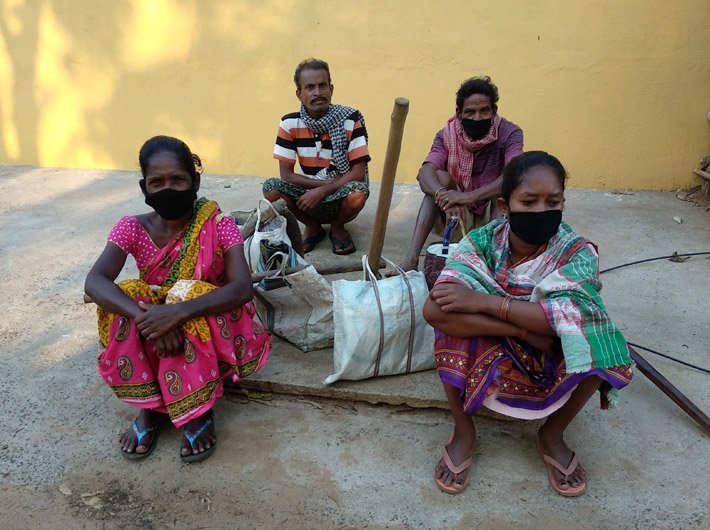
Surprisingly, though new to such restrictions, almost everyone is happy to adhere to the government advisory, covering faces seems to have become a newfound habit. It doesn’t matter whether it’s N95 masks or the surgical ones, handkerchiefs or locally available gamuchhas (cotton towels). “It’s for our good, we must follow the government’s instruction,” said a youth waiting outside a chemist shop in Bhubaneswar for medicine for his diabetic father.
Interestingly, in scores of villages across the state, the residents have put up barricades with wooden logs or bamboos at the entry and exit points. At places, the youths are guarding these points to prevent entry of outsiders.