
Reforms meaningful only if understood in proper perspective: Mundra

RBI’s prompt corrective action framework facilitates banks to take corrective measures to restore their financial health, said SS Mundra

geetanjali

Geetanjali Minhas | July 14, 2017 | Mumbai

#prompt corrective action   #banks   #RBI deputy governor   #SS Mundra   #Governance Now   #India Banking Reforms Conclave 2017  


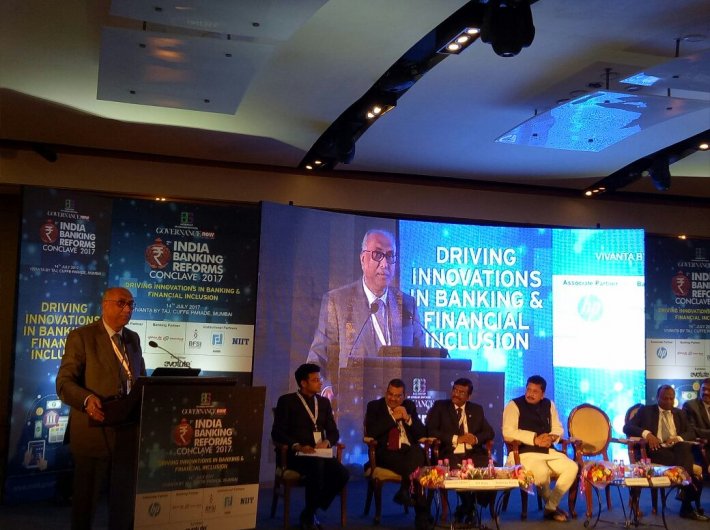
“Any intended reforms will be meaningful only if they are understood in proper perspective which all stakeholders have to value,” said RBI deputy governor SS Mundra while delivering his keynote address at the Governance Now, India Banking Reforms Conclave 2017, in Mumbai on Friday.
 
Mundra said that despite banks deploying best technology for securing their network, cyber attacks  have acquired unprecedented scale and complexity. 
 
He cautioned customers to use passwords protection provided by banks rationally and with responsibility. He added: “All security footprints of the person who has initiated the transaction can be captured in the system.”
 
Explaining PCA (Prompt Corrective Action) framework of the RBI, the top banking official said: “Sometimes the stake holders fail to appreciate the import of intended changes and get misled by the uninformed or at times motivated interpretations. The related aspect is the reaction of customers to such propaganda.”
 
He added: “PCA framework is one such supervisory tool which involves monitoring of certain performance indicators of banks as an early warning exercise. It is initiated on thresholds relating to capital, asset quality etc. Its objective is to facilitate for banks to take corrective measures including those prescribed by the RBI in a manner to restore their financial health.”
 
Mundra said though PCA Framework has been in operation since Decemeber2002, the April 13, 2017 guidelines are only a revision in the framework .
 
“The entire exercise is to restore the health of PCA bank through closer and expert engagement of our supervisory team with management of  such banks  for assessment of progress made.”
 
He explained that the amount of Rs 6 lakh crore lent to 10 companies/ individuals as mentioned by sections of the media may be exposure to certain groups of certain industrial conglomerates or several entities within the group, including SPVs. “It is too ad hoc to assume that all entities under in such a group are under stress and all would simultaneously default.”
 
He added that RBI being the regulator of financial sector is no way connected to lending by banks.


Comments


Other News

From one cow to a dairy business

In 2012, Anita Dash wasn`t dreaming of building a dairy brand. She wasn`t studying business models or planning market expansion. Like countless mothers across India, her focus was on something much simpler: giving her children a better future.   At the time, her most valuable

Ethanol blending: The two sides of a story

India`s crude oil consumption is estimated to be around 88.5% imported from abroad. This one single figure is also responsible for why ethanol has become both an economic strategy and fuel policy at the same time. In an economy like India, which depends so heavily on foreign oil, any increase in internat

Food inflation: Not a macroeconomic statistic but a developmental indicator

India`s retail inflation shows a reassuring picture at first glance. According to the latest data, Consumer Price Index (CPI) inflation edged up to 4.38% in June 2026 from 3.93% in May 2026, but continued to remain within the Reserve Bank of India`s (RBI) target band of 4% (+/- 2%). However, beneath this

Skin in the game or masterful market timing?

When a company founder opens their personal chequebook to buy shares in their own business, stock markets usually applaud. To the average retail investor, it feels like the ultimate vote of confidence, a sign that the people running the show have real skin in the game and believe brighter days are ahead.

India’s freedom struggle was shaped by wider Asian political thought

As we mark 80th anniversary of independence, ‘Asianism and the Fall of Empire’ (HarperCollins India) by historian Mithi Mukherjee offers a new perspective on Ind

What is colonialism? A relook at modern history

The Chromatic World Order: The Fiction That Rules Our World  By Sajid Mohamed Aakar Books  

Upcoming Conferences


-->

Archives

Current Issue

Opinion

Facebook Twitter Google Plus Linkedin Subscribe Newsletter

Twitter






