
One UPA idea NDA is not pursuing: women’s bank

Bharatiya Mahila Bank, launched in 2013, to merge with SBI

GN Bureau | March 21, 2017

#public sector   #Bharatiya Mahila Bank   #State Bank of India   #finance ministry   #NDA   #UPA   #Banking  
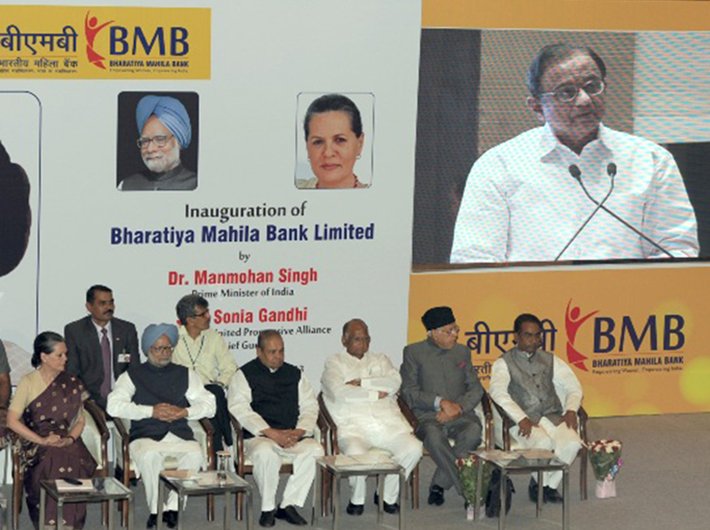
UPA inaugurating Bharatiya Mahila Bank in 2013

NDA has smartly appropriated a slew of UPA initiatives that it had opposed when in the opposition – from Aadhaar to DBT and financial inclusion. However, here is one initiative the government has decided to do away with: the women’s bank.

P Chidambaram had announced setting up of a bank catering exclusively to women in his 2013 budget. Bharatiya Mahila Bank (BMB), the youngest public sector bank, was launched on November 19, 2013, with registered office in Delhi and nine branches.

For the UPA government, BMB was part of its efforts to increase financial inclusion and empower women – and try out this one vote bank as well.

“The vision of the Bank has been empowering women financially. Hence our tagline - Empowering women, Empowering India. Keeping this in view, the Bank has developed a lot of women-centric products to suit to all categories of women right from a hawker at the roadside to a CEO of a big Corporate,” says the bank on its website.

And it has not done badly either. Over its three years, the bank set up 103 branches, covering almost all the states. Its total business reached a figure of about Rs 1,600 crore (Rs 1,000 core in deposits and Rs 600 crore of advances). When the whole public sector banking is suffering from the bad loan and NPA crisis, this bank was earning profit every year, and its NPA was less than one percent.

Usha Ananthasubramanian, its first CMD, had told Governance Now: “It is a huge societal transformation, because women who have been even shy to come out are able to come to a bank and ask for an account. In Indian society the man may earn and be the breadearner but ultimately it’s the woman who runs the household. It is the woman who aspires for improving the standard of living for the family. It is the woman who plans to send children to a better school, have better food, better clothing.

“I would say it is a blessing in disguise for the woman. All these years her money was kept in a masala box. She was hiding it from the man who would otherwise take it away. Only thing she did not know was that her money could multiply. Her Rs 100 can become Rs 105 or Rs 1,000. She never knew that a bank could help.”

However, on Monday, an official statement from the finance ministry said the government had decided to merge the BMB with the State Bank of India (SBI) “to ensure greater banking services outreach to a larger number of women, at a faster pace. The objectives of affordable credit to women as well as propagation of women-centric products need to be quickly achieved through a wider network and lower cost of funds”. 
The decision has been taken in view of the advantage of the large network of SBI among other things, the release said. In a way, the purpose of a women-centric bank is served better under the Pradhan Mantri Jan-Dhan Yojana (PMJDY), since it is increasing financial inclusion at a record-breaking pace. Under PMJDY, preference is given to women for overdraft facility. As many as 73 percent of the borrowers, under the scheme in previous financial year, were women.
 

Comments


Other News

When police data becomes the algorithm

For decades, policing has followed a familiar sequence: a crime occurs, the police respond, an investigation produces records and those records become part of the institutional memory of the criminal justice system. Artificial intelligence is beginning to alter that sequence. Instead of merely recording

Before India voted, the framers worried about the referee

“We are making a Constitution forever and not only for today.” Shibban Lal Saksena said this in the Constituent Assembly on June 15, 1949. He was warning that a ruling party might one day choose a loyalist to run India’s elections. Seventy-seven years later, the Supreme Court is wrestli

Delhi moves to real-time traffic management

The Cabinet Committee on Economic Affairs (CCEA), chaired by prime minister Narendra Modi, has approved implementation of the ITMS Project by Delhi Police at an estimated cost of Rs.1,789.52 crore, inclusive of taxes. The project will cover 42 identified traffic corridors and will be implemented in three

MDR on UPI: Can sustainability come without weakening the network?

The extraordinary transaction volumes and value (₹29.82 Lakh crore in August 2026 alone) of the Unified Payments Interface (UPI) have made it not only an Indian success story, but a global one. In 2024, UPI accounted for nearly 49% of the world’s real-time payment transaction volume, with more th

The Xi-Trump summit: The unending rivalry

Diplomacy is akin to an art, wherein the summitry, conflict resolution and negotiations form apt constituents of the entire context of deal making and “playing for keeps” in the international arena. The Xi-Trump summit in Washington last week, in which the American president broke all conside

“Indians, yet treated like outsiders”

Moving to Delhi-NCR for education can be an exciting experience for students from Northeast India. It gives us a chance to meet new people, experience a different culture and become more independent. But living away from home also comes with challenges that people who have not experienced them may not al


Upcoming Conferences


-->

Archives

Current Issue

Opinion

Facebook Twitter Google Plus Linkedin Subscribe Newsletter

Twitter





