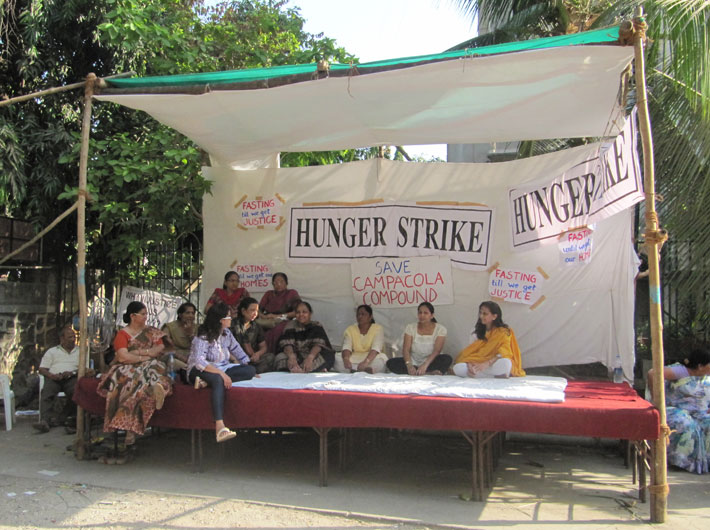
A day after the supreme court gave residents living in illegally constructed floors of a Mumbai residential complex five days to vacate the premises, we meet some of the on-notice residents, now on prayer mode after protests
As the Brihanmumbai Municipal Corporation (BMC) start the drive to evict residents living in illegally constructed floors of the Campa Cola compound in Mumbai’s upscale Worli area, we revisit an article we had done late April this year – when the matter was still in supreme court. The deadline set by the apex court for 986 residents to vacate their premises ended Tuesday (November 12).
It’s a day after the supreme court granted a temporary reprieve to owners of 140 flats in Campa Cola compound in downtown Mumbai, giving them five additional months to vacate their flats raised on ‘illegally constructed’ floors and make them ready for razing.
Passing an interim stay on demolition by the Brihanmumbai municipal corporation (BMC), an apex court bench led by justice GS Singhvi on Thursday refused to regularise all floors constructed in violation of the sanctioned plan. While the go-ahead was given for five floors, the buildings Midtown and Orchid, respectively, have 20 and 17 floors.
It’s a sunny and muggy Friday afternoon in Mumbai but it starts getting gloomier once you enter BG Kher Road (a bylane actually) at Worli Naka in central Mumbai. It appears post-monsoon gloom, when the city’s weather is at its sticky and muggy worst, as you step inside the otherwise plush-looking Campa Cola compound. In it, almost every conceivable space approached by hand has gone under handwritten bills and printed posters, protesting the imminent eviction.
“Fasting till we get justice,” ”Where do we go?” ”Save Campa Cola compound”, the posters declare on an erected platform on which several women are sitting on a hunger strike.
There are many others sitting or milling around — all wearing the same tense look on their face. Posters elsewhere say “Heights of corruption. Where do we go? Arrest us, put us in jail, we have nowhere to go,” giving out the mood among the residents of the seven buildings in the precincts.
On the 14th floor of 17-storey Orchid live Ashok and Rekha Parekh, residents for the last 20 years, say they bought the flat from builder and promoter Mohammed Yusuf Patel, who, Ashok says, had assured them of handing over the occupancy certificate (OC) soon enough.
“He (Patel) asked us to pay in installments — initially on bhoomi pujan, then on completion of stilts and as the construction proceeds ,” Ashok, 59, says. “But we never got the OC. If the flat was illegal why did they (civic body) register it and take stamp duty on it?”
Livid and concerned at the same time, wife Rekha narrates the crisis they had to go through to buy this flat: “We had been thrown out of house by my husband’s elder brother and had to quickly arrange Rs 20 lakh to move into this flat. One day we received a call from the builder asking for Rs 2 lakh as installment. We mortgaged my jewellery since we did not have that kind of money at the time.”
Calling it the builders’ and BMC’s “mistake”, Rekha, 59, says the civic body should have razed the additional illegal floors immediately after it learnt that builders had constructed in excess of five floors. “But they kept quiet,” she says, alleging that money exchanged hands to buy that silence.
Nowhere to go
“Now where will we go? We cannot take a house on rent since my husband is not working for the last 10 years or so. All our life’s savings have gone into educating and then sending our two children abroad. Today we make do with money our sons send us from abroad,” Rekha says. “This house is now valued at Rs 3 crore. How can we leave this house? If this is demolished we have nothing to depend on — no ornaments to sell, no money for rent or for livelihood.
“And my husband cannot work at this age.”
Stressing that the residents had requested the BMC to hold a review and were ready to pay Rs 5-10 lakh to get the flats regularised, Rekha says, “There are families with babies — some as young as seven months old — and people who are nearly 90 years old. Where will they go? Should we all sleep outside the BMC building?”
Rekha argues that the government spent crores of public money on Mumbai attack convict Ajmal Kasab’s upkeep. “But what about us?” she asks.
Pointing at a completed building next to theirs, Ashok says that one is lying vacant due to violations by the builder. He says even Adarsh housing society, which houses many VIPs, has had its share of violations and alleged acts of omission and commission but no one is calling for its demolition. “Our building has been home to so many families for the last 25 or years and we were paying Rs 16 lakh annually as property tax for this building alone, which has now been increased to Rs 32 lakh from this year, and yet they (corporation) is eager to raze it,” he says.
A neighbor from the adjacent flat, who had walked in through the open main door during our conversation and was eagerly listening, pitches in at this juncture, pointing out that filmstar-activist Shabana Azmi had intervened and saved the adjacent slums when the BMC was going to demolish them a few years ago. “When the government cannot demolish a ‘zoparpatti’(slum) how can they demolish a constructed building and throw out people living there for two and half decades?”
At this point, another resident comes and warns them to shut the door and not respond to doorbell since the police are serving notices under section 149 of CrPC (maintaining law and order during demolition).
The Parekhs decide to lock the house and go down; Rekha wants to visit the temple for “divine intervention”.