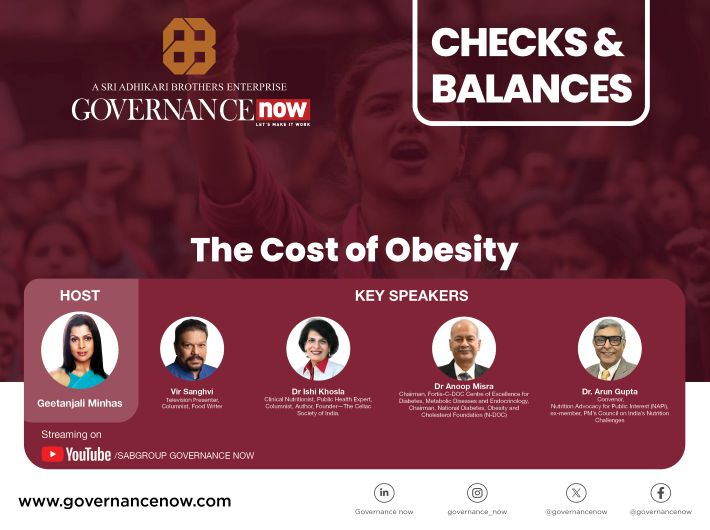
Checks and Balances: Leading experts examine how abdominal obesity, ultra-processed foods and changing lifestyles are accelerating a nationwide surge in obesity and metabolic disease and what must be done to reverse the trend
The latest episode of Checks and Balances focuses on the ticking time bomb of obesity in India, and Geetanjali Minhas of Governance Now spoke with a panel of experts. You can watch the episode here: https://youtu.be/mHOSeQ2g54Y?si=Utopj1jGqu0hRoIR
Here are the edited comments from the experts:
Dr Anoop Misra, chairman, Fortis-C-DOC Centre of Excellence for Diabetes, Metabolic Diseases and Endocrinology; chairman, National Diabetes, Obesity and Cholesterol Foundation
India’s obesity crisis is increasingly understood as a metabolic and environmental disorder rather than a simple issue of body weight. Research led by Dr. Anoop Misra, led consortium of experts found that BMI alone fails to capture the risk in the Indian population, where diabetes and metabolic diseases occur at lower body weights. While WHO standards define overweight at BMI 25 and obesity at 30, Indian studies show the risk begins at BMI 23. Hence, Indian cut-offs were lowered to BMI ≥23 for overweight and ≥25 for obesity. Subsequently, Dr. Misra's most influential contribution was determining appropriate waist circumference or abdominal adiposity as key drivers, for which cut-offs for Indians were set at ≥90 cm for men and ≥80 cm for women.
Dr. Misra explains that Indians tend to have a “high-fat, low-muscle” phenotype due to historical undernutrition and food insecurity, resulting in lower muscle mass and higher abdominal fat storage. This increases susceptibility to diabetes, fatty liver disease, cardiovascular disease, and other metabolic disorders.
This biological vulnerability is now intensified by a rapidly changing food environment. Cheap, calorie-dense ultra-processed foods, sugary beverages, and packaged snacks dominate diets due to their low cost, convenience, taste, and aggressive marketing. Healthy foods, though affordable, are often less recognised or less accessible.
A growing concern is fatty liver disease, now increasingly seen in children due to sedentary lifestyles, excessive screen time, and consumption of processed or fried foods. Dr. Misra stresses that obesity is not only fat accumulation but also muscle loss, requiring both aerobic and resistance exercise for effective management.
He further calls for systemic reforms including clear front-of-pack labelling, taxation on sugary drinks and unhealthy oils, and subsidies for fruits and vegetables. He highlights gaps in medical training and warns against overreliance on weight-loss drugs without lifestyle change.
Dr. Misra also advocates long-term national action, school-based interventions, and community participation. Ultimately, obesity is linked to over 50 diseases including diabetes, fatty liver, hypertension, heart disease, obstructive sleep apnea, polycystic ovarian disease, gall stones, different types of cancer etc., and demands urgent prevention-focused policy, behavioural change, and coordinated public health action.
Dr. Arun Gupta, paediatrician, public health expert and convenor of Nutrition Advocacy in Public Interest (NAPi)
India is facing a rapidly evolving nutrition crisis where undernutrition and obesity now coexist, driven largely by the growing dominance of ultra-processed foods (UPFs), according to paediatrician and public health expert Dr. Arun Gupta. He argues that while traditional public health efforts focused on stunting and wasting, the country is now witnessing a parallel surge in overweight, diabetes, and diet-related chronic diseases.
Dr. Gupta distinguishes traditional diets from industrial food products, noting that UPFs—packaged, factory-made items high in sugar, salt, and unhealthy fats—are engineered for taste, profit, and overconsumption. These products, often designed around the “bliss point,” are aggressively marketed and increasingly displacing home-cooked meals across both urban and rural India. As a result, obesity is no longer confined to affluent populations.
Citing NFHS-5 data and international research including ‘The Lancet’, he highlights a clear link between rising UPF consumption and increased risks of obesity, diabetes, cardiovascular disease, and cancer. Misleading packaging such as fruit images on sugary drinks further confuses consumers, while star-rating systems fail to communicate specific risks like sugar or sodium content.
Also analyzing the recently released NFHS-6 data, public health experts warn that high sodium, unhealthy trans-fats, and chemical emulsifiers in UPFs damage blood vessels, compounding the risk of hypertension, stroke, and heart attacks.
Dr. Gupta calls for strong policy action, including mandatory front-of-pack warning labels, restrictions on advertising especially targeting children and taxation of unhealthy foods. He argues that self-regulation by industry has consistently failed and that government intervention is essential to protect public health.
He also emphasizes early-life interventions such as breastfeeding, school-based nutrition programs, and hospital policies that avoid junk food sales. While acknowledging India’s rich dietary diversity, he stresses that prevention must take priority over treatment, warning against overreliance on medications or individual choice in an environment heavily shaped by marketing and availability.
Ultimately, Dr. Gupta frames India’s obesity crisis as a systemic failure of food environments, not individual willpower, requiring urgent regulatory, educational, and cultural shifts to reverse current trends.
Dr. Ishi Khosla, clinical nutritionist, author, public health expert
Dr. Ishi Khosla also presents obesity as a complex metabolic and lifestyle disorder that extends far beyond Body Mass Index (BMI), emphasizing that central or ‘apple shaped’ obesity is particularly harmful due to its strong link with inflammation and metabolic disease. She too notes that many Indians may have a normal BMI yet carry excess abdominal fat, significantly increasing risks of diabetes, hypertension, heart disease, high cholesterol, and metabolic syndrome.
According to her, obesity management fails when treated as a short-term diet rather than a lifelong behavioural shift. ‘A diet simply is a way of life,’ she states, underscoring the need for sustainable lifestyle changes, long-term planning, behavioural modification, and a holistic understanding of health beyond weight loss. She cautions that weight-loss drugs such as GLP-1 therapies are not standalone solutions, as weight regain is common after discontinuation, repeated cycles may raise the body’s weight set-point, and muscle loss during rapid weight reduction is often overlooked. True progress, she argues, depends on addressing root behavioural causes.
Dr. Khosla, who founded the Celiac Society of India and is the trustee of Food Future Foundation, highlights the broader ‘food industry vs health industry’ disconnect, where food systems, agriculture, and ultra-processed foods contribute significantly to disease, while healthcare focuses mainly on treatment.
A central theme in her work is gut health: the microbiome regulates nutrient absorption, metabolism, immunity, and gene expression. Disruption leads to “leaky gut,” chronic inflammation, and a wide spectrum of conditions ranging from obesity and diabetes to autoimmune diseases, mental health disorders, and cancer.
She draws attention to India’s ‘double burden’ of malnutrition, where undernutrition and micronutrient deficiencies coexist with rising obesity, particularly among children and adolescents. She attributes this to poor diet quality despite food availability, stating, ‘We have food sufficiency but nutritional insufficiency.’
Her framework for intervention includes the ‘Three I’s’—inflammation, insulin resistance, and individualisation—and the ‘4G Code’ focusing on gut, girth, grains, and glucose. She also advocates the ‘Three P’s’ of dietary planning: planning, protein-first meals, and protective foods such as fibre-rich vegetables, fruits, and fermented items, while limiting processed foods, sugar, salt, and trans fats.
Dr. Khosla calls for stronger government action, improved professional training, and early-life interventions, warning that rising childhood obesity and diseases like fatty liver and PCOS reflect deeper systemic failures in diet, environment, and public health awareness.
Vir Sanghvi, journalist, food writer
India’s obesity crisis, according to the veteran journalist, television presenter and food writer, Vir Sanghvi, is increasingly being driven not by traditional diets or restaurant culture, but by the rapid rise of ultra-processed foods (UPFs) that are reshaping everyday eating habits across the country.
Sanghvi argues that India has moved beyond a problem of hunger to one of poor nutrition, where rising incomes, improved food access, and reduced undernutrition have been accompanied by a surge in unhealthy dietary patterns. The central concern, he notes, is not western fast food chains but packaged snacks, ready-to-eat meals, and industrially manufactured foods consumed at home. As dual-income households increase and cooking time declines, convenience-driven food choices are becoming dominant.
He highlights that UPFs are expanding rapidly due to convenience, low cost, long shelf life, and mass production advantages. This shift is no longer limited to metros but has penetrated Tier-II and Tier-III cities as well as rural markets, making it a nationwide phenomenon. A key concern is the high levels of hidden sugar and salt in packaged foods, often masked in products perceived as savoury or healthy. Beyond nutrients, he warns that heavy processing, additives, and artificial ingredients fundamentally alter food structure and health impact.
Sanghvi also points to aggressive marketing strategies, including on television, digital platforms, and child-targeted advertising through cartoons, packaging, and promotions. He argues that children are increasingly shaping household consumption patterns under advertising influence.
To address this, he supports clearer front-of-pack warning labels, stricter regulation, and sugar taxes, comparing the challenge to past tobacco control efforts. However, he believes industry self-regulation is unlikely due to profit incentives, making government action and public advocacy essential.
While acknowledging emerging GLP-1 weight-loss medications as useful medical tools, he stresses they cannot replace broader food system reform. He distinguishes between ‘good food’ that is freshly prepared and industrial food designed for scale and shelf life, arguing that restaurants are not the problem – packaged foods are.
Sanghvi believes that healthier eating need not be expensive, and advocates simple home-cooked meals and practical principles such as choosing fresh food, applying the ‘grandmother test,’ and preferring food ‘from plants, not factories,’ with moderation rather than restriction as the guiding principle.