In his debut book, Raju Ramachandran presents portraits of 14 extraordinary lawyers
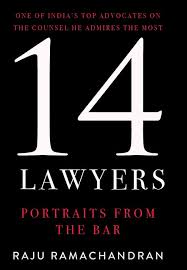
14 Lawyers: Portraits from The Bar
By Raju Ramachandran
Juggernaut, 248 pages, Rs. 799
 Raju Ramachandran, one of India’s leading advocates who served as amicus curiae to the Supreme Court in numerous high-profile and sensitive cases, has written an unusual first book. He asks: What separates great lawyers from ordinary ones? Is it brilliance, fearlessness in the face of power, quiet discipline, or a resilient devotion to justice? He selects 14 extraordinary lawyers who shaped the Indian bar, and devotes a chapter each to profiling them. Thus, the reader is introduced to some of the greatest legal minds of post-Independence India. They are: Frank Anthony, Tehmtan Andhyarujina, V.M. Tarkunde, Barry Sen, S. Govind Swaminadhan, R.K. Garg, Gobinda Mukhoty, Lal Narayan Sinha, Shyamala Pappu, M.K. Ramamurthi, Nirmal and Kapila Hingorani, S.N. Kacker and Dipankar Gupta.
Here is an excerpt:
V. M. Tarkunde
A little before I joined the Law Faculty as a student in July 1973, momentous events took place in the Supreme Court. The judgment in the Kesavananda Bharati case had been delivered on 24 April. Within three days (on 26 April), Justice A.N. Ray was appointed Chief Justice of India, superseding three senior judges (J.M. Shelat, K.S. Hegde, and A.N. Grover) who were part of the majority – basicstructure wallahs. I was a little confused, not knowing which side to take. I attended public meetings organized by both the pro- and anti-supersession groups, and I frequently changed my mind.
It was at one of the anti-supersession meetings that I first saw and heard V.M. Tarkunde, who had been in practice for just four years in the Supreme Court after resigning as a judge of the Bombay High Court in 1969. Unlike the other speakers, he was not fiery. In a calm and dispassionate voice, he warned that this was only the beginning, and that we could expect worse attacks on the independence of the judiciary.
I was to hear more of him later, as I progressed through my three years in the Law Faculty. The JP movement had gathered steam in 1974, and I began to read and hear more about Tarkunde as he started the group Citizens for Democracy with Jayaprakash Narayan, its first president. Tarkunde was its general secretary (and he later became its president). On 12 June 1975, the Allahabad High Court delivered an unexpected judgment, setting aside the election of Indira Gandhi on the ground of corrupt practice in a petition filed by her electoral opponent, Raj Narain. She appealed to the Supreme Court and on 24 June 1975, Justice V.R. Krishna Iyer, the vacation judge of the Court, passed a balanced interim order by which she could continue as prime minister but could not exercise the rights and privileges of a Member of Parliament. The very next day, on 25 June, Indira Gandhi’s government declared a state of emergency. Tarkunde was one of the prominent lawyers and public intellectuals leading the struggle against the Emergency. In September 1976, when I was just two months old in practice, the Peoples’ Union for Civil Liberties (PUCL) was formed, with Jayaprakash Narayan as president and Tarkunde as its working president.
I began seeing Tarkunde in court regularly and got to know more about his fascinating life and work, for which I developed huge respect. I can’t honestly say that he was my favourite counsel, because in those days one looked for charisma, which he singularly lacked.
Vithal Mahadeo Tarkunde was born on 3 July 1909, in Saswad, Pune district, as the second of five children of Mahadeo Rajaram Tarkunde – himself a popular lawyer and social reformer, a Brahmin who had fought against the practice of untouchability. Mahadeo Tarkunde had his volume of the Code of Civil Procedure transcribed by hand because he could not afford to buy the book. In the matriculation examination of 1925, Vithal Tarkunde stood first in the Bombay Presidency and also won the Jagannath Shankarsheth Scholarship for Sanskrit. With his academic record, he could have chosen to study any subject, but with his already well-formed understanding of the Indian economy, he decided to study agriculture in Pune, because he believed that for an understanding of India, one needed to understand agriculture. In my entire career, I have come across only one other lawyer with a B.Sc. in Agriculture, and that is my friend Naveen Kumar who is a leading mining lawyer.
Compared to Calcutta, barristers were not so common in Bombay, and certainly not in Pune. Tarkunde went to London to qualify as a barrister, which he did from Lincoln’s Inn. While in London, he had attended lectures in economics, political science and social anthropology at
the London School of Economics as an external student. He returned to India in 1933 and started practice in Pune.
He did social work in villages in the Pune district, having joined the Congress Socialist Party (a socialist caucus of the pre-Independence Indian National Congress) on his return from England. He also became a member of the All India Congress Committee in 1938. In 1936, he met M.N. Roy (1887–1954), who became his mentor. In January 1942, he quit legal practice to work fully for the Radical Democratic Party started by Roy and was its general secretary from 1944–1948. The party itself was dissolved in December 1948 because Roy came to believe that party politics was antithetical to genuine democracy.
Tarkunde married Dwarka (later known as Chitra) Walimbe, a graduate of Fergusson College, Pune, on 25 December 1940. She soon became his comrade-in-arms, involved in every aspect of his social and political work. After giving up party politics, M.N. Roy started the Radical Humanist movement and Tarkunde was deeply involved in it.
Roy evolved through three distinct phases of political life – a militant nationalist, an ardent communist and ended as a creatively active radical humanist. He had evolved the philosophy of ‘Radical Humanism’, to which Tarkunde subscribed and contributed. Here’s what radical humanism means. It is a philosophy and an attitude of mind which gives primacy to the individual, and recognizes one’s right to live in freedom and with dignity. Its basic tenet is that the individual is the measure of things, that he is an end in himself and is not the means to any superior end. Radical Humanism did not claim to be a new philosophy but is based on the age-old values of humanism. The difference is that it does not derive its inspiration from any superior being or supernatural phenomena.
Tarkunde in his book Radical Humanism writes in its Foreword: ‘From its inception, I felt Radical Humanism to be my own philosophy. The feeling has become a conviction during the years which have elapsed since the basic tenets of philosophy were formulated. It has become an integral part of my thinking, and since I have been living by that philosophy all this time, it has acquired new facets which I hope have enriched it.’
After a gap of six-and-a-half years, in July 1948, Tarkunde resumed his legal practice. Considering his beliefs and commitments, the practice to which Tarkunde returned was not ‘posh’. His clients were mainly from the working class and underprivileged sections of society. The Tarkundes lived in a small flat in Girgaum. His daughter, Manik Karanjawala (Founding Partner, Karanjawala & Co.) remembers that the apartment block had a common bathroom for all residents, separate from the building. Tarkunde used the flat as his office and at night, the work table would be converted into a dining table. He soon made a mark in the legal profession and within seven years of resuming practice, he was asked by the legendary Chief Justice M.C. Chagla to join the bench.
Objections were raised to him being elevated because of his political past. Chagla put his foot down and ensured his appointment, taking the view that a lawyer without political beliefs was not worth his salt. Tarkunde proved to be a bold and independent judge, and came to be described as the best judge of the Bombay High Court in the post-Chagla era. But he was quite strict and so, not hugely popular.
[The excerpt reproduced with the permission of the publishers.]