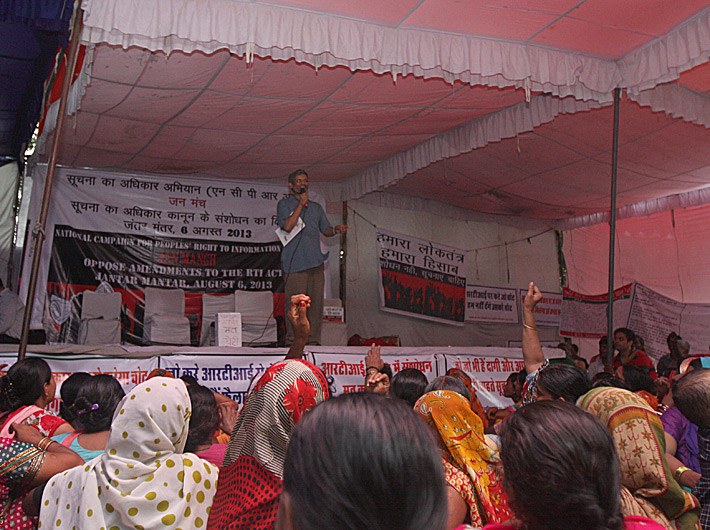
As expected, leading political parties shied away from supporting a campaign by RTI activists opposing a move to exclude these organisations from the transparency law.
Only the Communist Party of India (CPI) and Aam Aadmi Party (AAP) sent representatives to the open meet at Jantar Mantar on Tuesday. Organised by the National Campaign for People’s Right to Information (NCPRI), the forum was addressed by activists Aruna Roy, Nikhil Dey, Anjali Bhardwaj and Subhash Chandra Agrawal.
D Raja of CPI said that though the party did not agree that it was a ‘public authority’ under the RTI Act as decided by the central information commission (CIC), it was open to discussion.
It was AAP that was unambiguous in its stance, as its leader Manish Sisodia said it did not want any amendment in the RTI Act. “The government has not yet worked on so many pending bills. Instead of that, it has introduced an amendment in the RTI Act. AAP is an open and transparent party and we are ready to give all details of our funding,” he told the activists.
Also read: Govt slammed for sheilding parties from RTI Act
The issue at stake is whether political parties come under the transparency law or not. RTI activist Subhash Chandra Agrawal and Anil Bairwal of the Association for Democratic Reforms (ADR) had approached various parties seeking details of their fundings, but the parties refused to do so, prompting them to approach CIC.
The CIC in its June 3 order had said that six national parties – Congress, BJP, NCP, CPM, CPI and BSP – are ‘public authorities’ under the RTI Act, and thus would have to reveal any information sought by people, since they have been substantially funded indirectly by the central government.
As the leading parties in near unison opposed the verdict, the union cabinet on August 1 cleared amendments to the law exempting political parties. The amendments are expected to be introduced in the ongoing session of parliament.
Activist says this is yet another attempt to dilute the revolutionary law. Since its implementation in 2006, they have vocally criticized several attempts by the government to restrict transparency and accountability. But despite promising the consultation with NGO and social activists, the government has gone ahead and cleared amendments without any dialogue.
The activists want that the government to talk with NGOs – just like it did with political parties –before the amendments are introduced in parliament. They also maintain that the political parties must not be exempted to come under RTI’s ambit.
Agrawal, on whose petition CIC had given the order, said, “The political parties say that they give details of their funding to the election commission but in reality only 20 percent of their funding detail reaches there. They could have approached the court against the order. But they have their apprehension and opted to amend the act itself.”
RTI activists from various states attended the forum and pressed the demand for protecting the sanctity of the RTI Act. They slammed the government for its half-hearted attempt at transparency.
Anjali Bhardwaj, co-convener of NCPRI, said they were demanding pre-consultations on any change being made to the law. “This was promised by the government. The government and political parties have absolutely no business to bring changes without consultation,” she added.
The activists have been holding protests across the country, Bhardwaj said. She added that if needed they would approach courts. “They cannot take away the fundamental right to know from people.”