
‘Debating Swaraj’, a collection of essays by eminent thinkers, extends the concept to various aspects of the political community
GN Bureau | December 26, 2025

Debating Swaraj
Edited by Dhananjay Rai
Orient BlackSwan, 227 pages, Rs 1155
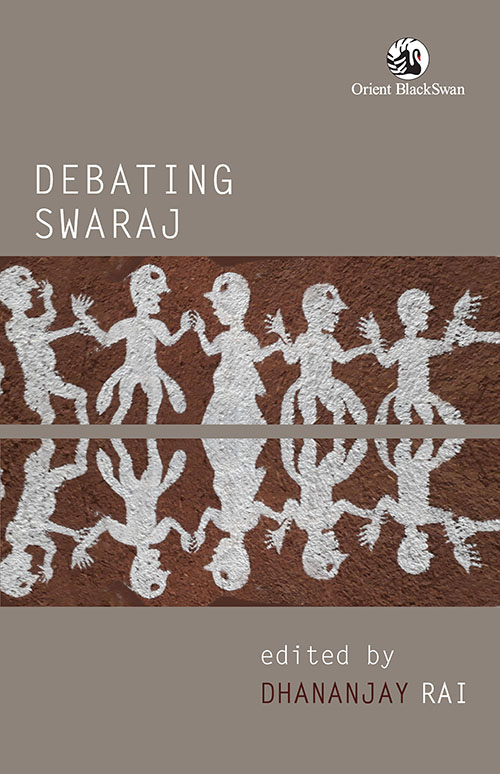 For ‘freedom’, Gandhi’s preferred term was ‘Swaraj’, the self-rule and the rule over the self. ‘Debating Swaraj’, an anthology of essays by eminent thinkers, studies Gandhi’s notion of swaraj as a ‘living concept’, and extends it to various aspects of the political community. It seeks to understand political community by juxtaposing the state/government with the increasingly blurred distinction between peoples’ participation and decision-making on behalf of the people.
Studying Gandhi’s view of swaraj as a ‘living alternative’ for current times, ‘Debating Swaraj’ offers a detailed interpretation in a manner that reclaims the centrality of the people in a nation-state. Gandhi believed that real swaraj is not majoritarianism; it is rule by the people for justice. Taking this as the point of departure, the authors, who hail from diverse fields in the social sciences and Gandhian Studies, construe swaraj as a shared responsibility for collective living.
The anthology includes: ‘Swaraj and Sovereignty’ by Anuradha Veeravalli, ‘Gandhi’s Swaraj: A Revisit’ by Sudarshan Iyengar, ‘Hind Swaraj: Metaphors of Political Community’ by Dhananjay Rai, ‘Gandhi, Economics and Welfare’ by Prabhat Patnaik, ‘Spinning the Swaraj: Technology, Science and Experience in the History of the Spinning Wheel’ by Sadan Jha, ‘Swaraj and Nai Talim: Notes on Self-sufficiency’ by Deeptha Achar and ‘Reading Texts and Traditions: The Ambedkar–Gandhi Debate’ by Valerian Rodrigues.
The collection begins with an essay by philosopher Akeel Bilgrami, a portion of which is reproduced here:
A Genealogical Reading of Gandhi’s Critique of Modernity
By Akeel Bilgrami
Modern life is beset with distinctive anxieties. That, if true, suggests that the Early Modern period of history and intellectual history is an appropriate focus for a genealogical diagnosis of the conditions in which and with which we now live and cope. This is a methodological instinct shared by thinkers and sensibilities as diverse as J. J. Rousseau, Karl Marx, T. S. Eliot, and M. K. Gandhi.
I look to Gandhi among these for my initiating framework because the seemingly miscellaneous themes that I want to integrate in this chapter are all present with something approximating the requisite integrity in Gandhi’s ideas. By comparison, Eliot’s interests are far too narrow, Rousseau has no real grasp of the colonial condition, and though all the conceptual elements are certainly there in Marx, the abiding disservice done by Louis Althusser’s distinction between an early and late Marx makes miscellaneous the very things I want eventually to integrate. But I am getting ahead of myself; at this point, I merely want to briefly motivate my interest in Gandhi’s ideas and the urge in him to give them some genealogical depth.
Although ‘Hind Swaraj’ presents a critique of what Gandhi summarised in such portentous terms of generality as ‘modern Western civilization’, its themes are very diverse and range vastly over (to name just a few): the political economy of capitalism; the deracination of education in India from its roots in living and making to a set of intellectually distanced cognitive enterprises (what came to be called ‘disciplines’), pursued not just in an imposed natural language but an imposed ideological repertory remote from the conceptual vernacular; the social effects of the introduction of railways in India; the transformation of the public aspects of moral life into a lawyer’s professional domain; the effects of modern medicine in shifting the notion of the body into a site not of health understood as an equilibrium of meaning and emotions, but in purely corporeal terms of near-forensic diagnosis and detached treatment and cure (Gandhi 1997). The relation between the general nature of the critique and this diverse thematic breakdown needs to be put in a proper historical and interpretative framework before it can be philosophically understood and politically motivated. And this, I believe, eventually requires, as I stated above, a genealogical reading of the text, which I try and provide, leaving a detailed analysis of the text itself to another occasion.
Let me begin with a frameworking interpretative remark.
In the first decade of the last century when Gandhi wrote ‘Hind Swaraj’, he was convinced that (a) ‘modernist’ ideological voices (like the Hindu ideologue V. D. Savarkar’s, for instance) were wrong to think that there was something inevitable about the idea that India must go down the path of nationalist modernity set by the post-Westphalian ideal in politics and, equally, that (b) all the voices of the Right and Left around him in the Congress party and beyond were wrong to think that there was something inevitable about the path that political economy in Europe in the late seventeenth century was on. There was passion in his scepticism regarding all these voices as well as a quiet desperation about not losing his people and his country to the future they envisioned.
All this makes poignant his intellectual efforts to understand the cast of mind that made such a future seem inevitable. He wished for an exorcism of such a cast of mind, but for that to happen we first need to come to some genealogical understanding of it. In Gandhi’s view, India, in his time, stood at the sort of cusp that an accurate genealogy would trace back to and properly identify with our term ‘Early Modernity’, if it was not so laden with the air of forward historical movement towards a teleological end. Were it possible to speak that term in an entirely innocuous and neutral tone, as a pure descriptor of a time in Europe that left it entirely open which way things would turn out, then Indian society was indeed properly describable by the term in the much later chronological time in which he lived.
His own approach to such a genealogy was to ask a question of profound importance, a question whose central theme, he thought, provided the metaphysical basis upon which his more specific economic and political themes were to be integrated: How and when did the concept of nature get transformed into the concept of natural resources?
The precise idiom in which I have posed this question is mine, not Gandhi’s. For complicated and ambitious intellectual reasons, he would ask it differently. Like Martin Heidegger, he preferred to talk of the ‘world’ rather than of ‘nature’. And though, like Heidegger, he must have known that the word ‘world’ was a term of art, he did not want it to be more abstract and rarefied than is found in our most ordinary talk about the world. That is to say, in a crucial commitment, perhaps more Ludwig Wittgenstein’s than Heidegger’s, he was drawn to the idea of, as Wittgenstein would put it, ‘leaving the world alone’.
That last phrase (and thought) needs elaborate interpretation and, in a way, the rest of this chapter will obliquely be devoted to it. At first sight, the phrase might give the impression of quietism. That impression would be wrong. Quite apart from the fact that (far from quietist) Gandhi was an activist of unique genius, his view of what the phrase might mean amounted to a wholesale resistance to many of the admired orthodoxies of the Enlightenment.
Let me explain.
It is well known that Gandhi showed a studied indifference to the familiar principles and codes and rights that defined the Enlightenment. Commentators often ask why this was so and give a disappointingly insufficient answer, drawn from a cursory look at some of his least interesting writings. Their answer to his indifference is that those things are alien to Indian culture and society.
The real grounds for Gandhi’s indifference went much deeper because, in his view, all these principles and codes and rights stand supported by a much deeper and more underlying commitment that is usually unspoken. Indeed, I would go so far as to say that it may be the deepest commitment of the Enlightenment: that even though we are capable of bad things, the bad in us can be constrained by good politics. Gandhi simply did not believe this.
[The excerpt reproduced with the permission of the publishers.]
Mumbai’s real estate market keeps growing, yet homeownership remains out of reach for much of its population. Three experts – urban researcher Hussain Indorewala, urban planner Vidyadhar Phatak and developer Kamlesh Thakur of NAREDCO Maharashtra, agree that simply constructing more apartments
US secretary of state Marco Rubio has said he was unfamiliar with the Wall Street Journal report suggesting Elon Musk had decided to throttle Starlink services in Ukraine, but rejected claims that Washington had ordered the restrictions to pressure Kyiv. “There was no
Breast cancer has become a public-health challenge in India. The greatest opportunity is to find cancers earlier. Artificial intelligence (AI) is opening a new era in breast cancer detection. AI systems can analyse mammograms and other breast-imaging studies, identify subtle abnormalities and assist radi
Indian agriculture is experiencing significant climate volatility, while the world economy seems to be in a highly volatile situation. Economic indices from various countries show that they need to recalibrate their strategies to withstand economic headwinds. In such a challenging situation, a country li
India’s southwest monsoon ended with a 13% rainfall deficit in 2026, its weakest performance in a decade, raising concerns over agricultural production, water security and the upcoming rabi season. With El Niño expected to persist into early 2027, experts warn that declining soil moisture, dep
For over a decade, India’s e-commerce story has rested on a simple premise: platforms connect buyers and sellers, while data fuels efficiency, personalisation, and scale. However, as the market matured, its structure has revealed a growing imbalance. E-commerce platforms, especially marketplace ent










