Indian agriculture is experiencing significant climate volatility, while the world economy seems to be in a highly volatile situation. Economic indices from various countries show that they need to recalibrate their strategies to withstand economic headwinds. In such a challenging situation, a country like India, which accounts for approximately 18% of the global population, needs to stretch itself to survive and grow.
Agri-volatility
For country like India, where more than 85% farmers have less than 2 hectares of land in 15 different agro-climatic zones, about 813.5 million people receive free ration under the Pradhan Mantri Garib Kalyan Yojna (PMGKAY) and grain-based ethanol makes up nearly 67% of total supplies, climate change is not merely an environmental issue; it has become decisive challenge for food security, economic stability and soft power.
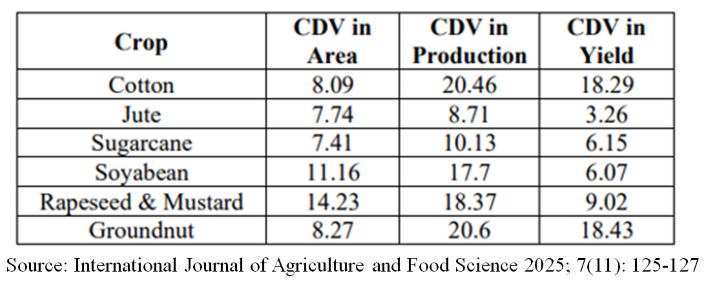
This season's south-west monsoon has already shown sufficient spatial and temporal volatility. The Cuddy-Della Valle, which captures the degree of volatility, shows us that from the year 1991 to 2024, there are significant variations in the degree of instability across all crops and dimensions of growth. The reason for this instability can be price, input cost, as well as pest attack, but weather shocks are becoming the major factors among all contributing to this volatility.
All India Rainfall Time Series
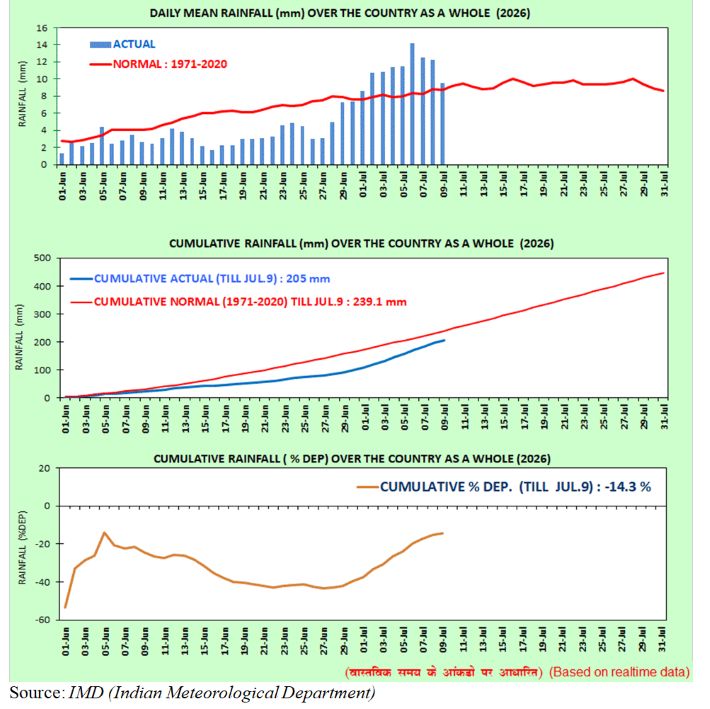
This year, the monsoon shows three kinds of volatility: temporal, spatial and intensity, which can be seen in the diagram. While cumulative rainfall across the country was about 38% below the long-period average during the early phase of the season, the Mumbai region witnessed episodes of extreme rainfall, and Dakshin Kannada experienced shorter but more intense rainfall, highlighting a shift from predictable seasonal rainfall to increasingly erratic and uneven rainfall patterns. Recent climate-related incidents show that the impacts are not limited to crop and yield losses but also include the loss of human lives and property. This trend depicts that the government needs prior preparation to inject resources based on real-time data and information sets.
Climate a redefining factor
The Indian agriculture story has transformed from that of a deficit producer to that of a surplus producer, but metrics of success have changed over the years. A good harvest now tells a part of the story of success because a heatwave exposure can affect the quality of the product and hence the price, and a flash flood can destroy infrastructure, and an erratic rainfall can derail the sowing for a farmer. McKinsey has estimated that by 2050, nearly 80% of small farmers in India could suffer at least one major climate hazard, and 4.5 lakh square kilometres of rainfed area suitable for rice production today may not remain suitable for future cultivation. Studies like this point out that climate change can’t be considered an occasional shock anymore; rather, we need to treat it as a structural constraint. A country with 85% of small landholders having constraints like limited savings, limited access to formal credit, and very little room to absorb repetitive climate shocks should be on its toes to prepare itself.
Diversification and road to resilience
A lesson coming from the majority of studies worldwide that diversity brings resilience into the system; however, the combination may differ from geography to geography. Multiple income streams help in fighting vulnerabilities during shocks or externalities. A McKinsey report suggests that agroforestry is one of India’s largest climate opportunities because it brings moisture to the soil, stores carbon, and prevents soil erosion, along with added income opportunities through timber, fodder, and fruits, etc. The Food and Agriculture Organisation (FAO) of the United Nations also argues that resilient agriculture must work on ecological functions rather than being dependent solely on external inputs. Healthy soils, biodiversity and integrated farming bring natural insurance to climate change.
Water management a go-to strategy
Combating climate risk, water management is very crucial for any economy, and it brings special impetus to the system when we talk about an agrarian economy like ours. The most effective water management strategy is to balance operational needs with the local catchment situation at a particular period of time. Organisations like the United States Environmental Protection Agency (USEPA) and corporate leaders like Nestle work continuously on water management to meet the ESG parameters of compliance. It’s good to see that the government has started working on digital twins, which include data-driven planning via software and AI representation, where the model can use predictive analytics to reduce yield and financial volatility for the farming community. Reliable data can identify climate hotspots, and districts can intervene in a targeted way to mitigate the risk, but the government needs to be cautious that technology should not become a reason for inequalities. It should be equally accessible to small farmers as well, and digital advisory must be timely to bring fruitful results.
Localised solutions matter the most
Every climatic zone has distinct challenges, which are also illustrated by this South-West Monsoon, which speaks loud and clear that climate resilience is very local in nature. Flood-prone districts need very different adaptation strategies from the drought- or cyclone-prone districts. Climate assessments by individual districts and resilience policy interventions can bring the desired result instead of a one-size-fits-all policy mechanism.
Policy beyond the yield performance
Traditionally, agricultural policy mechanisms have boosted production, but it's time to go beyond this to be resilience-focused by changing the success parameters. We need to bring digital adoption, water efficiency, climate-resilient cropping patterns, ecosystem restoration, adaptive capacity, and income stability. The World Bank started giving impetus to climate-smart agriculture and advocates for increasing productivity by strengthening resilience and reducing emissions. This is the time to practise an integrated approach to make the farm stable and address the volatility.
Rahul Kumar teaches economics at Pune Institute of Business Management. Dr Barun Kumar Thakur teaches economics at FLAME University, Pune.