
Suraj Milind Yengde’s latest work broadens the scope of inquiry to ‘Dalit Universality’
GN Bureau | December 29, 2025

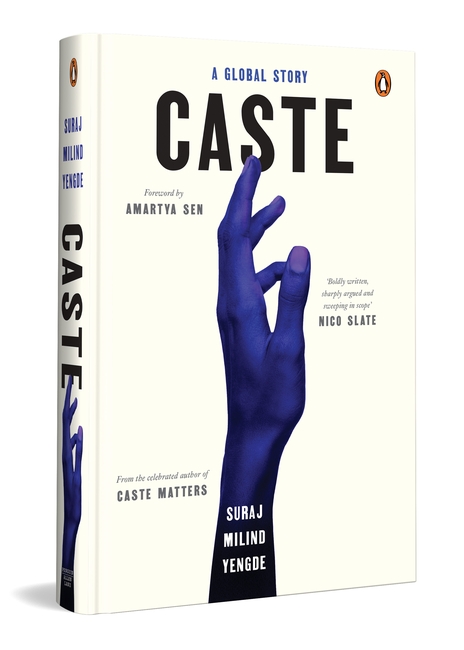
Caste: A Global Story
By Suraj Milind Yengde
India Allen Lane, 384 pages, Rs 899
 Suraj Milind Yengde, a first-generation Dalit scholar, reignited debates around the concept of caste with his ‘Caste Matters’ (2019). Then he completed his second doctorate, at Oxford, on the intellectual histories of caste and race. He now teaches at University of Pennsylvania.
“Caste: A Global Story” has already generated significant academic and critical interest. Amartya Sen, in a short foreword, says, “Yengde's work compels us to recognise caste not as an insular Indian institution but as a social form with global ramifications.” The new work is less of a personal polemic and more of an archival and ethnographic attempt.
While it builds on his previous work, Caste Matters, this book is much broader in scope, shifting the focus from the Indian subcontinent to the global South Asian diaspora and its intersections with other systems of oppression. The key point here is that caste and caste-based discrimination are not just Indian phenomena; they happen around the world, from Britain to Bahrain, Canada to South Africa. ‘Dalit Universality’ encompasses the experience of many, from indentured labourers in the nineteenth-century Caribbean to present-day migrant workers in the Middle East.
Yengde’s primary contribution with this volume is “globalizing” caste studies. He moves away from the traditional “village ethnography” model to show how caste travels. He documents how caste discriminations persist in the Indian diaspora in the UK, USA, and Australia, and even in the Caribbean (Trinidad and Tobago) and the Middle East. Upper-caste migrants often use their ‘model minority’ status to mask caste privilege, sometimes even labeling anti-caste interventions as “racist” to deflect scrutiny.
Another notable feature of the ambitious work is his methodological innovation. Given the subject matter, he rejects detached objectivity of academic treatises, and puts his felt experience to use. He justifies this swa-anubhuti approach by arguing that knowledge of caste must come from those who live it, not just those who study it from an elite, textual perspective. The result is a hybrid style – part memoir, part social commentary – to etch out a map of caste violence as it is faced, experienced.
Yengde also takes up the oft-discussed race-caste analogy, and explores the Dalit-Black solidarity movement. He analyses Dalit activism in the light of the Black Lives Matter (BLM) movement in the US. Though coming from different historical arcs, the two have a lot in common in terms of the exclusion faced by the two communities.
The book concludes with a nearly exhaustive list of Dalit organizations around the world.
Last summer, the two of us spent several weeks in rural Madhya Pradesh with a non-profit that works on gender justice through women’s self-help groups. We went in with a notebook full of laws. The Protection of Women from Domestic Violence Act. The Dowry Prohibition Act. Free legal aid for every wo
Digital payments have become a reflex for urban India, but the confidence earned in paying has not yet carried over to borrowing. That is the central finding of `How Urban India Pays Report 2026`, released by Pahlé India Foundation in collaboration with Amazon Pay. Based on a survey of 5,149 consu
Commerce and industry minister Piyush Goyal has called upon businesses in India and the United Kingdom to translate the opportunities created by the India-UK Comprehensive Economic and Trade Agreement (CETA) into expanded trade, investment, partnerships and job creation. Addressing the Bu
The Gandhian movement in India, after Gandhi’s death, failed, says Ramachandra Guha, and blames Vinoba Bhave for it. But the movement found new, fertile grounds around the world and succeeded in bringing about a change in South Africa, the US and elsewhere. It is high time it returned home. Of cour
Tavleen Singh, noted journalist and political commentator, has turned to fiction, with her debut novel ‘The Actor’ (HaperCollins India). Set in the near future, it has a superstar, Amit Singh, turning to politics, when the political landscape is dominated by prime minister Guru Gaynendraj
The union cabinet, chaired by prime minister Narendra Modi, on Tuesday approved the setting up of a Special Purpose Vehicle (SPV), called Integrated Transport & Logistics Authority (ITLA), to strengthen research, planning, appraisal, monitoring and impact assessment within the broad domains of Transp










