As the year ends, we replug some of our stories on the significant events of 2016
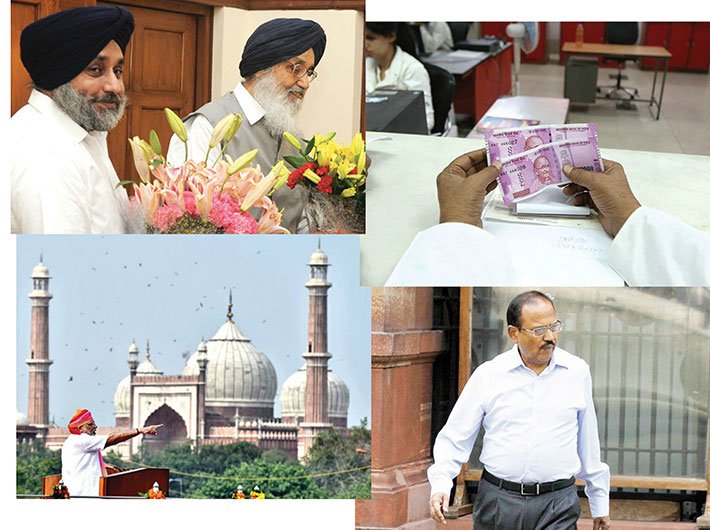
2016 was a year that kept India on the edge. The dramatic decision to scrap Rs 500 and Rs 1,000 currency notes was like a bolt from the blue, forcing people to stand in serpentine queues at banks and ATMs. On Pakistan, India twice flexed its muscles – the first, when soldiers carried out a surgical strike against terror launch pads, and the second, when prime minister Narendra Modi broached the Balochistan issue during his speech from the ramparts of the Red Fort.
Freedom of speech was hotly debated following the agitation at the country’s premier Jawaharlal Nehru University and the subsequent arrest of JNU students union president Kanhaiya Kumar. The year also saw the ascension of Mehbooba Mufti as Jammu and Kashmir chief minister following the death of her father Mufti Mohammad Sayeed. The state also saw over 100 days of violence after a young terrorist leader Burhan Wani was killed by security forces.
Gujarat, which saw a change of chief minister with Vijay Rupani taking over from Anandiben Patel, saw tension after gau rakshaks brutally assaulted four dalits. After violence in Una, dalits vowed not to pick up carcasses. The year also saw the Badals in Punjab facing considerable flak just ahead of the assembly elections.
We are putting together stories that will help you get an overview of the year that was:
Demonetisation: Villages are emptying out, but 67 percent of people still live in rural and semi-rural areas – where there are few banks, where getting to an ATM may take half a day, where many have not seen handheld devices for cashless transactions, where smartphones are rare. How people in these places are coping with – and reacting to – the bold move of demonetisation to get rid of all black money overnight? To find out, I went to a few villages in Uttar Pradesh...
Read: “The really cashless economy”
Cash out: Can you imagine a day without cash? The answer is an obvious ‘no’. The rustle of notes and jingle of coins still have the power to light up any face. In fact, more than 99 percent of transactions by volume are still in cash payments in India, according to a McKinsey Global Insights report. Some argue that this overdependence on physical money is due to challenges like inaccessible banking services, lack of infrastructure to support non-cash payment and internet connectivity, which continue to persist, especially in the rural and remote regions of India. Others say that Indians are simply cash-obsessed.
Read: Case against cash
Surgical Strikes: The time has come for India to announce to the world that India can no longer be transgressed or trespassed with impunity. And there couldn’t have been a more telling way of doing so than by unleashing the special mission operations, with the brilliance and precision of an experienced surgeon’s scalpel, and spread across the LoC in Jammu and Kashmir. This retaliation to the unprovoked terror attack on administrative echelons of the army in Uri achieved total surprise as it was least expected.
Read: The sledgehammer blow and its aftermath
Ajit Doval: To his admirers, spy Doval is a living legend; a hero with unmatched courage and sharp thinking on India’s security and strategic interests. His critics envy his qualities of head and heart yet can’t find fault with him... Dulat says Doval’s success as NSA is also because of the fact that he and PM Modi think alike on matters of national security. People who have known Doval closely can clearly see his signature on Modi’s key foreign policy decisions.
Read: Ajit Doval: The hawk
JNU: If a citizen cares for all the rest of fellow citizens, where is any harm in it? It is a great bonding, and can only do good to all. In the process, if a citizen feels a surge of emotion at a soldier’s martyrdom, that is a welcome sense of gratitude, of camaraderie. This patriotic sense, this nationalism, this bonding, of course, should not be limited to soldiers, and it will extend to all fellow citizens. Thus, this citizen will introspect if she also feels a surge of emotion when she hears of a farmer ending his life. Or, when she hears of anger a Meghalaya woman feels for the government’s attempts to grab her land for uranium mining… Or, when ruling party leaders routinely express desire to send somebody off to a neighbouring country. That is the trouble with nationalism, patriotism, and similar noble notions. Rabindranath Tagore, the most important public intellectual of twentieth century India, only saw “selfishness”.
Read: Nationalism and its discontents and Letter to my daughter: Why JNU matters
Balochistan: Prof Naela Quadri Baloch landed in New Delhi in April. Her mission was to canvass support of the Narendra Modi government for the independent Balochistan movement. Naela used to teach pharmacy in the University of Balochistan, Quetta – till that day in 2010 when she learnt that the Pakistan army was planning to kill her family in Quetta in a bomb attack, the way it had killed one of the most respected Baloch leaders, Nawab Akbar Bugti, in 2006. Overnight Naela, her filmmaker husband, Mir Ghulam Mustafa Raisani, and children crossed the border and moved to Afghanistan. The family took shelter with the United Nations High Commissioner for Refugees (UNHCR) and later moved to the West where they were received as political asylum seeker.
Read: Modi’s Balochistan game plan
Una: On July 11, three men were attacked by self-styled cow protectors – ‘cow protection’ being a shorthand of the informal show of strength spearheaded by many BJP leaders after the party came to power – in Moti Samadhiyala village near Una town of Rajkot district. The victims were paraded naked and beaten by iron rods and wooden sticks. Following this, at least a dozen youngsters from scheduled caste (SC) communities attempted suicide in various small towns in Saurashtra region of Gujarat, protesting against the state government’s alleged inaction.
Read: In Anandiben’s Gujarat, dalits are lining up to die
Breaking bread with Governance Now: Jignesh Mevani, leader of Una Dalit Atyachar Ladat Samiti talks about cow protection and his dalit movement
Read: Here is a spiritual opportunity for Modi
Punjab: Deepak Dhaba is a popular eatery on the Barnala-Sangrur highway. Truckers, drivers and passengers break their journey here for a tasty Punjabi meal. One day, the regulars to the place were told that its ownership had changed hands. Now, visitors talk in hushed tones about its new albeit unconfirmed owner, Sukhbir Singh Badal, Punjab’s deputy chief minister and son of octogenarian chief minister Parkash Singh Badal.
Read: The SAD saga of Punjab
Kashmir: Mehbooba Mufti had a rather low self-esteem, as her siblings were doing well in life – sisters Rubaiya and Mehmooda are doctors and brother Tassaduq was in the US studying film-making. She felt that unlike them, she had not made her parents proud. So when her father [Mufti Mohammad Sayeed] sought her help, Mehbooba was too overwhelmed to even think of the pros and cons of saying yes.
Read: Mehbooba Mufti: Daddy's girl comes of age
When a small team of the Special Operations Group of the J&K police and troops of 19 Rashtriya Rifles (RR) was pumping the last bullet into Burhan Muzaffar Wani in his hideout at Bumdoora village in south Kashmir, little did they know that their act would plunge Kashmir into yet another vicious cycle of death and destruction. There were impromptu celebrations in the camps of counterinsurgency forces over the killing of this 22-year-old Hizbul Mujahideen militant who had been challenging them with his bold social media presence. They didn’t realise that Kashmir was about to erupt in rage.
Read: Why Kashmir is angry again
Seventh pay commission: As the NDA government, aims for a double-digit growth trajectory of the Indian economy, a pay hike to almost one crore government employees and pensioners can come handy, as it will push demand. The 7th central pay commission (CPC), submitted its report earlier this year, and finance minister Arun Jaitley welcomed it, terming it ‘historic’. The cabinet accepted the recommendations last month. However, employees are not happy, and have announced plans for a protest strike.
Read: Seventh pay commission: A damp squib?