It is time AAP redefines the “aam aadmi” in its strategies for a wider political transformation
On the day the results of the Delhi election were announced, I wrote an article, Redefining Aam Aadmi (read it here), to mark the turning point in India’s political history. The Aam Aadmi Party (AAP) had rapidly achieved remarkable results among Delhi citizens in promoting trust, solidarity, and hope alongside promises of other traditional welfare. By doing so, it had opened the doors of the party to increase its army for the impending nationwide struggle. Though the testimony of the AAP government is too short to predict the consequences, the rise of aam aadmi and fall of the AAP government is a testimony of the changing goalpost in Indian politics.
Today, the contemporary goalpost of Indian politics is much more than roti, kapda aur makaan. As Robert Michels once wrote, “The revolutionary political party is a state within a state, pursuing the avowed aim of destroying the existing state in order to substitute for it a social order of a fundamentally different character. The party remains a mere organisation if it fails to carve towards identical objectives and practical aim.”
As a party, AAP created objectives but failed towards practical aim, resulting in the fall of the government. Initially, it sacrificed its political virginity by entering into an alliance with the Congress. Later, with repeated attempts to strive for sustaining sentiments, it pitched itself on the wrong foot. The initial experience of AAP has been like a traditional arranged marriage in India. The marriage of AAP and aam aadmi, the common man, is like that of a bridegroom who planned the wedding but failed to consider the challenges of marriage. The wedding did retain the emotion and succeeded in consolidating citizens’ voices against poor governance emanating from corruption in the former governments.
Does that mean the Delhi election result was a wedding celebration of exemplary objectives, while the fall of the government is a failed marriage of practical aim? It is too early to predict the future of AAP’s marriage with the aam aadmi. However, it is for sure that the honeymoon will be over by the coming general elections.
We hope the marriage sustains itself by bridging expectation with experience. What it needed was to condense expectation beyond the capability of the government to deliver on time. Instead, to avoid the ripple, the AAP government sealed its destiny with quick-fix solutions, resulting in appeasement and demonstration of an erroneous strategy of public action on the streets and the secretariat.
The marriage of AAP and the aam aadmi is more than enlightenment for politicians. The chief minister’s bungalow provides neither shadow nor shelter to the bride. Neither do the possession of car, cravat and credo of the groom reduce inequality of income in the family.
The chief minister and the ministers, as heads of the family, began policing and protesting on the streets. Instead of taking policy decisions by asserting the authority of the government for the aam aadmi, AAP tried to retain the image of the hapless aam aadmi. The true enlightenment of marriage in politics is possession of political rights for transforming the government into effective public institutions and strengthening administrative competence in implementing public services.
A marriage in a family can sustain with appeasement but not in parliament.
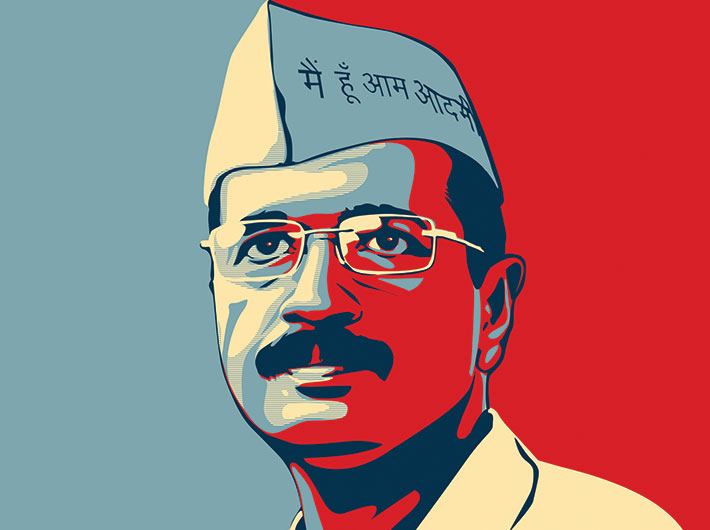
At this point, it is worthwhile for AAP to ponder on one question: has it been a failure of the AAP and aam aadmi marriage at large? Certainly, it is not a failed marriage but it is the failure of Arvind Kejriwal and his team in categorising and targeting the aam aadmi. Kejriwal and his team have failed to understand the aam aadmi. AAP’s action and advocacy were limited to literal intellect the aam aadmi as opposed to “khas” (significant) aadmi. The fact is that the very day AAP was elected, its leaders became ‘significant others’ with the power vested in them as elected representatives of the government.
More importantly, does this mean every khas aadmi is essentially opposed to the aam aadmi?
Surely, AAP needs more clarity on aam aadmi as a category for targeted public action. One needs to ask what the basket of characteristics that defines an aam aadmi is. Is the aam aadmi a person or a process? Certainly, aam aadmi is a process and not a person. The aam aadmi constituency is not any individual but a situation, as every honest citizen is a victim of poor governance – be it an honest bureaucrat in the government, a teacher in a school, a politician in parliament, a street vendor, or a girl on a lonely street. The legitimate power of citizens and probity in public services and parliament together defines the constituency of the aam aadmi.
The marriage of AAP and aam aadmi is a fertilisation of a consistent illegitimate relationship between the powerless and the powerful, resulting in widening inequality over time. Therefore, marriage in politics is concerned with the analysis of the relationship which the aam aadmi can forge with the “powerful” in his/her attempt to solve social problems and not vice versa.
Targeting corrupt politicians or a corporate is scratching the surface – AAP needs to redefine the system, structure, and scope of politics with effective policy-making, and not mere policing. It is high time AAP redefines the “aam aadmi” in its strategies for a wider political transformation.