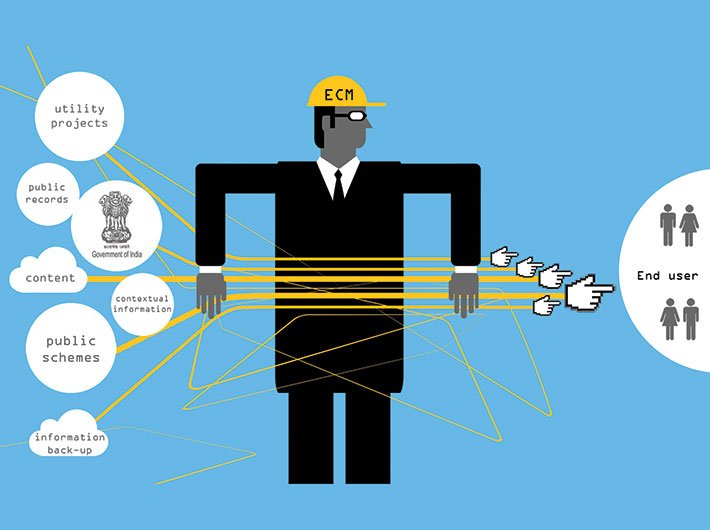
An enterprise content management solution can improve operational efficiency and transactional speed for many citizen-centric services
The Digital India initiative talks about creating a digital infrastructure for citizens to enable on-demand services and a connected society at large. The programme’s success largely depends on how well the government can ensure the availability of right information to the right audience (internal and external) at the right time. The key will be to digitise all existing information across various government departments and enable its anytime, anywhere exchange with citizens and businesses.
However, if the accompanying challenges are to be considered, it looks like a daunting task right now!
Take for example, the volume and complexity of information that one has to deal with. Government agencies are flooded with files and documents pertaining to citizen records and government policies. Digitising such enormous amount of documents can take months, if not years. The other factor to consider is the widely distributed presence of this information. Citizen records may reside in silos across various government departments, sometimes located in different parts of the country, which makes consolidation an arduous task.
Another roadblock lies in the last mile connectivity with citizens who are residing in the remote areas of the country. Making sure that they receive the true benefits of government schemes and initiatives is imperative. Security remains a challenge too. The information contained in these documents is both functionally critical and content-wise classified, and thus needs to be handled with utmost care.
Technology as an enabler of digital governance serves this objective quite well by ensuring information quality, accessibility, confidentiality and affordability – the four drivers of user adoption and citizen engagement. Robust information technology (IT) platforms also facilitate transactional reliability and operational scalability in a way that can drive large-scale transformations.
In the space of public documents and information management, enterprise content management (ECM) platform holds a lot of promise. With its ability to store and manage content dynamically and contextual information delivery along with content life-cycle management, ECM can serve as an important cog in the wheel for Digital India.
Here’s a look at the role of an enterprise content management platform within the functional framework of smart governance model.
Real-time accessibility: From utility projects such as highways and power plants to public service platforms such as provident fund and RTI, most government initiatives are information driven. An ECM suite ensures readily available information in the right context from a centrally maintained repository. By doing so, it becomes an enabler of electronic service delivery.
Wide G2C coverage: Remote-area citizens claiming benefits of a public scheme need to wait for long periods either due to non-registrations or longer disbursal cycles. ECM extensions such as mobile capture, e-signature along with robust records management module enables wide-area coverage and faster turnaround time. In fact, mobility features such as anytime-anywhere capture and information accessibility can be leveraged extensively to reach the untapped regions. This ECM feature can catapult financial inclusion to the next level through various means such as eKYC and e-delivery of citizen-centric services by allowing real-time capture and uploading of documents.
Service accuracy and quality: The implementation of ECM project prevents a huge amount of rework on account of a loss or misplacement of public records. Also, it ensures that only the documents that meet minimum threshold quality standards as well as compliance guidelines are accepted during the process. Standardisation of information at such a large scale and high volumes is what suggests the need for an ECM driven information management.
G2B and G2G communications: A centralised ECM facilitates prompt and contextual inter and intra-government correspondences. Modern ECM systems have inbuilt PDF A App which has the distinct advantage of preserving documents in their original shape over long archival times. In citizen context, the active engagement on social media is a means to better connect with the masses. It suggests the need for a real-time capture and monitoring of social content in the form of records.
Cost reduction and resource productivity: ECM implementation drives lean and 5S practices at the workplace by eliminating the need to store paper-based records. The departments also free up a considerable portion of office used for stocking files for more productive purposes.
Change management within governance structure: An effective ECM suite is designed with an inherent capability to integrate with a variety of online and modern-day office systems and applications. Government units such as ministries and departments can therefore scale up technologically with time and also restructure, merge or consolidate operations.
Indirect impacts of ECM: Government revenue collection departments, such as tax collection agencies, stand to experience a favourable impact on account of a well-implemented ECM project. Besides, it will lead to significant trimming of utility and infrastructural expenditure.
Public service and utility departments (such as courts and universities) can simplify information access through installation of public interfaces such as kiosks, for necessary public information retrieval. Moreover, during crisis and emergency situations ECM allows the auto back-up of information and work continuity from alternate locations on a sustainable basis. Besides, it can also help improve the operational efficiency and transactional speed for many of their citizen centric services.
Jeet is a senior VP-Technology at Newgen Software.
(The column appears in the January 16-31, 2016 issue)