
Mani Rao’s translation of the devotional poem ascribed to Adi Shankara does justice to its manifold aims
GN Bureau | January 31, 2023

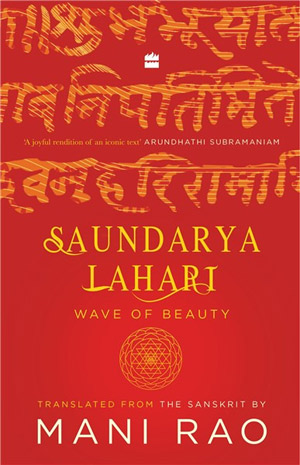
Saundarya Lahari: Wave of Beauty
Translated from the Sanskrit by Mani Rao
HarperCollins, 218 pages, Rs 399
‘Saundarya Lahari’, usually ascribed to Adi Shankaracharya, has a unique status among the religious-spiritual works of Hinduism.
The popular ones among them, the ones known widely and read or recited by generations – in Sanskrit or later languages, are usually hymns to various gods, which would place them in the Bhakti Yoga. Many works of Jnana Yoga, especially those with Advait Vedanta at the core and supposedly composed by Shankara, also enjoy a significant readership. An amalgamation of these two paths is not uncommon either. But a work of Tantra is a rarity.
‘Saundarya Lahari’ has that rare distinction of being a poem that can be read as purely devotional or as an arcane Tantrik text. In about a hundred verses, it is also a marvelous poem, with a rich variety of literary devices at play.
Mani Rao, a poet in her own right, is also a spiritual seeker, and is thus ideally placed to render both the sacred and the literary aspects in a translation. After the English-language translations of the Bhagavad Gita and selections from ‘Mahakavi’ Kalidas, she has come out with an English version of ‘Saundarya Lahiri’.
***
 Verse 24
The universe:
Brahma creates
Hari preserves
Rudra destroys
Isha dissolves all of them
And his own body
The primeval Sadaashiva
Restores it all
On cue—
The quick flick of
Your eyebrow-tendrils
***
While there have been numerous translations of this well-known work, this is probably the first that has a poet’s touch. Rao’s excellent introduction is helpful, placing the poem in context, and preparing the reader for the best reading experience. Equally helpful are the explanatory notes. In this near-perfect edition, what one might have wished for is unpacking the Tantrik subtext, or at least more hints in that direction, along with an introduction to Tantra. This edition, however, is for a first-timer reader in English of this work, who can then explore the text in more depth with suggestions for further reading.
Mumbai’s real estate market keeps growing, yet homeownership remains out of reach for much of its population. Three experts – urban researcher Hussain Indorewala, urban planner Vidyadhar Phatak and developer Kamlesh Thakur of NAREDCO Maharashtra, agree that simply constructing more apartments
US secretary of state Marco Rubio has said he was unfamiliar with the Wall Street Journal report suggesting Elon Musk had decided to throttle Starlink services in Ukraine, but rejected claims that Washington had ordered the restrictions to pressure Kyiv. “There was no
Breast cancer has become a public-health challenge in India. The greatest opportunity is to find cancers earlier. Artificial intelligence (AI) is opening a new era in breast cancer detection. AI systems can analyse mammograms and other breast-imaging studies, identify subtle abnormalities and assist radi
Indian agriculture is experiencing significant climate volatility, while the world economy seems to be in a highly volatile situation. Economic indices from various countries show that they need to recalibrate their strategies to withstand economic headwinds. In such a challenging situation, a country li
India’s southwest monsoon ended with a 13% rainfall deficit in 2026, its weakest performance in a decade, raising concerns over agricultural production, water security and the upcoming rabi season. With El Niño expected to persist into early 2027, experts warn that declining soil moisture, dep
For over a decade, India’s e-commerce story has rested on a simple premise: platforms connect buyers and sellers, while data fuels efficiency, personalisation, and scale. However, as the market matured, its structure has revealed a growing imbalance. E-commerce platforms, especially marketplace ent










