
SY Quraishi offers suggestions to improve the institution and the process at the heart of our ‘experiment’
GN Bureau | October 30, 2023

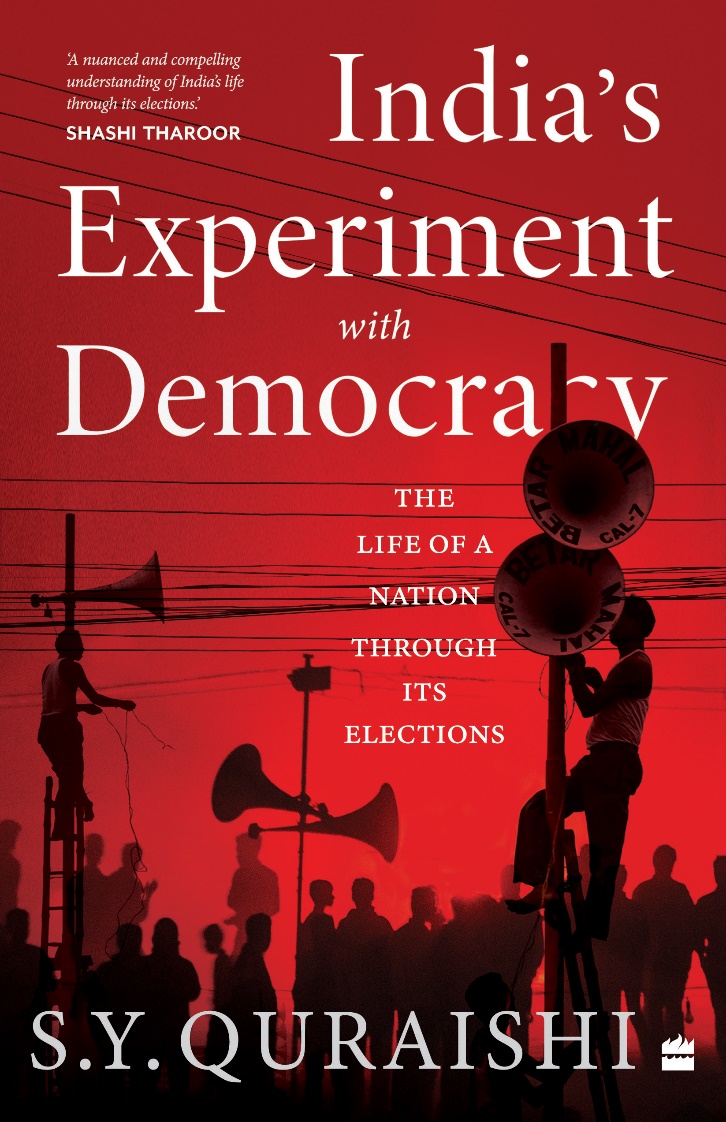
India’s Experiment with Democracy: The Life of a Nation through its Elections
By S. Y. Quraishi
HarperCollins, 560 pages, Rs 699
S. Y. Quraishi, former chief election commissioner (2010-12), is considered a walking encyclopedia of electioneering in India. He was born in June 1947, a week before Salman Rushdie, which makes him one of those Midnight’s Children, whose life stories possibly mirror the story of the Republic. (In the introduction, he also speaks of ‘India and me – a journey together’.) He has enthusiastically taken part in many a debate in this republic, and he has always been a voice of reason, of conscience.
‘India’s Experiment with Democracy’ is Quraishi’s second book on the topic, after ‘An Undocumented Wonder: The Making of the Great Indian Election’ (2014). The latest work is, according to the author, “a product of multiple decades of my life … essays, reflections, questions and explorations that have kept me occupied all throughout my career, ever since I started as an IAS officer in the early 1970s”. It is mostly a collection of previously published edit-page articles.
Given the long range of time over which they were written, they cover an immense range of topics, making it necessary to put together the chapters under several sections. They include: General Elections, The Role of the Election Commission: Powers, Procedures and Politics, State Elections, Electoral Reforms, International Elections. Then, the book branches out into other territories: Constitution and Indian Polity, Gender and the State of Democracy, Religion and the Future of India. All this is rounded off with an annexure on Legislative Framework of Election Law in India.
As a result, some of the chapters may seem dated, some comment on a controversy that made news at some point and was soon forgotten. The later sections break the coherence of the book too, making it an unwieldy collection. While the contents of these chapters are no less interesting – anything from the pen of this distinguished administrator of such vast experience is highly readable, but they possibly dilute the core of the book.
This is rather unfortunate, as there is a very coherent and very relevant book inside this book, focusing on Electoral Reforms – the holy grail of India’s democracy. Here he discusses the now formalised proposal of ‘One Nation, One Poll’. As a former CEC, his views, presented over three chapters, are critically important – all the more so, since few other former CECs have brought their experience to bear on the topic in an elaborate manner.
As the next general elections draw closer, the ten chapters forming Quraishi’s views on “main reforms and recommendations” would be a necessary reading.
In spite of the mixed-up nature of its composition, the book offers a thorough analysis of the institution and the process at the heart of our democracy, and makes eminently reasonable suggestions to improve it further. For citizens who are well aware of their stakes in this system, this book will remain indispensable for long.
September 12 marks the International Day for South-South Cooperation, commemorating the 1978 Buenos Aires Plan of Action (BAPA). Forty-eight years later, its central proposition remains relevant: countries of the Global South can draw on their own knowledge, experience and innovations to address shared d
As India prepares to host the 18th BRICS Summit this weekend, and as prime minister Narendra Modi is set to hold a bilateral meet with president Xi Jinping, China’s growing global influence and the changing dynamics of India-China relations will be under focus. But to understand where China is head
This year marks 20 years of BRICS, with India set to host the grouping’s leaders’ summit this weekend. The anniversary offers an opportune moment to assess BRICS’ growing importance at a time when the effectiveness of global governance and the credibility of multilateralism are under in
Triumph of the Indian Republic: My Life, My Struggles By Ram Nath Kovind Rupa Publications, 400 pages, Rs 795 All our presidents so far stand out, each for a different reason. Ram Nath Kovind, the 14th president of India, from 2017 t
Pathbreakers: How 10 Visionary Leaders Transformed India by award-winning journalists By Sucheta Dalal and Debashis Basu Rupa Publications, 304 pages, Rs 695
In a significant gain for citizen protection in the digital economy, the Department of Telecommunications (DoT) has helped prevent suspected cyber fraud losses of more than ₹5,000 crore through its Financial Fraud Risk Indicator (FRI) within fifteen months of its launch on May 22, 2025. This money did











