
Sudipta Bhawmik’s ‘Dwapar Katha’ brings the epic alive for all readers
GN Bureau | January 24, 2024
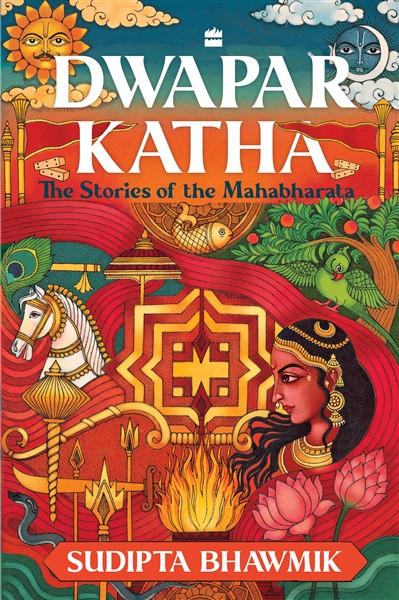
Dwapar Katha: The Stories of the Mahabharata
By Sudipta Bhawmik
HarperCollins, 608 pages, Rs 599.00
 The Greatest Story Ever Told. That was the title of an American movie of 1965, narrating biblical stories. The epithet is, arguably, more befitting for the Mahabharata. It is the story of all of us. It has something to offer to each one of us, entertainment as well as education.
No wonder, it is one of India’s two most cherished epics. The age-old saga of warring cousins-the valiant Pandavas and the formidable Kauravas has left an indelible mark on our collective imagination. Yet, beneath the stories of valour and villainy lie complex human emotions that challenge our ideas about ‘good’ and ‘evil’. Can the virtuous always conquer the malevolent? Are the Kauravas truly the embodiment of darkness, while the Pandavas exude righteousness? Does Dharma triumph in the end?
The Mahabharata has fascinated generations. Each has its own retelling of the intricate web of characters and stories. They have a life of their own, flowing from grandmothers to children in the oral tradition. As for the textual tradition, only scholars can be expected to read the master edition of the Bhandarkar Oriental Research Institute, and the rest of us turn to ‘popular’ versions. In Indian languages, publishers such as Gita Press have brought out various editions, from literal translations to a selection of stories retold in simple diction. In English, there have been numerous wonderful creations. C Rajagopalachari’s version from the Bharatiya Vidya Bhavan and RK Narayan’s retelling as part of his ‘Indian Epics Retold’ served earlier generations well. Experts also recommend the editions by P. Lal, JD Smith and Carole Satyamurti. In recent years, Bibek Debroy made a monumental translation of the complete text, apart from many others.
Sudipta Bhawmik approached the epic differently – with a podcast, the oral tradition of the twenty-first century. An award-winning playwright who has written nearly forty plays in both Bengali and English languages, he has also authored four books. He also holds a Ph.D., a Master’s degree, and a Bachelor’s degree in Electronics and Computer Engineering from IIT Kharagpur. When he moved to the US in 1989, he carried with him ‘Krishna Dwaipayan Vyasa’s Mahabharata’ – a popular abridged retelling in Bangla, translated by Rajsekhar Basu.
In 2014, he writes, he got an opportunity to host a talk show, which led to his collaboration with Avi Ziv, who helped with the technicalities of the medium, and the podcast was on, bringing timeless tales to new audiences in new places. It was immensely popular (over 40 million downloads) and then came demands for a book based on it.
‘Dwapar Katha: The Stories of the Mahabharata’ is not a transcript of that podcast, but a reading-oriented version of it. Bhawmik delves deep into the intricacies of human nature as he explores the psyches of an eclectic cast of characters, unearthing their motivations and desires. He immerses us in their ceaseless inner struggles on a battlefield more profound than Kurukshetra. The reader can feel the seething anger of Bheem as he rages against the silent Yudhishtir during Draupadi’s disrobing and grieve with Duroyadhan when he loses his dear friend Karna in the war. The reader can also explore the concepts of Dharma and Karma along with the Pandavas, as Sudipta unearths age-old tales of the Vana Parva, where rishis share life lessons with the exiled Pandavas.
For the book, Bhawmik made three rules: (1) tell just the story, no interpretations, because there’s no end to the latter and it is subjective too, (2) highlight the drama (he is a dramatist and here is the biggest drama of humankind), and (3) keep it simple and readable for all. The result is a highly readable, engrossing work, suitable for a wider audience. The prose is engaging, aided by beautiful illustration (by Onkar Fondekar, who also did the stunning cover), and numerous authors and Mahabharata experts have endorsed it.
In other words, if you are still unfamiliar with the intricacies of this epic, this is the volume to immerse yourself in.
Mumbai’s real estate market keeps growing, yet homeownership remains out of reach for much of its population. Three experts – urban researcher Hussain Indorewala, urban planner Vidyadhar Phatak and developer Kamlesh Thakur of NAREDCO Maharashtra, agree that simply constructing more apartments
US secretary of state Marco Rubio has said he was unfamiliar with the Wall Street Journal report suggesting Elon Musk had decided to throttle Starlink services in Ukraine, but rejected claims that Washington had ordered the restrictions to pressure Kyiv. “There was no
Breast cancer has become a public-health challenge in India. The greatest opportunity is to find cancers earlier. Artificial intelligence (AI) is opening a new era in breast cancer detection. AI systems can analyse mammograms and other breast-imaging studies, identify subtle abnormalities and assist radi
Indian agriculture is experiencing significant climate volatility, while the world economy seems to be in a highly volatile situation. Economic indices from various countries show that they need to recalibrate their strategies to withstand economic headwinds. In such a challenging situation, a country li
India’s southwest monsoon ended with a 13% rainfall deficit in 2026, its weakest performance in a decade, raising concerns over agricultural production, water security and the upcoming rabi season. With El Niño expected to persist into early 2027, experts warn that declining soil moisture, dep
For over a decade, India’s e-commerce story has rested on a simple premise: platforms connect buyers and sellers, while data fuels efficiency, personalisation, and scale. However, as the market matured, its structure has revealed a growing imbalance. E-commerce platforms, especially marketplace ent










