
Experts express concern over Chennai oil spill

Livelihood of the fisherman of the state have been affected amid falling sales

shivani

Shivani Chaturvedi | February 4, 2017 | Chennai

#fishermen   #pollution   #oil spill   #Chennai  


Businesses of the fishermen of Chennai have been hit hard following the oil spill last week when two ships collided near Ennore situated in the north of Chennai. 
 
Tonnes of fish remain unsold and fishermen are incurring huge losses. Customers are not willing to buy fish from places that were not even affected by the spill. “Sale of fish has gone down. Affect of oil spill has come to Thiruvanmiyur and Kottivakkam localities in the south of Chennai. We are reluctant to go into the sea as we know that we won’t get the price for it,” says M Senthil, a fisherman. 
 
“People are not buying the fish even if we catch and bring fish from Kovalam fishing village which is 40 kms south of Chennai. People say that they can’t differentiate whether the fish is from Ennore or Kovalam, so they don’t buy it. We don’t know how long the situation will continue,” says Gobi, another fisherman.  
 
Not only will the livelihood of fishermen located in and around Ennore is going to get affected but the entire city of Chennai, says professor S Janakarajan president of the South Asia Consortium for Interdisciplinary Water Resources Studies (SaciWATERS).
 
“Government is taking the situation very lightly. Though anthropogenic activities are taking place in Ennore port, the sea is highly polluted due to large quantities of chemical industrial dump waste. The oil spill will have a cumulative impact on the already disturbed coastal ecosystem,” he says. 
 
Janakarajan adds that the worse part is that the work to remove the oil is being done manually and the authorities concerned are not using an advanced system.
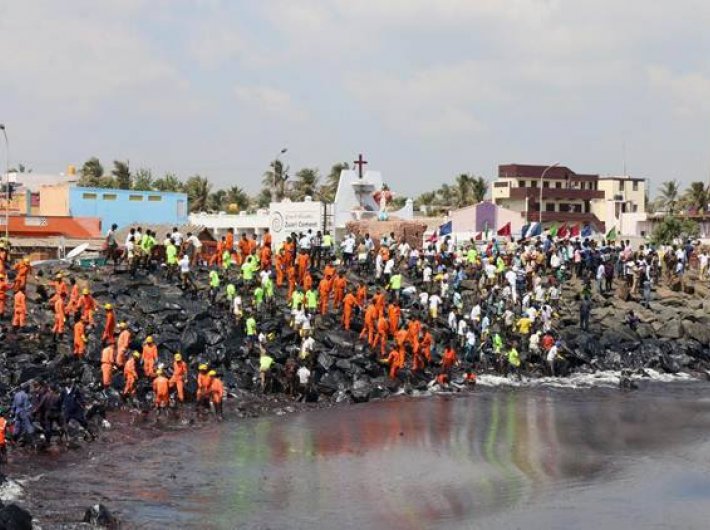
Currently about 2,000 volunteers are engaged in the cleanup process. They can be seen wearing shorts, bare body, lifting buckets.
 
Environmental activist Nityanand Jayaram raises concern that people who are involved in the cleaning process are inhaling harmful vapour. “This is not at all the way it should be done. This is hazardous waste cleanup,” he says.
 
“Nobody knows what is the quantum of the leakage and what kind of material leaked. Moreover, the worst affected areas are the rocky areas, so it is very difficult to clean everything as things get caught in between the cracks. Also, since the area is slippery it is dangerous for people to indulge in the operation. It is not something that can be removed using buckets, it requires technology which is not available with us, says Jayaram.
 
The way the government is handling the situation is absurd. Agencies concerned like the state pollution control board and disaster management authority are mum about the incident. They are not following any protocol. Many untrained and unprofessional people are getting exposed to a very serious toxin. “It is a clear example of how unprepared we are. The affect of oil spill could have been reduced. The government tried to underplay the incident and has lost valuable time. They have harmed the environment and have put people at risk,” he adds.       
 
Experts of Chennai are worried about that how long it would take to cleanup. Can the oil be removed completely? Will it have any impact? How long it would take to restore the livelihood of fishermen?


Comments


Other News

Not just politics, let`s discuss policies too

Why public policy matters Most days, India`s loudest debates stop at the ballot box. We can name every major leader and recall every campaign slogan. Still, far fewer of us can explain why a widow`s pension is delayed or how a government school`s budget is actually approved. That

When algorithms decide and children die

The images have not left me, of dead and wounded children being carried in the arms of the medics and relatives to the ambulances and hospitals. On February 28, at the start of Operation Epic Fury, cruise missiles struck the Shajareh Tayyebeh school – officially named a girls’ school, in Minab,

The economics of representation: Why women in power matter

India’s democracy has grown in scale, but not quite in balance. Women today are active participants in elections, influencing outcomes in ways that were not as visible earlier. Yet their presence in legislative institutions continues to lag behind. The Nari Shakti Vandan Adhiniyam was meant to addres

India will be powerful, not aggressive: Bhaiyyaji

India is poised to emerge as a global power but will remain rooted in its civilisational ethos of non-aggression and harmony, former RSS General Secretary Suresh `Bhaiyyaji` Joshi has said.   He was speaking at the launch of “Rashtrabhav,” a book by Ravindra Sathe

AI: Code, Control, Conquer

India today stands at a critical juncture in the area of artificial intelligence. While the country is among the fastest adopters of AI in the world, it remains heavily reliant on technologies developed elsewhere. This paradox, experts warn, cannot persist if India seeks technological sovereignty.

RBI pauses to assess inflation risks, policy transmission

The Reserve Bank of India (RBI) has begun the new fiscal year with a calibrated pause, keeping the repo rate unchanged at 5.25 per cent in its April Monetary Policy Committee (MPC) meeting. The decision, taken unanimously, reflects a shift from aggressive policy action to cautious observation after a signi


Archives

Current Issue

Opinion

Facebook Twitter Google Plus Linkedin Subscribe Newsletter

Twitter






