With below-normal rainfall forecast for 2026, experts fear disruptions to agriculture, groundwater recharge, hydropower generation and rural livelihoods
India is heading into the southwest monsoon season this year under the shadow of a rapidly strengthening El Nino, with meteorologists warning that the climate phenomenon could significantly disrupt rainfall patterns, intensify heat stress and place additional pressure on the country’s agriculture-dependent economy.
The India Meteorological Department (IMD) has forecast below-normal rainfall for the 2026 monsoon season, projecting seasonal precipitation at 90 percent of the Long Period Average (LPA) of 870 mm, with an error margin of plus or minus four percent. The forecast places India on the threshold between below-normal and deficient rainfall categories, with IMD assigning a 60 percent probability to deficient rainfall and a 24 percent chance to below-normal rainfall.
The forecast comes amid growing evidence that El Nino conditions are developing in the equatorial Pacific Ocean. According to the latest advisory from the US National Oceanic and Atmospheric Administration (NOAA), there is an 82 percent chance of El Nino emerging between May and July 2026, increasing to 96 percent during the Northern Hemisphere winter of 2026-27. Climate projections further indicate a two-in-three probability that the event could strengthen into a strong or very strong El Niño by the end of the year.
If those projections materialise, the world could witness one of the strongest El Nino events in decades. Since 1950, only four super El Nino events have been recorded globally in 1982-83, 1991-92, 1997-98 and 2015-16. The strongest among them, in 1982-83, recorded temperature anomalies of around 2.5 degrees Celsius.
For India, the timing of the evolving El Nino is particularly concerning. The year began under weak La Nina conditions before transitioning into an ENSO-neutral phase. Scientists expect a rapid shift into El Nino conditions during the second half of the year, creating atmospheric instability during the crucial monsoon months.
El Nino disrupts the Walker Circulation, a large-scale atmospheric circulation system across the tropical Pacific. This disturbance often suppresses the upward movement of moisture-laden air over the Indian subcontinent, weakening monsoon rainfall. Historical records indicate that nearly 60 percent of El Nino years since 1951 have resulted in deficient or below-normal monsoons across India.
Experts say the evolving phase of El Nino can be just as disruptive as a fully established event.
“Anything that is not in a stable state creates turbulence, and the monsoon is known for a stable air mass,” said meteorologists tracking the Pacific Ocean conditions. “The transition itself can increase uncertainty and interrupt rainfall patterns.”
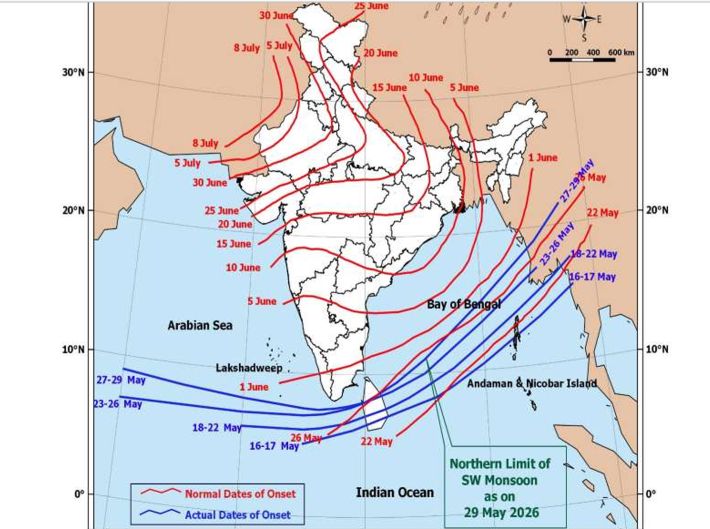
The first signs of this impact could emerge as early as June. IMD has already projected below-normal rainfall for the month, forecasting less than 92 percent of the monthly average rainfall of 166.9 mm.
However, climate scientists caution that total seasonal rainfall figures may not tell the full story. Increasingly, rainfall distribution rather than cumulative rainfall is becoming the critical factor for agriculture, water management and disaster preparedness.
Professor Raghu Murtugudde, Emeritus Professor at the University of Maryland and Visiting Professor at IIT Kanpur, said the developing El Nino is likely to make monsoon rainfall more erratic.
“The number is not important; the distribution of rainfall is,” he said. “Models are not predicting a pretty picture. We can expect patchy rainfall distribution, longer break-monsoon periods and more variability across regions.”
According to him, delayed monsoon advancement could also create conditions favourable for humid heatwaves in north western India. If the monsoon fails to advance on schedule, hot winds from Pakistan combined with moisture influx from the Arabian Sea could expose parts of Rajasthan, Punjab, Haryana and Delhi to dangerous humid heat conditions during July.
The implications for agriculture could be severe. Nearly 52 percent of India’s cultivated land remains rain-fed, making millions of farmers dependent on timely and adequate monsoon rainfall. Prolonged dry spells during critical crop-growth stages can significantly reduce yields, particularly for kharif crops such as rice, maize, soybean and pulses.
Food policy analyst Devinder Sharma described 2026 as a critical year for Indian agriculture.“India is facing a deadly combination of climate stress, fertiliser shortages and rising inflation,” he said. “The ongoing heat conditions and the expected El Nino could severely affect agricultural productivity. This should push us towards agro ecological and climate-resilient farming systems.”
Agricultural experts argue that adaptation will be essential if rainfall remains erratic. Dr G. V. Ramanjaneyulu, Executive Director of the Centre for Sustainable Agriculture, said the larger concern is not just reduced rainfall but delayed rainfall and prolonged dry spells.
“Crops can survive dry spells of about a week. Beyond that, soil moisture becomes insufficient,” he said. “Farmers need to diversify crops, increase soil organic matter and reduce dependence on water-intensive crops such as rice.”
He recommended greater cultivation of pulses, oilseeds and millets, which require less water and are generally more resilient to climatic fluctuations.
The consequences extend beyond farming. Lower monsoon rainfall could weaken groundwater recharge, reduce reservoir levels and intensify water stress across both urban and rural India. Hydropower generation may also suffer if reservoir storage declines.
Dr Anjal Prakash, Professor of Public Policy at FLAME University and contributor to Intergovernmental Panel on Climate Change (IPCC) assessments, warned that a below-normal monsoon threatens India’s broader water and food security.
“With 40 percent of India’s food production dependent on monsoon rainfall, a weak monsoon can affect rural livelihoods, food availability and drinking water supplies,” he said. “Integrated water management and climate-resilient planning are urgently needed.”
Economic analysts are equally concerned. Rising energy prices, geopolitical tensions and potential disruptions to fertiliser supplies are already creating uncertainty ahead of the kharif season.
Aarti Khosla, Founder and Director of Climate Trends, said the country is confronting a growing ‘polycrisis’ where climate shocks, energy insecurity and inflation risks overlap.“The challenge is no longer a single weather event,” she said. “Climate impacts are colliding with economic vulnerabilities, making it increasingly difficult to manage food, energy and water security independently.”
Archana Chaudhary, Associate Director at Climate Trends, warned that India could face simultaneous pressures from food inflation, reduced rural demand, lower labour productivity, rising irrigation costs and industrial water shortages.
There is, however, one possible mitigating factor. Climate models indicate increasing chances of a positive Indian Ocean Dipole (IOD) developing later in the season. A positive IOD can sometimes offset El Nino’s drying influence by promoting warmer waters in the western Indian Ocean and enhancing moisture transport towards India.
Yet experts caution against excessive optimism. While a positive IOD has helped rescue monsoon rainfall in some previous El Nino years, it may not be powerful enough to counter a strong or very strong El Nino event.
As India prepares for the arrival of the southwest monsoon in early June, the coming months are expected to test the country’s resilience to climate extremes. Whether through adaptive farming practices, improved water management or timely policy interventions, experts agree that preparedness will be critical as India navigates what could become one of the most challenging monsoon seasons in recent memory.