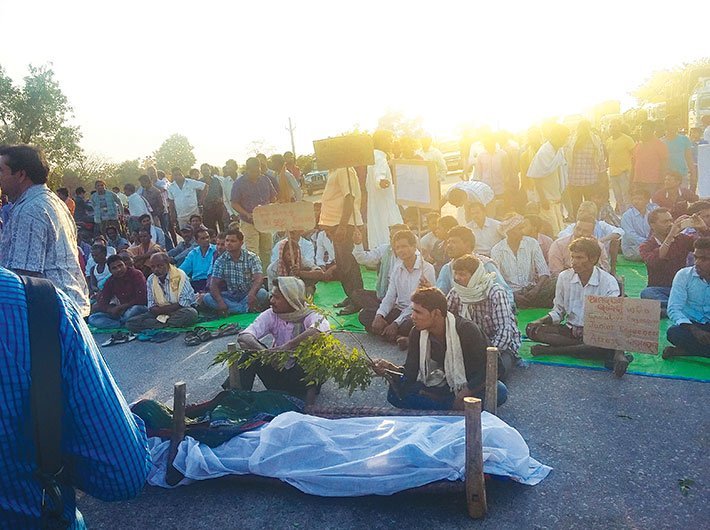
Farmers killed in police firing shows the unbearable stress that the farming sector is under. Coupled with high expectations of farmers, it makes for a deadly, explosive mix
The killing of six farmers in police firing in Madhya Pradesh’s Mandsaur district shows a breakdown in governance and complete lack of empathy towards agriculturists by the BJP that has been in power in the state for three consecutive terms and is hoping for a fourth term in the assembly elections scheduled for 2018.
The
protesting farmers were seeking better prices for their produce and loan waiver, a demand that is not new. Neighbouring Maharashtra, again ruled by the BJP, too is witnessing demonstrations by farmers who are upset over the poor price their produce is fetching.
Shivraj Singh Chouhan, who has been the chief minister since 2005, tweeted: “I appeal to my fellow brothers to maintain peace. I am deeply pained by the turn of events today. I stand by families in this hour of grief.”
It was ironical that the fatal shooting of farmers was splashed across the front pages of newspapers even as the same newspapers carried two full pages highlighting the achievements of the Narendra Modi government in the farming sector.
The huge amount of money spent on releasing the advertisements could have been better utilised if the woes of farmers had been tackled.
Farming is clearly a high-stressed and dangerous occupation. Changing farming practices and various regulations governing it have compounded stressors traditionally associated with agricultural production, said a
study called Farmers' suicide: Across culture by PB Behere and MC Bhise.
A number of studies have found high rates of depression and anxiety among farmers. Various risk factors act in cohesion to culminate into suicide by farmers, said the study that appeared in the Indian Journal of Psychiatry.
The issue of loan waivers, which has been repeatedly used by politicians to garner votes, has done considerable damage to the economy and also failed to satiate the appetite of farmers.
Niti Aayog member Prof Ramesh Chand while delivering the first Dadabhai Naoroji lecture on the issues of inequality and growth in the agricultural and rural sectors said that farmers in India are being spoilt by politicians through populist measures such as loan waivers, and this can have an adverse impact on the agriculture sector in the long run.
“Expectations of farmers are becoming more and more unreasonable,”
said Chand. “They want free water, free fertiliser; they want loan waivers, and they want governments to pay 50 percent of price of the cost of production. No country can meet these kind of things.”
It was another BJP government which seems to have triggered the latest crisis.
Yogi Adityanath, soon after taking over as the chief minister of Uttar Pradesh, waived off crop loans of up to Rs 1 lakh of small and marginal farmers in the state. The BJP kept its promise made in the February-March assembly elections.
About 21 million Uttar Pradesh farmers benefited from the decision. About 92.5% of the state’s farmers fall in the small and marginal categories. The state cabinet also wrote off Rs 5,630 crore in non-performing assets (NPAs) of 700,000 farmers. The twin waivers cost the BJP government a whopping Rs 36,359 crore.
Agricultural loan needs closer scrutiny as it is weighing down the economy. Minister of state for agriculture Parshottam Rupala
told the Rajya Sabha in November 2016: “The total agricultural loan outstanding as on September 30, 2016, stood at Rs 12,60,26,450.46 lakh (Rs 12.60 lakh crore)”.
The agricultural loan outstanding stood at Rs 1.45 lakh crore with regional rural banks, Rs 1.57 lakh crore at cooperative banks and Rs 9.57 lakh crore at commercial banks, according to data.
On April 6, Reserve Bank of India governor Urjit Patel
touched upon it and stressed the need to build a national consensus on loan waiver schemes. “We need to create consensus so that such loan waiver promises are eschewed. Otherwise, sub-sovereign fiscal challenges in this context could eventually affect the national balance sheet,” he said.
“It also entails, at the end of the day, transfer from tax payers to borrowers,” Patel said.
“If on account of this, the overall government borrowing goes up; yields on government bonds are also impacted. It can also lead to crowding out of private borrowers as higher government borrowing can lead to an increase in cost of borrowing for others.”
The government needs to acts fast before the farmers' unrest spreads to other states and brings the agriculture sector to its knees. Reports of a good monsoon ahead won't be enough to assuage frayed nerves.