
Law soon on contract farming

Effort to protect farmers from price volatility

GN Bureau | September 11, 2017

#farmers. agriculture   #contract farming  
GN Photo
GN Photo

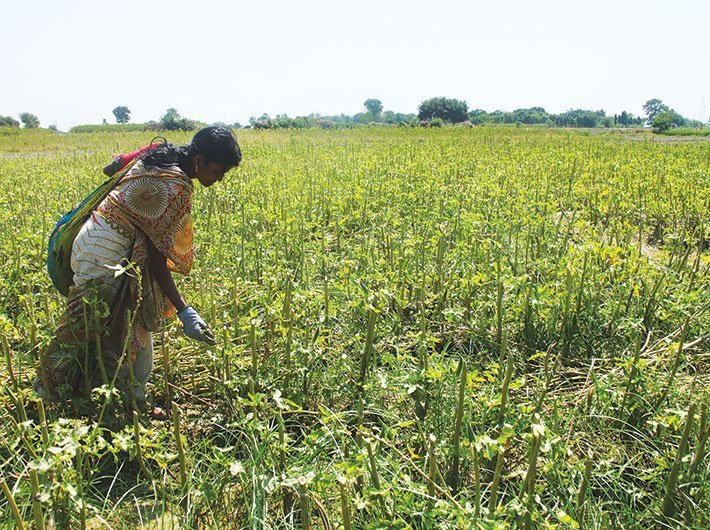
A draft model law on contract farming is expected to be ready this month and it promises to protect farmers from price volatility and will ensure guaranteed price for their produce.
 
“The final model Act will serve as a guide for states to bring required legislation on contract farming. In fact, many states including Uttar Pradesh have shown eagerness in adopting it as early as possible,” reported Times of India  quoting a member of the committee that is working on the draft.
 
"Idea of the contract farming law is to protect farmers from price volatility, particularly in perishable items. Such a law will protect farmers from market fluctuations as it will ensure assured and better price of agricultural and horticultural produce to them through advance agreements," the official added.
 
Finance minister Arun Jaitley had spoken about contract farming in his budget speech.
 
“A model law on contract farming is to be prepared and circulated among the States for adoption,” is mentioned in the 2017 budget
 
Niti Aayog has been working on a model contract farming law to connect farmers with the food processing industry.
 
“Niti Aayog is preparing a model contract farming law. That would connect farmers to the food processing industry,” Niti Aayog vice-chairman Arvind Panagariya said in a question and answer (Q&A) on Budget 2017-18 on Facebook, reported The Mint
 
According to the contract, the farmer is required to plant the contractor’s crop on his land, and to harvest and deliver to the contractor a quantum of produce, based upon anticipated yield and contracted acreage. This could be at a pre-agreed price. Towards these ends, the contractor supplies the farmer with selected inputs, including the required technical advice, said a report in SPICE that is published by the director general, National Institute of Agricultural Extension Management.
 
Thus, the contractor supplies all the inputs required for cultivation, while the farmer supplies land and labour. However, the terms and nature of the contract differ according to variations in the nature of crops to be grown, agencies, farmers, and technologies and the context in which they are practiced, said the report
 
But, Jayshree Sengupta, a senior fellow, working with Observer Research Foundation’s (ORF) Economy and Development programme, has sounded a note of caution with regard to contract farming.
 
Sengupta wrote: “Problems arise in the case of very small and marginal farmers. They may not be roped in for this form of farming because companies may want a particular size of the crop which small farmers with their small parcels of land may not be able to produce. So, this will leave out the most vulnerable farmers from the ambit of corporate farming.”
 
“To make contract farming inclusive, farming groups like cooperatives should be encouraged.  Sometimes, however, small farmers are picked up because there is benefit of low cost of production as these farmers have access to cheaper family labour who work more conscientiously than hired labour” she added


Comments


Other News

India faces critical shortage of skin donors amid rising burn cases

India reports nearly 70 lakh burn injury cases every year, resulting in approximately 1.4 lakh deaths annually. Experts estimate that up to 50% of these lives could be saved with adequate access to skin donations.   A significant concern is that around 70% of burn victims fall wi

Not just politics, let`s discuss policies too

Why public policy matters Most days, India`s loudest debates stop at the ballot box. We can name every major leader and recall every campaign slogan. Still, far fewer of us can explain why a widow`s pension is delayed or how a government school`s budget is actually approved. That

When algorithms decide and children die

The images have not left me, of dead and wounded children being carried in the arms of the medics and relatives to the ambulances and hospitals. On February 28, at the start of Operation Epic Fury, cruise missiles struck the Shajareh Tayyebeh school – officially named a girls’ school, in Minab,

The economics of representation: Why women in power matter

India’s democracy has grown in scale, but not quite in balance. Women today are active participants in elections, influencing outcomes in ways that were not as visible earlier. Yet their presence in legislative institutions continues to lag behind. The Nari Shakti Vandan Adhiniyam was meant to addres

India will be powerful, not aggressive: Bhaiyyaji

India is poised to emerge as a global power but will remain rooted in its civilisational ethos of non-aggression and harmony, former RSS General Secretary Suresh `Bhaiyyaji` Joshi has said.   He was speaking at the launch of “Rashtrabhav,” a book by Ravindra Sathe

AI: Code, Control, Conquer

India today stands at a critical juncture in the area of artificial intelligence. While the country is among the fastest adopters of AI in the world, it remains heavily reliant on technologies developed elsewhere. This paradox, experts warn, cannot persist if India seeks technological sovereignty.


Archives

Current Issue

Opinion

Facebook Twitter Google Plus Linkedin Subscribe Newsletter

Twitter






