
Modi keeps his word: Turns up heat on benami properties

Action against benami properties coupled with demonetisation is an attempt to tackle corruption

GN Bureau | August 16, 2017

#Narendra Modi   #corruption   #benami properties  
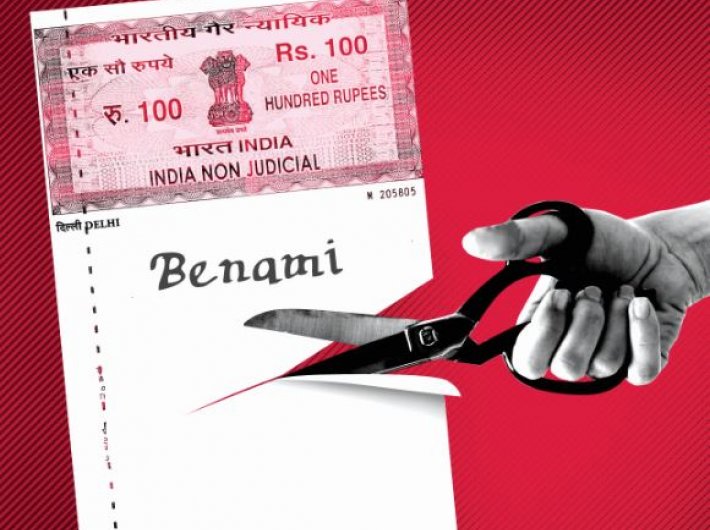
(Illustration: Ashish Asthana)

When prime minister Narendra Modi spoke about action against benami properties while delivering the I-Day address from the Red Fort ramparts, he was in fact fulfilling a promise he made during the last Mann ki Baat of 2016.
 
“The law against benami property was lying in limbo for years. Now, we have come up with a law against benami property. In such a short time, the government has confiscated benami properties worth over Rs 800 crore. When these things happen, the common man develops faith that the country is for the honest persons,” said Modi on Tuesday.
 
Modi, who had carried out demonetisation on November 8, had widened the effort to tackle corruption by taking on benami properties.
 
“We will take action against ‘benami’ properties. This is major step to eradicate corruption and black money… We are going to take action against the properties which are purchased in the name of others (benami). That is the property of the country,” said Modi during his last Mann ki baat of 2016.
 
The Benami Transactions (Prohibition) Act, 1988 was amended through the Benami Transactions (Prohibition) Amended Act, 2016. The amended Act, 2016 came into effect from November 1, 2016.
 
The Act says that “No person shall enter into any benami transaction.”
 
“…purchase of property by any person in the name of his wife or unmarried daughter and it shall be presumed, unless the contrary is proved, that the said property had been purchased for the benefit of the wife or the unmarried daughter. Whoever enters into any benami transaction shall be punishable with imprisonment for a term which may extend to three years or with fine or with both,” says the Act
 
What exactly is benami property?
 
Any property bought by an individual which is not under his or her name is benami property. Commonly, benami property is in the name of the wife and children and unaccounted money, better known as black money, is ploughed into purchase benami property.
 
Santosh Kumar Gangwar, minister of state for finance in written reply to a question in Rajya Sabha on July 25, 2017, said: “Action against the benami transactions under the new law is an ongoing process. More than 400 benami transactions have been identified since the coming into effect of the amended law. Provisional attachment of properties under the Act has been done in more than 230 cases. The market value of properties under attachment is more than Rs. 800 crore. The benami properties attached include deposits in bank accounts, immovable properties.”
 
The minister said that the Act prohibits benami transactions and empowers the authorities specified in the Act to provisionally attach and eventually confiscate the benami properties.
 
“The Act also provides for prosecution of any person found guilty of the offence of benami transaction by the competent court. The offence of entering into a benami transaction is punishable with rigorous imprisonment for a term not less than one year but which may extend to 7 years and shall also be liable to fine which may extend to 25% of the fair market value of the property,” he said. 


Comments


Other News

Not just politics, let`s discuss policies too

Why public policy matters Most days, India`s loudest debates stop at the ballot box. We can name every major leader and recall every campaign slogan. Still, far fewer of us can explain why a widow`s pension is delayed or how a government school`s budget is actually approved. That

When algorithms decide and children die

The images have not left me, of dead and wounded children being carried in the arms of the medics and relatives to the ambulances and hospitals. On February 28, at the start of Operation Epic Fury, cruise missiles struck the Shajareh Tayyebeh school – officially named a girls’ school, in Minab,

The economics of representation: Why women in power matter

India’s democracy has grown in scale, but not quite in balance. Women today are active participants in elections, influencing outcomes in ways that were not as visible earlier. Yet their presence in legislative institutions continues to lag behind. The Nari Shakti Vandan Adhiniyam was meant to addres

India will be powerful, not aggressive: Bhaiyyaji

India is poised to emerge as a global power but will remain rooted in its civilisational ethos of non-aggression and harmony, former RSS General Secretary Suresh `Bhaiyyaji` Joshi has said.   He was speaking at the launch of “Rashtrabhav,” a book by Ravindra Sathe

AI: Code, Control, Conquer

India today stands at a critical juncture in the area of artificial intelligence. While the country is among the fastest adopters of AI in the world, it remains heavily reliant on technologies developed elsewhere. This paradox, experts warn, cannot persist if India seeks technological sovereignty.

RBI pauses to assess inflation risks, policy transmission

The Reserve Bank of India (RBI) has begun the new fiscal year with a calibrated pause, keeping the repo rate unchanged at 5.25 per cent in its April Monetary Policy Committee (MPC) meeting. The decision, taken unanimously, reflects a shift from aggressive policy action to cautious observation after a signi


Archives

Current Issue

Opinion

Facebook Twitter Google Plus Linkedin Subscribe Newsletter

Twitter







