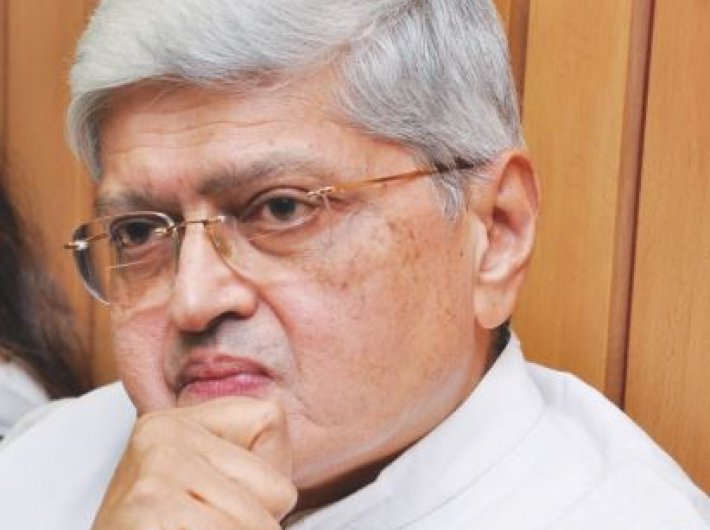
Former West Bengal governor Gopalkrishna Gandhi, who is Mahatma Gandhi’s grandson, doesn’t hesitate to call a spade a spade. He once said that fear rules India and at another time pointed out that our democracy is deeply flawed. The erudite scholar spoke his mind when he wrote that our national anthem is not a tax that requires compliance.
The election of the vice president will take place on August 5. Outgoing vice president Hamid Ansari’s term ends on August 11.
Here is what Gandhi said:
At the second V.R. Krishna Iyer Memorial lecture
“Who rules India? I will not mention the name of a person. I shouldn’t say who. I should say what. Fear rules India. How does fear manifest itself? Why is the lokpal still dangling in mid-air? Why is the whistleblower’s protection Act not yet notified? There is a kind of fear to face reality in our legislatures, not just Parliament, but in our State legislatures too,” said Gandhi
“I was asked recently that if fear is a fact, how am I speaking all this and writing what I write. In Delhi, the suspended particulate matter which make up the pollutions is a fact. Imagine if somebody is told, why do you complain of pollution when you are breathing. The fact that you are breathing does not mean there is no pollution. Pollution is a fact,” he said.
At the BG Verghese Memorial lecture, 2014-15
“In authoritarian regimes, there would be no room for opponent. Pol Pot, Idi Amin, Saddam Hussain – none of them allowed dissent. But in dictatorships, while opponents have no room, dissenters can arise. The democratic set-up has opposition, but when it comes to dissent, democracy and dictatorships equally dislike them,” said Gandhi.
“The Congress started as a party of dissenters. Now the Congress is 130 years old. But the Congress is in effect two Congresses: 1885-1975 is one Congress; it conduced itself with dignity, democratic grace; Gandhi himself was a dissenter, and the Congress of the day made space for Gandhi. Nehru was a dissenter, he made no bones about his dissent with Gandhi.
“Those 90 years and the second 40 years, post-75, are different universes. From ’75 to ’77 the opposition evaporated, but dissent survived. Even opposition leaders became dissenters. There was an extraordinary metamorphosis. Dissent revives, in a way, when space shrinks. It is quite extraordinary: technically the space had shrunk. They were in Tihar [jail], but still their dissent was eloquent, JP (Jayaprakash Narayan) being the most prominent of the lot. He had been in opposition for years. But in the years leading to the Emergency, when he became a political dissenter, he became an irresistible force.”
At 15th D P Kohli Memorial lecture, 2014
“For us in India, in ever so many ways, this is the best of times. Our democracy is in bloom. While in countries around us, democracy has taken bruising and even battering, our elections are in progress to elect the next Lok Sabha, the 16th in a row. Millions are participating in the proceedings with what can only be called elan. They know the process thoroughly and can be said to be post-doctoral experts in it. They know how to re-endorse earlier verdicts ; equally, how to reverse them. They can return people and parties to office with generosity ; equally they can throw them out of it without mercy. Illiterate they may be, and poor as well, but once in the booth, they are monarchs. We are a democracy with a highly powerful monarch – the voter,” said Gandhi.
“Our democracy is large, vibrant, but is also deeply flawed. Size and scale cannot and do not in themselves validate a democracy. There is something called quality also. The monarch, the voter, is powerful but his power is constantly subverted by blandishment. Money is at our democracy’s throat. Money can and does do worse. It can abduct, assault. It can finance hurt, it can fund harm, it can injure and manage to look injured. It can purchase death.
“Currency notes come into the election bazaar first in container and cargo quantities, then in truck-loads, going into wholesale, small retail and finally in attaché, thailaa, jholaa and jeb-sized portions, every five years at the least and often oftener than that. They originate either legally, through licit company donations or come from a myriad sources which, necessarily and unavoidably, go back to our natural resources such as mines, forests and land. Illegal transactions in all these yield harvests of black cash and this is disgorged on people in jhuggis, jhompris and jhopad-pattis, right amidst tonnes of garbage and, within inches of it, cook, wash, sleep and being human, procreate, give birth and die in. It is on these that politicians descend at election time, laden with cash and hooch, to buy votes. Dr Ambedkar had spoken of how this India may well explode and blow up our Constitutional edifice.”
On “North and South in India’s Political Imagination” when Gandhi was Tagore Fellow, King’s India Institute.
“Of the fifty plus individuals to have held the office of Congress President before India became independent , no more than four hailed from the South. Of the fifty-eight Congress‘ pre-independence annual sessions, only eight were held in the South – seven in Madras and one in Coconada. Stalwart leader and frontranking associate of Gandhi though he was , Rajagopalachari never became Congress president. Post-independence the Congress Presidentship statistics are only slightly better,” said Gandhi https://www.kcl.ac.uk/sspp/departments/kii/Tagore-Centre/documents/Gopal-Gandhi-lecture.pdf
“Mother India‘s image reverberated recently in the campaign against corruption led by Anna Hazare, as an enormous stage backdrop, to be moved from there when it was pointed out to him that his sympathisers and potential supporters from the liberal secular circles would be uncomfortable with it. Icons are needed, with parental icons needed more than others and so Mother India was replaced on that mount by the Father of the Nation. India is home to wise children, childish adults. Its political imagination can be , at once, both jejune and sublime.”
“Is there a draconian emergency on today? So there is no fear today? There is! But that present level of fear itself is unacceptable. In a country which has been through the fires of Emergency, we do not have a state of emergency today but we have in the air the whiffs of the emergency sentiment. We have strains of the emergency doctrine and palpable pulsations of emergency fear. I believe this is reversible for the reason that JP still means something to the BJP. But even more for the reason that our country is alert and awake in a manner it has not ever been. Let us not dispute or deny or denigrate the fact that this government has got 30-31% of the votes cast. It has got it. Under the first past the post system it is perfectly entitled to being in power but let us not forget that 69-70% of the people have voted differently. They may have not voted the same differently but they have voted differently. Is it strength or a weakness? Hard to say because the supremo phenomena is not confined to the BJP alone but the Congress does not have a supremo like the BJP does but the Cong has not been hospitable to dissent either. They have been hospitable to sycophancy,” he said.
“The fear that is prevailing in our country is the starkest and most palpable among the minority communities of India. This level of fear among those communities has precedence only in times of riots that have defaced the history of our country. But in times when there are no riots or riots in real time there has never been a time when fear has been so pronounced in the hearts and minds of the minority communities in India. JP would not have been able to stand or stomach the sight of a cow being slaughtered but he would not have allowed cow slaughter to become a political tool in the hands of a majority party which is using the majority community’s susceptibility, sentiments and heartstrings to needle the minority community, in this case the Muslim community in particular.”
“I respect my nation’s anthem, I am devoted to Tagore’s great vision in it. I am committed to the integrity of my nation as it stands visualised, region by region, river by river, in its image of India conjured by its diverse people — “jana”.
“No one needs to make me respect that song, be devoted to it, and committed to it. The national anthem is not a traffic signal that has to be respected. It is not a tax that requires compliance. It is not a test that has to be submitted to. It is the poetic equivalent of collective pride, the lyrical expression of a nation’s resolve to advance from ancient primitivisms and medieval bigotries to a future in dignity and justice. If songs are sung because one wants to sing them, heard because one wants to hear them and not under orders, anthems are sung or played when the occasion and the moment for it is right, when the sound of it saturates one’s sense of belonging to the greatness of India, and the greatness of India belonging to oneself,” Gandhi wrote in the Hindustan Times on December 2, 2016.