
Indian Railways celebrates 171 years of its pioneering journey

The first train in the country (and Asia) was flagged off from Boribunder (where CSMT stands today) on April 16, 1853

geetanjali

Geetanjali Minhas | April 16, 2024 | Mumbai

#Railways   #Mumbai   #History  


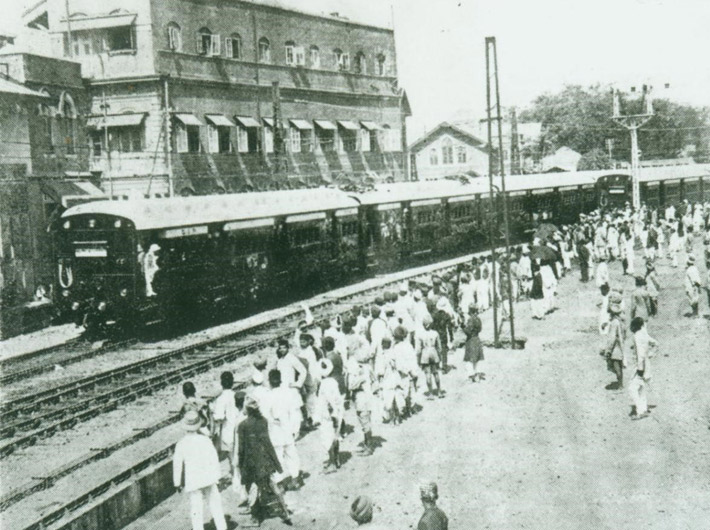
The Indian Railways is celebrating 171 glorious years of its existence. Going back in time, the first train in India (and Asia) ran between Mumbai and Thane on April 16, 1853. It was flagged off from Boribunder (where CSMT stands today). As the years passed, the Great Indian Peninsula Railway which ran the first train merged with the Indian Midland Railway Company in 1900 and extended its frontiers from Delhi in the North, Kanpur and Allahabad in the North-east and Nagpur in the East to Raichur in the South-east.  

On November 5, 1951, Central Railway was formed by integrating Nizam State, Scindia State and Dholpur State Railways. Today Central Railway has five divisions: Mumbai, Bhusaval, Nagpur, Solapur and Pune; and a network over 4,275 route kms spanning the states of Maharashtra, Madhya Pradesh and Karnataka through 466 stations.

From the first train in April 1853 to the most modern train of India, Vande Bharat Express, the Railways have successfully expanded network to the huge area in last 171 years. Central Railway runs six Vande Bharat Express trains: CSMT-Sainagar Shirdi, CSMT-Solapur, CSMT-Madgaon, CSMT-Jalna, Nagpur-Bilaspur & Nagpur-Indore Vande Bharat.
 
Central Railway also has many firsts like the first Shatabdi Express, first Jan Shatabdi Express, first Tejas Express among others. With trains like Punjab Mail in operation for more than 100 years, Central Railways has come a long way.

Since running the first electric train service in India between Bombay VT and Kurla Harbour on February 3, 1925, it laid the foundation of electrification of railways and Mumbai's suburban services which today have become the lifeline of the city. Today, Central Railway has achieved 100% electrification and the suburban network has also steadily increased.
 
At present Central Railway has five suburban corridors. The suburban services started with three coaches, gradually increased to nine coaches, 12 coaches and today some services have 15 coaches. Moreover presently the corridor also has AC suburban services.

In terms of loading, originating loading which was 16.58 million tonnes at the time of formation is now increased to 89.24 million tonnes in 2023-24 – the best ever so far.

Moreover,  infrastructure works like construction of new railway lines, doubling, construction of bridges, construction of new stations etc. are taken up at a fast pace. The highest volume of 348 kms of multi-tracking work was achieved in this financial year.

Alongside, the Neral-Matheran Light Railway too has completed 117 years. Its construction started in 1904 and the two feet gauge line finally opened to traffic in 1907. As a precautionary measure, the line used to be closed during the monsoons. Later, from September 29, 2012 shuttle services between Aman Lodge and Matheran were introduced to run during monsoons.

Comments


Other News

New pathways for tourism growth

Traditionally, India’s tourism policy has been based on three main components: the number of visitors, building tourist attractions and providing facilities for tourists. Due to the increase in climate-related issues and environmental destruction that occurred over previous years, policymakers have b

Is the US a superpower anymore?

On April 8, hours after warning that “a whole civilisation will die tonight,” US president Donald Trump, exhibiting his unique style of retreating from high-voltage brinkmanship, announced that he agreed to a two-week ceasefire with Iran. The weekend talks in Islamabad have failed and the futur

Machines communicate, humans connect

There is a moment every event professional knows—the kind that arrives without warning, usually an hour before the curtain rises. Months of meticulous planning are in place. And then comes the call: “We’ll also need a projector. For the slides.”   No email

Why India is entering a ‘stagflation lite’ phase

India’s macroeconomic narrative is quietly shifting—from a rare “Goldilocks” equilibrium of stable growth and contained inflation to a more fragile phase where external shocks are beginning to dominate domestic policy outcomes. The numbers still look reassuring at first glance: GDP

Labour law in India: A decade of transition

The story of labour law in India is not just about laws and codes, but also about how the nation has continued to negotiate the position of the workforce within its economic framework. The implementation of the Labour Codes across the country in November 2025 marks a definitive endpoint in the process. Yet

Time for India to build genuine resilience in energy security

There is a strip of water barely 33 kilometres wide between Iran and Oman that connects the Persian Gulf to the rest of the world`s oceans. For most of India`s history, it was a distant geographic fact. Since late February, it has been a kitchen problem.   The Strait of Hormuz. T


Archives

Current Issue

Opinion

Facebook Twitter Google Plus Linkedin Subscribe Newsletter

Twitter







