3 reasons why BJP sweep doesn't mean end of caste factor

A wave flattens everything else before it. Real test would come in future local elections in Bihar, UP and Haryana

shantanu

Shantanu Datta | May 16, 2014


Only a follow-up election after this can tell us whether dalits have stopped voting for Mayawati.

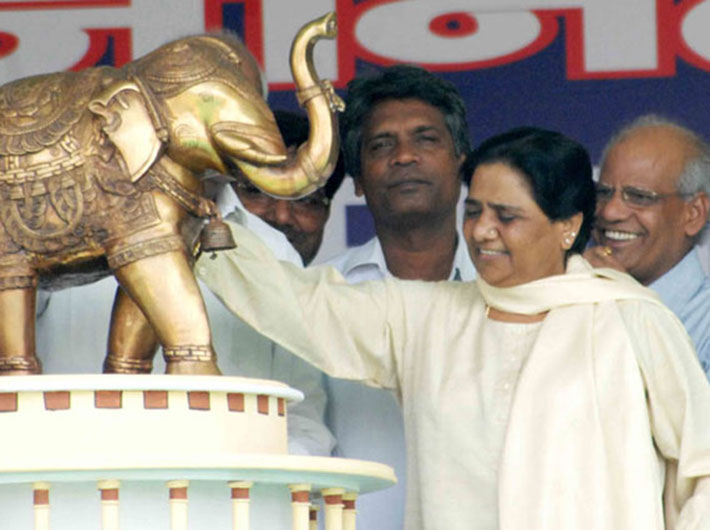
Has caste ceased to be a factor in India? The early trends on the result day of the general elections would indicate so, as many are inferring. The decimation of the Bahujan Samaj Party and the Samajwadi Party in Uttar Pradesh, and the likely defeat of the father-son duo of Ajit Singh (from Baghpat in UP) and Jayant Chaudhary (Mathura), among many other results/trends, would hint at that.

There are many other indicators for something as complex and deep-rooted for caste equations in India. While this is not to say that caste is an alien concept for other political parties, we take these four for the simple reason that the BSP and the SP, apart from Lalu Prasad’s Rashtriya Janata Dal (RJD) in Bihar, have perfected the art of nurturing caste sections and garnering votes. Ajit Singh’s INLD, meanwhile, has banked on the caste-cum-community votes of the Jat of western UP.

According to the update at 11.51 am on the election commission’s website, when this piece was written, the BSP’s vote share was 3.6 percent, the SP’s 2.8 percent and the RJD’s 0.5 percent. This is against 6.17, 3.42 and 1.27 percent, respectively, for the three parties. Of course, this is just the middle overs, to use a cricket parlance, and nothing can be said till the fat lady sings, to use another cricket commentary cliché, but the fact that the BSP was leading at that point in one seat, the SP in eight and the RJD in only five seats says a lot about cross-voting on caste lines.

The three parties between them won 48 seats in 2009 Lok Sabha elections.

So, has caste ceased to be a factor? Three reasons why it’s too early to bet on that.

1. If the BJP is winning 272 seats or thereabouts – as trends are showing it might – on its own, it can easily be called a ‘wave’. And a wave flattens everything else on its path.

2. The BJP fought this election primarily on the ‘development’ plank, showcasing its prime ministerial candidate Narendra Modi’s work as the chief minister of Gujarat for the last dozen years. According to all reports and estimates, the voters – weighed down over the last four years by sky-high inflation, runaway price rise and record joblessness – opted for the saffron party with a singular aim: economic. Caste, in such cases, does not enter the picture.

3. Even Modi did not shy away from using his OBC status as a campaign ploy – so many votes might have gone from one OBC caste to that of another. And in this case, with majority of voters pressing the button on the EVM for Modi, and not the local candidate, as Modi himself asked them to in advertisements and in many of his rallies, the voters might have gone for Modi’s caste, if not his ‘development record’.

The real test would be any local election after this, for that is when the caste factor would come into play once more.

Comments


Other News

“Cancer is just a mind game”

Dr. Ananda Shankar Jayant, a Padma Shri awardee, inspired audiences for decades through her mastery of Bharatanatyam and Kuchipudi. But it was her journey through cancer that taught some of life`s most powerful lessons in courage and resilience.

Why Swami Vivekananda is the pathfinder for our times

Swami Vivekananda for Our Times  Edited and compiled by Rajiv Sikri, with Introduction by S. Gurumurthy Rupa Publications, 552 pages, Rs 695  

Five ways to realise the potential of India’s handicraft and handloom sector

India`s economic ambitions are increasingly defined by the industries of the future. Semiconductors, electronics, artificial intelligence and advanced manufacturing dominate policy conversations. Yet one of India`s largest employment-intensive sectors continues to occupy a surprisingly marginal place in ec

Beyond toilets: Why open defecation persists in rural India

Despite the awareness campaigns on sanitation across India, open defecation (OD) is practised openly and widely in both rural and urban areas. Research shows that rural respondents are well aware of the negative impacts of OD, yet this awareness does not lead to toilet construction or use. In rural North I

What unpaid nation builders want from policymakers

The Supreme Court recently described homemakers as “nation builders” and fixed a notional monthly income of Rs 30,000 for them in motor accident compensation cases. The judgment was not about wages. It was about compensation. Yet it inadvertently raised a larger economic question: If a homemake

What the US–Iran peace deal means for India

After months of rising tensions, the United States and Iran have reached a memorandum of understanding called the "Islamabad Agreement." This agreement allows for the immediate reopening of the Strait of Hormuz without tolls and provides Iran with relief from sanctions, depending on its complianc


Archives

Current Issue

Opinion

Facebook Twitter Google Plus Linkedin Subscribe Newsletter

Twitter